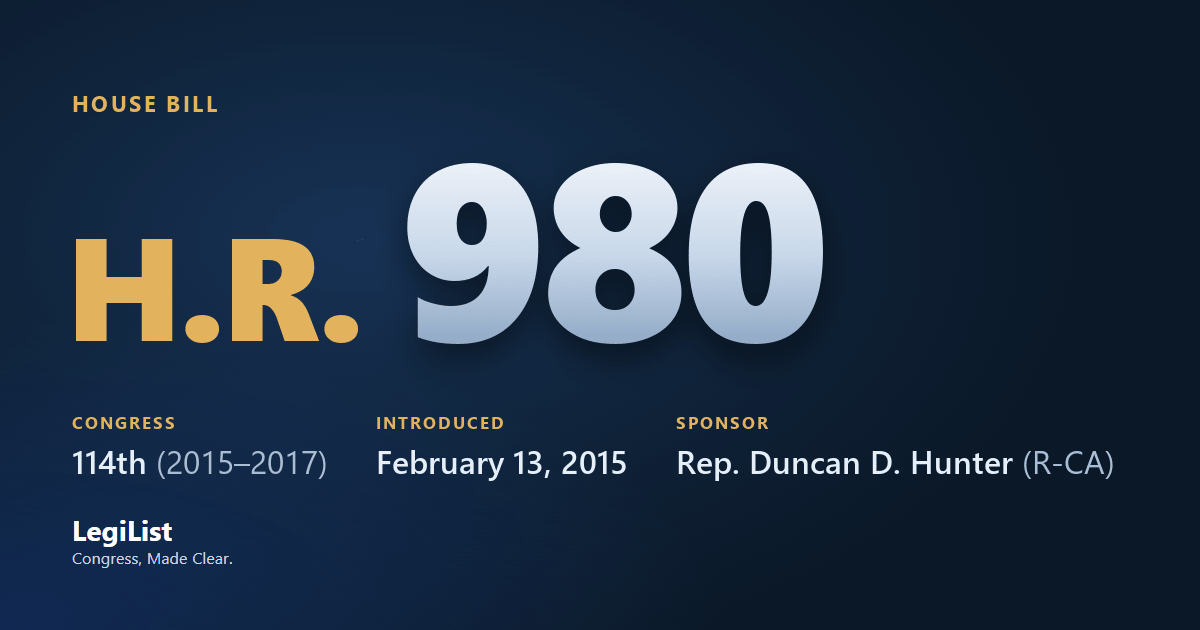
Vessel Incidental Discharge Act
Latest action · Feb 17, 2015 Referred to the Subcommittee on Coast Guard and Maritime Transportation.
Progress
Where this bill reached, and when. A stage with no date was not reached; one that failed a vote and later carried shows the date it carried.
- IntroducedFeb 13, 2015
- Passed HouseNot reached
- Passed SenateNot reached
- To the PresidentNot reached
- Became lawNot reached
Summary
Vessel Incidental Discharge Act
This bill requires the Coast Guard to establish and implement enforceable uniform national standards for the regulation of discharges incidental to the normal operation of a vessel into navigable waters. The Coast Guard's existing rule for ballast water discharges incidental to the normal operation of a vessel are adopted until those performance standards are revised or a more stringent state standard is adopted. Ballast water is water taken aboard a vessel to control stability or during the operation of a vessel's ballast water treatment technology.
Within two years, the Coast Guard must establish best management practices for discharges incidental to the normal operation of a vessel other than ballast water.
By January 1, 2020, the Coast Guard must complete a feasibility review to determine whether revising ballast water performance standards will result in a scientifically demonstrable and substantial reduction in the risk of introduction or establishment of aquatic nuisance species. The Coast Guard must establish a revised standard based on the ballast water treatment technology available. Further revisions to the performance standards are to be considered every 10 years.
This bill establishes a certification requirement for ballast water treatment technology. The Coast Guard may not approve a technology if it uses a biocide or generates a biocide that is a pesticide.
This bill establishes a petition process for a state seeking to enforce a state or local statute or regulation related to ballast water discharges incidental to the normal operation of a vessel that is more stringent than federal performance standards.
Cosponsors 41
Members who signed on, in the order they did. Signatures ran from Feb 13, 2015 to Jul 14, 2016; 2 are original cosponsors, there from the day it was introduced.
| Seat | Cosponsor | Signed on | |
|---|---|---|---|
| D-MD | Elijah E. Cummings | Original | Feb 13, 2015 |
| R-NJ | Frank A. LoBiondo | Original | Feb 13, 2015 |
| D-FL | Gwen Graham | Apr 14, 2015 | |
| D-MS | Bennie G. Thompson | Apr 15, 2015 | |
| R-FL | David W. Jolly | Apr 15, 2015 | |
| R-LA | Steve Scalise | Apr 15, 2015 | |
| R-MO | Blaine Luetkemeyer | Apr 21, 2015 | |
| D-LA | Cedric L. Richmond | Apr 21, 2015 | |
| R-TX | John Abney Culberson | Apr 21, 2015 | |
| R-VA | J. Randy Forbes | Apr 22, 2015 | |
| R-MO | Sam Graves | Apr 22, 2015 | |
| R-NY | Peter T. King | Apr 23, 2015 | |
| R-LA | Ralph Lee Abraham | Apr 23, 2015 | |
| R-FL | Ander Crenshaw | Apr 30, 2015 | |
| R-IL | Peter J. Roskam | May 13, 2015 |
Committees 1
Where it was sent and what each committee and subcommittee did with it, in order.
| Chamber | Committee | What it did |
|---|---|---|
| House | Transportation and Infrastructure Committee | Referred Feb 13, 2015 |
| Coast Guard and Maritime Transportation Subcommittee | Referred Feb 17, 2015 |
Actions 3
Everything that happened, newest first.
- Feb 17, 2015Referred to the Subcommittee on Coast Guard and Maritime Transportation.
- Feb 13, 2015Introduced in House
- Feb 13, 2015Referred to the House Committee on Transportation.
Research
What has been written about this bill: committee reports, cost estimates, the sponsor’s authority statement, printed hearings and the Congressional Research Service’s work.
Constitutional authority
The sponsor’s statement, as printed in the Congressional Record, vol. 161, no. 25, February 13, 2015, page H1070.
Printed hearings 1
Hearings whose printed record names this bill, newest first: hearings on it, and wider hearings where it came up.
| Number | Hearing | Committee | Held |
|---|---|---|---|
| Serial No. 114-38 | MARITIME TRANSPORTATION SAFETY AND STEWARDSHIP PROGRAMS188 pages | Transportation and Infrastructure Committee | Apr 14, 2016 |
CRS reports 1
Congressional Research Service work that CRS links to this bill or the law it became, newest first.
Cite it 1
Products on other subjects that cite it, usually among other measures.
| Product | Title | Kind | Published |
|---|---|---|---|
| R42142 | EPA’s Vessel General Permits: Background and Issues Archived | Report | Oct 12, 2016 |
Related bills 2
Companion bills and other measures the record links to this one.
| Bill | Title | Relationship | Latest action |
|---|---|---|---|
| S 373 | Vessel Incidental Discharge Act | Related bill | Jul 29, 2015 |
| HR 4909 | National Defense Authorization Act for Fiscal Year 2017 | Related bill | May 26, 2016 |
Titles 2
Every title it has carried, official and short, at each stage.
- Official Title as Introduced
- To provide for the establishment of nationally uniform and environmentally sound standards governing discharges incidental to the normal operation of a vessel.
- Short Titles as Introduced
- Vessel Incidental Discharge Act
Subjects
Assigned by the Library of Congress. Policy area: Transportation and Public Works.
- Administrative law and regulatory procedures
- Administrative remedies
- Aquatic ecology
- Coast guard
- Department of Homeland Security
- Environmental regulatory procedures
- Environmental technology
- Hazardous wastes and toxic substances
- Licensing and registrations
- Marine and inland water transportation
- Marine pollution
- Technology assessment
- Transportation and Public Works
- Water quality
Text 1
Each version as it was printed, newest first.
- Feb 13, 2015Introduced in House
Everything here is as published by Congress: the summary is the Congressional Research Service's, the action wording is the clerks', and the subjects are the Library of Congress's. How far it got is read from the actions themselves, taking the most recent one of each kind, so a bill that failed a vote and later passed is shown as having passed. Records come from this bill on Congress.gov and govinfo.gov; cost estimates are the Congressional Budget Office's, and the hearings are the printed hearings GovInfo publishes, which can appear months after the hearing.