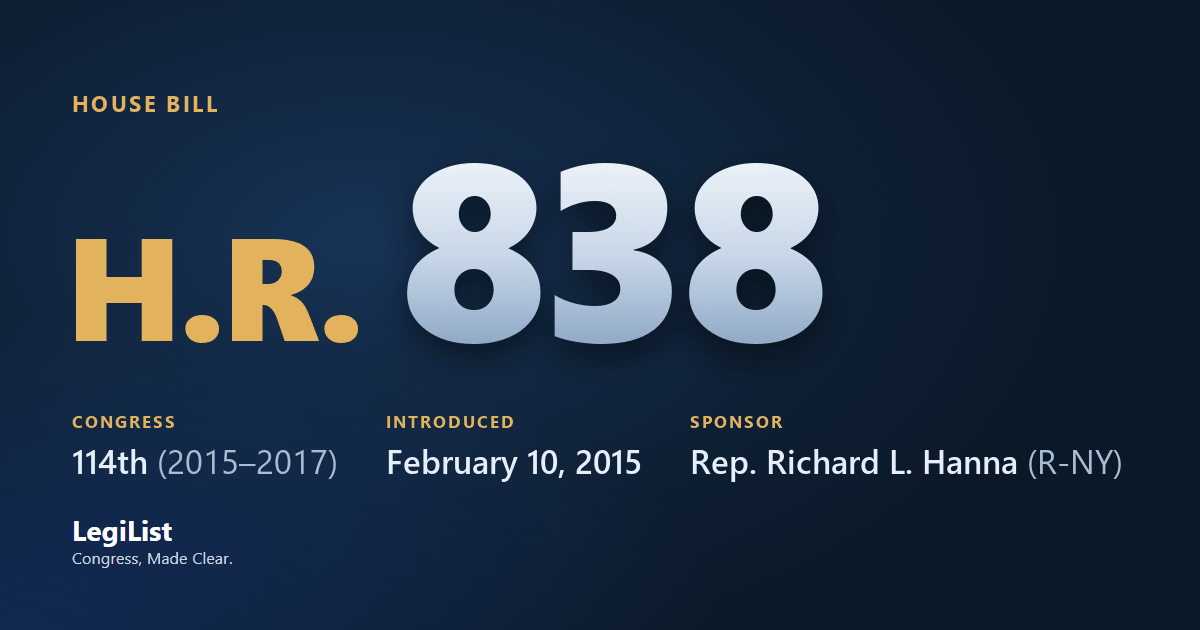
Security in Bonding Act of 2015
Latest action · Mar 16, 2015 Referred to the Subcommittee on Regulatory Reform, Commercial And Antitrust Law.
Progress
Where this bill reached, and when. A stage with no date was not reached; one that failed a vote and later carried shows the date it carried.
- IntroducedFeb 10, 2015
- Passed HouseNot reached
- Passed SenateNot reached
- To the PresidentNot reached
- Became lawNot reached
Summary
Security in Bonding Act of 2015
Revises requirements related to assets pledged by a surety and to surety bond guarantees subject to the Small Business Investment Act of 1958. (A surety bond is a three-party instrument between a surety who agrees to be responsible for the debt or obligation of another, a contractor, and a project owner.)
Declares that if another applicable law or regulation permits the acceptance of a bond from a surety that is not subject to specified federal law, and is based on a pledge of assets by the surety, the assets pledged by such surety shall: (1) consist of eligible obligations given as security instead of surety bonds; and (2) be submitted to the government official required to approve or accept the bond, who shall deposit the assets with a depository (the Secretary of the Treasury, a federal reserve bank, or a depository designated by the Secretary).
Amends the Small Business Investment Act of 1958 to increase from 70% to 90% of the loss incurred and paid by a surety authorized to issue bonds (subject to Small Business Administration [SBA] guarantee) the SBA's guarantee of surety bonds. The SBA is required, under the guarantee, to indemnify a surety, under the Small Business Investment Program, against loss from a breach of the terms of a bid bond, payment bond, performance bond, or ancillary bonds, by a principal on any total work order or contract amount at the time of bond execution that does not exceed $6.5 million, as adjusted for inflation.
Requires the Comptroller General (GAO) to study:
- all instances during the 10-year period before enactment of the Act in which a surety bond proposed or issued by a surety in connection with a federal project was: (1) rejected by a federal contracting officer; or (2) accepted by one, but was later found to have been backed by insufficient collateral or to be otherwise deficient or with respect to which the surety did not perform;
- the consequences to the federal government, subcontractors, and suppliers of the instances; and
- the percentages of all federal contracts that were awarded to new startup businesses (including new startups that are small disadvantaged businesses or disadvantaged business enterprises), small disadvantaged businesses, and disadvantaged business enterprises as prime contractors in the two-year period before and the two-year period after enactment of this Act, together with an assessment of the impact of this Act and its amendments upon such percentages.
Cosponsors 5
Members who signed on, in the order they did. Signatures ran from Feb 10, 2015 to Sep 8, 2015; 2 are original cosponsors, there from the day it was introduced.
| Seat | Cosponsor | Signed on | |
|---|---|---|---|
| D-NY | Grace Meng | Original | Feb 10, 2015 |
| R-OH | Steve Chabot | Original | Feb 10, 2015 |
| R-GA | Rick W. Allen | May 19, 2015 | |
| R-CA | Stephen Knight | Jun 3, 2015 | |
| D-NY | Kathleen M. Rice | Sep 8, 2015 |
Committees 2
Where it was sent and what each committee and subcommittee did with it, in order.
| Chamber | Committee | What it did |
|---|---|---|
| House | Judiciary Committee | Referred Feb 10, 2015 |
| Administrative State, Regulatory Reform, and Antitrust Subcommittee | Referred Mar 16, 2015 | |
| House | Small Business Committee | Referred Feb 10, 2015 |
Actions 3
Everything that happened, newest first.
- Mar 16, 2015Referred to the Subcommittee on Regulatory Reform, Commercial And Antitrust Law.
- Feb 10, 2015Introduced in House
- Feb 10, 2015Referred to the Committee on the Judiciary, and in addition to the Committee on Small Business, for a period to be subsequently determined by the Speaker, in each case for consideration of such provisions as fall within the jurisdiction of the committee concerned.
Research
What has been written about this bill: committee reports, cost estimates, the sponsor’s authority statement, printed hearings and the Congressional Research Service’s work.
Constitutional authority
The sponsor’s statement, as printed in the Congressional Record, vol. 161, no. 22, February 10, 2015, page H918.
Printed hearings 2
Hearings whose printed record names this bill, newest first: hearings on it, and wider hearings where it came up.
| Number | Hearing | Committee | Held |
|---|---|---|---|
| H.A.S.C. No. 114-34 | HEARING ON NATIONAL DEFENSE AUTHORIZATION ACT FOR FISCAL YEAR 2016 AND OVERSIGHT OF PREVIOUSLY AUTHORIZED PROGRAMS BEFORE THE COMMITTEE ON ARMED SERVICES HOUSE OF REPRESENTATIVES ONE HUNDRED FOURTEENTH CONGRESS FIRST SESSION143 pages | Armed Services Committee | Apr 14, 2015 |
| 114-1 | CONTRACTING AND THE INDUSTRIAL BASE87 pages | Small Business Committee | Feb 12, 2015 |
CRS reports 1
Congressional Research Service work that CRS links to this bill or the law it became, newest first.
Cite it 1
Products on other subjects that cite it, usually among other measures.
| Product | Title | Kind | Published |
|---|---|---|---|
| R42037 | SBA Surety Bond Guarantee Program | Report | Jul 18, 2025 |
Related bills 2
Companion bills and other measures the record links to this one.
| Bill | Title | Relationship | Latest action |
|---|---|---|---|
| S 1526 | Construction Consensus Procurement Improvement Act of 2015 | Related bill | Oct 27, 2016 |
| HR 1735 | National Defense Authorization Act for Fiscal Year 2016 | Related bill | Oct 22, 2015 |
Titles 2
Every title it has carried, official and short, at each stage.
- Official Title as Introduced
- To amend title 31, United States Code, to revise requirements related to assets pledged by a surety, and for other purposes.
- Short Titles as Introduced
- Security in Bonding Act of 2015
Subjects
Assigned by the Library of Congress. Policy area: Finance and Financial Sector.
Text 1
Each version as it was printed, newest first.
- Feb 10, 2015Introduced in House
Support LegiList
This page is free, carries no paywall, and is built and maintained by one person. If the record here is useful to you, a few dollars keeps it going.
Everything here is as published by Congress: the summary is the Congressional Research Service's, the action wording is the clerks', and the subjects are the Library of Congress's. How far it got is read from the actions themselves, taking the most recent one of each kind, so a bill that failed a vote and later passed is shown as having passed. Records come from this bill on Congress.gov and govinfo.gov; cost estimates are the Congressional Budget Office's, and the hearings are the printed hearings GovInfo publishes, which can appear months after the hearing.