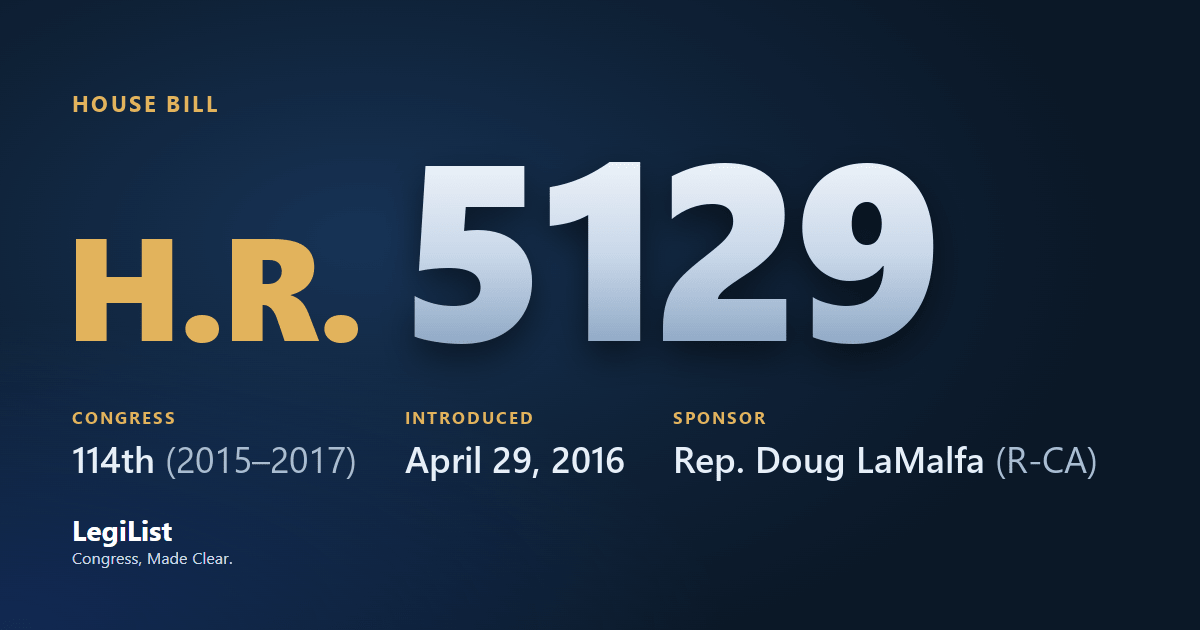
GO Act
Latest action · Nov 30, 2016 Subcommittee Hearings Held.
Progress
Where this bill reached, and when. A stage with no date was not reached; one that failed a vote and later carried shows the date it carried.
- IntroducedApr 29, 2016
- Passed HouseNot reached
- Passed SenateNot reached
- To the PresidentNot reached
- Became lawNot reached
Summary
Guides and Outfitters Act or the GO Act
This bill amends the Federal Lands Recreation Enhancement Act to specify the circumstances in which the Department of the Interior and the Department of Agriculture (USDA) may: (1) issue special recreation permits for federal recreational lands and waters, and (2) charge a special recreation permit fee for them.
Interior and USDA may issue special recreation permits:
- for specialized individual and group use of federal facilities and federal recreational lands and waters;
- to recreation service providers who conduct outfitting, guiding, and other recreation services on federal recreational lands and waters; and
- to recreation service providers who conduct recreation or competitive events, which may involve incidental sales on federal recreational lands and waters.
Interior and USDA shall issue joint permits for the use of lands managed by the Forest Service and the Bureau of Land Management (BLM).
Interior shall publish guidelines for establishing recreation permit fees.
Revenues from special recreation permits issued to recreation service providers shall be used to: (1) offset partially Interior's direct cost of administering permits, and (2) improve and streamline the permitting process.
When reviewing and adjusting allocations for the use of priority use permits for special uses of federal recreational lands and water managed by the Forest Service USDA shall allocate to the permit holder a prescribed amount subject to a cap.
USDA and Interior shall implement a program that authorizes temporary permits for new recreational uses of federal recreational lands and waters managed by the Forest Service or the BLM, respectively.
A permit holder prohibited by a state from indemnifying the federal government shall be considered to be in compliance with Interior and USDA indemnification requirements if the permit holder carries the required minimum amount of liability insurance coverage or is self-insured for the same minimum amount.
Interior and USDA shall revise certain:
- special land use and special recreation permit regulations to streamline the processes for the issuance and renewal of outfitter and guide special use permits, and
- cost recovery fee regulations to reduce costs and minimize the burden of cost recovery on small businesses and adverse impacts of cost recovery on jobs in the outfitting and guiding industry and on rural economies.
If a holder of a special use permit for outfitting and guiding that authorizes priority use has requested renewal of the permit, USDA may grant one or more exiting permit extensions for additional items for up to five years altogether, as necessary to allow completion of the renewal process and avoid the interruption of services under the permit.
Cosponsors 6
Members who signed on, in the order they did. Signatures ran from Apr 29, 2016 to Jul 7, 2016; 4 are original cosponsors, there from the day it was introduced.
| Seat | Cosponsor | Signed on | |
|---|---|---|---|
| R-UT | Chris Stewart | Original | Apr 29, 2016 |
| R-CA | David G. Valadao | Original | Apr 29, 2016 |
| R-UT | Mia B. Love | Original | Apr 29, 2016 |
| R-CA | Tom McClintock | Original | Apr 29, 2016 |
| R-WA | Dan Newhouse | May 26, 2016 | |
| R-WY | Cynthia M. Lummis | Jul 7, 2016 |
Committees 2
Where it was sent and what each committee and subcommittee did with it, in order.
| Chamber | Committee | What it did |
|---|---|---|
| House | Natural Resources Committee | Referred Apr 29, 2016 |
| Federal Lands Subcommittee | Referred May 12, 2016Hearings Nov 30, 2016 | |
| House | Agriculture Committee | Referred Apr 29, 2016 |
| Forestry and Horticulture Subcommittee | Referred May 20, 2016 |
Actions 6
Everything that happened, newest first.
- Nov 30, 2016Subcommittee Hearings Held.
- May 20, 2016Referred to the Subcommittee on Conservation and Forestry.
- May 12, 2016Referred to the Subcommittee on Federal Lands.
- May 10, 2016Sponsor introductory remarks on measure. (CR H2195)
- Apr 29, 2016Introduced in House
In the Congressional Record 2
Days the Record’s own index lists this bill, newest first, with the pages and the members it names. Pages starting H are the House, S the Senate, E Extensions of Remarks.
| Where | In the Record | Members | Date |
|---|---|---|---|
| House | Debate and remarks H6357 | Doug LaMalfa R-CA | Nov 29, 2016 |
| House | Debate and remarks H2195 | Doug LaMalfa R-CA | May 10, 2016 |
Research
What has been written about this bill: committee reports, cost estimates, the sponsor’s authority statement, printed hearings and the Congressional Research Service’s work.
Constitutional authority
The sponsor’s statement, as printed in the Congressional Record, vol. 162, no. 67, April 29, 2016, page H2150.
Related bills 1
Companion bills and other measures the record links to this one.
| Bill | Title | Relationship | Latest action |
|---|---|---|---|
| HR 289 | GO Act | Reintroduced Bill | Oct 3, 2017 |
Titles 3
Every title it has carried, official and short, at each stage.
- Official Title as Introduced
- To authorize the Secretary of the Interior and the Secretary of Agriculture to issue permits for recreation services on lands managed by Federal agencies, and for other purposes.
- Short Titles as Introduced
- GO Act
- Guides and Outfitters Act
Subjects
Assigned by the Library of Congress. Policy area: Public Lands and Natural Resources.
- Administrative law and regulatory procedures
- Department of Agriculture
- Department of the Interior
- Forests, forestry, trees
- Government liability
- Land use and conservation
- Licensing and registrations
- Outdoor recreation
- Parks, recreation areas, trails
- Public Lands and Natural Resources
- Rural conditions and development
- Small business
- User charges and fees
Text 1
Each version as it was printed, newest first.
- Apr 29, 2016Introduced in House
Support LegiList
This page is free, carries no paywall, and is built and maintained by one person. If the record here is useful to you, a few dollars keeps it going.
Everything here is as published by Congress: the summary is the Congressional Research Service's, the action wording is the clerks', and the subjects are the Library of Congress's. How far it got is read from the actions themselves, taking the most recent one of each kind, so a bill that failed a vote and later passed is shown as having passed. Records come from this bill on Congress.gov and govinfo.gov; cost estimates are the Congressional Budget Office's, and the hearings are the printed hearings GovInfo publishes, which can appear months after the hearing.