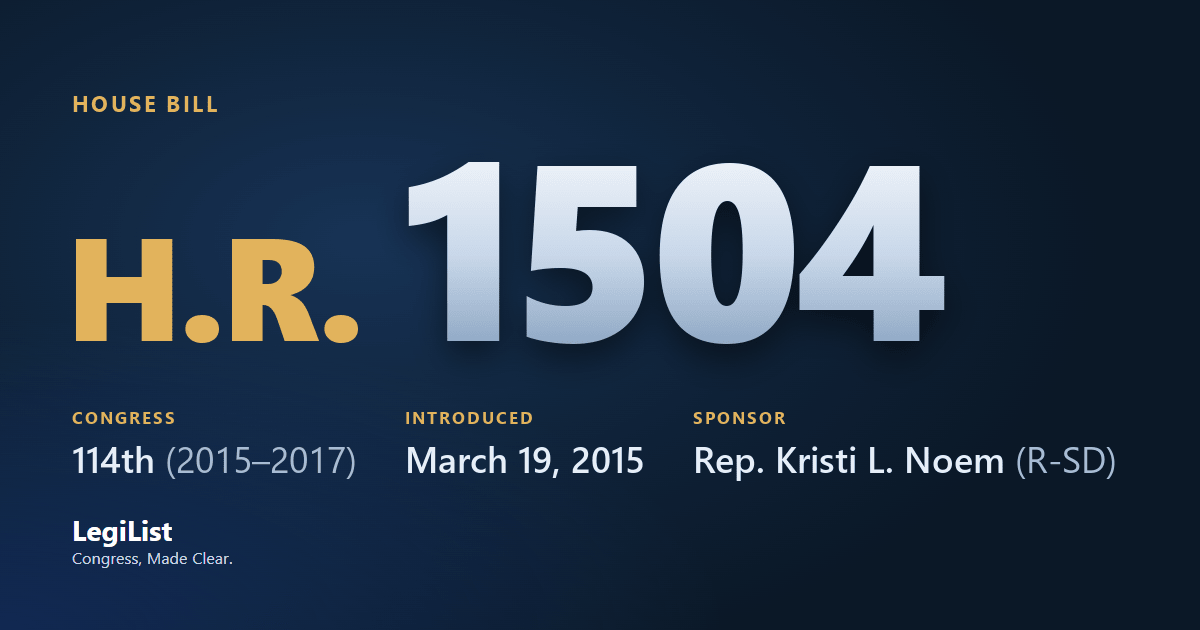
Reducing Federal Mandates on School Lunch Act
Latest action · Nov 16, 2015 Referred to the Subcommittee on Early Childhood, Elementary, and Secondary Education.
Progress
Where this bill reached, and when. A stage with no date was not reached; one that failed a vote and later carried shows the date it carried.
- IntroducedMar 19, 2015
- Passed HouseNot reached
- Passed SenateNot reached
- To the PresidentNot reached
- Became lawNot reached
Summary
Reducing Federal Mandates on School Lunch Act
This bill prohibits the Department of Agriculture (USDA) from implementing, administering, or enforcing a specified regulation, or promulgating or enforcing any new rule or regulation, establishing a maximum calorie limit or quantity of grains, meat, or meat alternatives for the school lunch program.
USDA may not implement, administer, or enforce specified rules and regulations with respect to any school food authority that certifies to its state that it: (1) has calculated the costs of complying with such rules and regulations; and (2) has determined, in a manner consistent with school district operational procedures, that it cannot operate a food service program without incurring increased costs for complying with those rules and regulations.
Those rules and regulations are:
- the rule entitled "National School Lunch Program and School Breakfast Program: Nutrition Standards for All Foods Sold in School as Required by the Healthy, Hunger-Free Kids Act of 2010";
- any new rule regarding foods sold in schools that are not foods provided under the school lunch or breakfast programs;
- a specified regulation and any new rule or regulation regarding school lunch price increases; and
- a specified regulation and any new rule or regulation which establishes new food-based meal patterns, nutrition standards, or meal planning approaches for the school breakfast program.
USDA may not define the phrase "costs of complying" or establish or suggest how a school food authority is to calculate those costs or increased costs for complying.
The prohibitions will remain in effect until a law is enacted that extends by at least five fiscal years the authorization or duration of one or more school lunch or breakfast programs.
The bill amends the Richard B. Russell National School Lunch Act to prohibit USDA from implementing any regulation that would require a reduction in the quantity of sodium contained in federally reimbursed meals, foods, and snacks sold in schools below specified July 2014 maximum levels allowed in school breakfasts for school year 2014-2015.
With respect to grain contents, USDA shall only require that half of all grains in such food items are whole grain-rich. School food authorities must comply with the applicable grain component or standard with respect to the school lunch or school breakfast program in effect before July 1, 2014.Cosponsors 23
Members who signed on, in the order they did. Signatures ran from Mar 19, 2015 to Jun 1, 2015; 19 are original cosponsors, there from the day it was introduced.
| Seat | Cosponsor | Signed on | |
|---|---|---|---|
| R-KY | Andy Barr | Original | Mar 19, 2015 |
| R-AL | Bradley Byrne | Original | Mar 19, 2015 |
| R-NY | Chris Collins | Original | Mar 19, 2015 |
| R-MI | Dan Benishek | Original | Mar 19, 2015 |
| R-TN | David P. Roe | Original | Mar 19, 2015 |
| R-NY | Elise M. Stefanik | Original | Mar 19, 2015 |
| R-AR | Eric A. "Rick" Crawford | Original | Mar 19, 2015 |
| R-WI | Glenn Grothman | Original | Mar 19, 2015 |
| R-PA | Glenn Thompson | Original | Mar 19, 2015 |
| R-IL | John Shimkus | Original | Mar 19, 2015 |
| R-ND | Kevin Cramer | Original | Mar 19, 2015 |
| R-NY | Lee M. Zeldin | Original | Mar 19, 2015 |
| R-AZ | Matt Salmon | Original | Mar 19, 2015 |
| R-AL | Robert B. Aderholt | Original | Mar 19, 2015 |
| R-IL | Rodney Davis | Original | Mar 19, 2015 |
| R-CO | Scott R. Tipton | Original | Mar 19, 2015 |
| R-AR | Steve Womack | Original | Mar 19, 2015 |
| R-MO | Vicky Hartzler | Original | Mar 19, 2015 |
| R-NC | Walter B. Jones | Original | Mar 19, 2015 |
| R-MI | John R. Moolenaar | May 1, 2015 | |
| R-OH | Brad R. Wenstrup | May 12, 2015 | |
| R-AR | Bruce Westerman | May 15, 2015 | |
| R-NV | Cresent Hardy | Jun 1, 2015 |
Committees 1
Where it was sent and what each committee and subcommittee did with it, in order.
| Chamber | Committee | What it did |
|---|---|---|
| House | Education and Workforce Committee | Referred Mar 19, 2015 |
| Early Childhood, Elementary, and Secondary Education Subcommittee | Referred Nov 16, 2015 |
Actions 3
Everything that happened, newest first.
- Nov 16, 2015Referred to the Subcommittee on Early Childhood, Elementary, and Secondary Education.
- Mar 19, 2015Introduced in House
- Mar 19, 2015Referred to the House Committee on Education and the Workforce.
Research
What has been written about this bill: committee reports, cost estimates, the sponsor’s authority statement, printed hearings and the Congressional Research Service’s work.
Constitutional authority
The sponsor’s statement, as printed in the Congressional Record, vol. 161, no. 47, March 19, 2015, page H1805.
Related bills 2
Companion bills and other measures the record links to this one.
| Bill | Title | Relationship | Latest action |
|---|---|---|---|
| S 1146 | Healthy School Meals Flexibility Act | Related bill | Apr 30, 2015 |
| HR 2508 | Healthy School Meals Flexibility Act | Related bill | Nov 16, 2015 |
Titles 2
Every title it has carried, official and short, at each stage.
- Official Title as Introduced
- To prohibit regulations establishing certain limits for the school lunch program, and for other purposes.
- Short Titles as Introduced
- Reducing Federal Mandates on School Lunch Act
Subjects
Assigned by the Library of Congress. Policy area: Agriculture and Food.
Text 1
Each version as it was printed, newest first.
- Mar 19, 2015Introduced in House
Everything here is as published by Congress: the summary is the Congressional Research Service's, the action wording is the clerks', and the subjects are the Library of Congress's. How far it got is read from the actions themselves, taking the most recent one of each kind, so a bill that failed a vote and later passed is shown as having passed. Records come from this bill on Congress.gov and govinfo.gov; cost estimates are the Congressional Budget Office's, and the hearings are the printed hearings GovInfo publishes, which can appear months after the hearing.