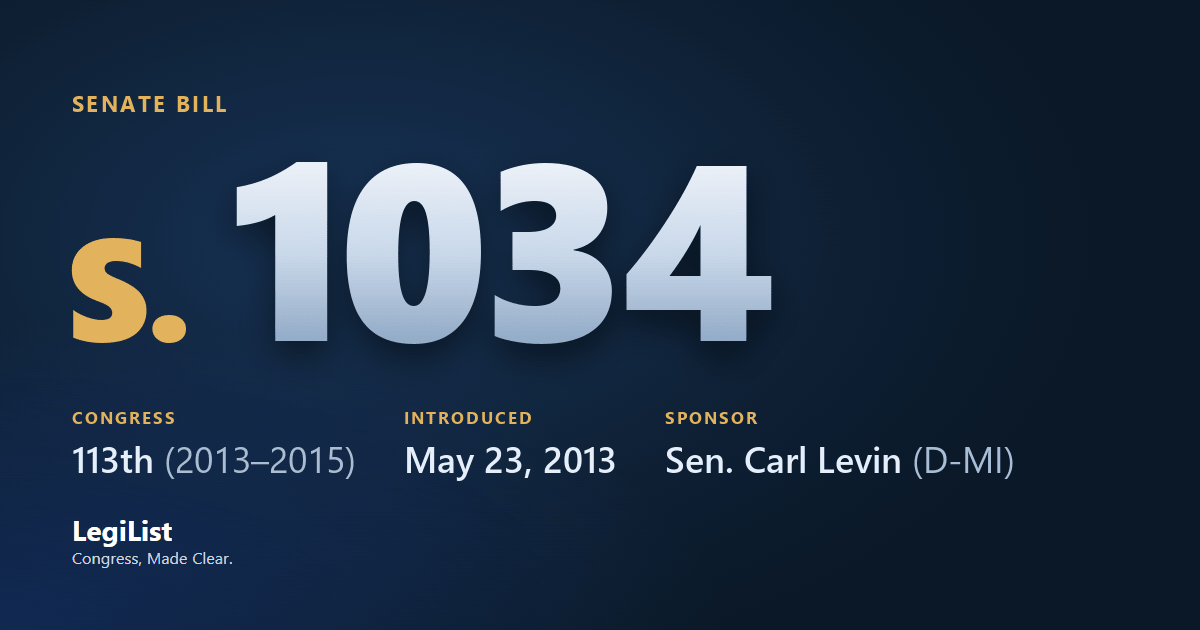
National Defense Authorization Act for Fiscal Year 2014
Latest action · May 23, 2013 Read twice and referred to the Committee on Armed Services.
Progress
Where this bill reached, and when. A stage with no date was not reached; one that failed a vote and later carried shows the date it carried.
- IntroducedMay 23, 2013
- Passed SenateNot reached
- Passed HouseNot reached
- To the PresidentNot reached
- Became lawNot reached
Summary
National Defense Authorization Act for Fiscal Year 2014 - Authorizes appropriations for the Department of Defense (DOD) for FY2014.
Authorizes appropriations to DOD for: (1) procurement, including aircraft, missiles, weapons and tracked combat vehicles, ammunition, shipbuilding and conversion, other procurement, and purchases under the Defense Production Act of 1950; (2) research, development, test, and evaluation; (3) operation and maintenance; (4) active and reserve military personnel; (5) the Afghanistan Security Forces Fund; (6) Working Capital Funds; (7) the National Defense Sealift Fund; (8) the Joint Urgent Operational Needs Fund; (9) chemical agents and munitions destruction; (10) drug interdiction and counter-drug activities; (11) the Defense Inspector General; (12) the Defense Health Program; (13) the Armed Forces Retirement Home; (14) overseas contingency operations, including the Joint Improvised Explosive Device Defeat Fund; (15) the North Atlantic Treaty Organization (NATO) Security Investment Program; (16) Guard and reserve forces facilities; and (17) base closure and realignment activities.Sets forth provisions or requirements concerning: (1) military personnel policy, including education and training; (2) military pay and allowances; (3) military health care; (4) acquisition policy and management; (5) DOD organization and management; (6) financial matters, including counter-drug activities; (7) civilian personnel matters; (8) matters relating to foreign nations, including assistance and training; and (9) matters relating to military construction and military family housing.
Directs the Secretary of the Navy to establish southern sea otter military readiness areas.
Provides procedures for the judicial review of decisions concerning the correction of military personnel records.
Provides civil remedies for DOD and the National Aeronautics and Space Administration (NASA) for losses resulting from the submission of false or fraudulent claims and statements.
Authorizes the Secretary of the Air Force to operate the Inter-European Air Forces Academy.
Revises or adds overseas servicemember voting rights and authorities under the Uniformed and Overseas Absentee Voting Act.
Military Construction Authorization Act for Fiscal Year 2014 - Authorizes appropriations for FY2014 for military construction for the Armed Forces and defense agencies.
Defense Base Closure and Realignment Act of 2013 - Establishes the Defense Base Closure and Realignment Commission to provide a process for the closure and realignment of U.S. military installations.
Cosponsors 1
Members who signed on, in the order they did. All signed on May 23, 2013.
| Seat | Cosponsor | Signed on | |
|---|---|---|---|
| R-OK | James M. Inhofe | Original | May 23, 2013 |
Actions 3
Everything that happened, newest first.
- May 23, 2013Introduced in Senate
- May 23, 2013Read twice and referred to the Committee on Armed Services.
- May 23, 2013Sponsor introductory remarks on measure. (CR S3849)
Related bills 2
Companion bills and other measures the record links to this one.
| Bill | Title | Relationship | Latest action |
|---|---|---|---|
| S 1309 | Military Land Withdrawals Act of 2014 | Related bill | May 14, 2014 |
| HR 1960 | National Defense Authorization Act for Fiscal Year 2014 | Related bill | Jul 8, 2013 |
Subjects
Assigned by the Library of Congress. Policy area: Armed Forces and National Security.
- Administrative remedies
- Advisory bodies
- Afghanistan
- Alliances
- Armed Forces and National Security
- Arms control and nonproliferation
- Asia
- Bahrain
- California
- Caribbean area
- Chemical and biological weapons
- Computers and information technology
- Congressional oversight
- Defense spending
- Department of Commerce
- Department of Defense
- Department of Veterans Affairs
- Diplomacy, foreign officials, Americans abroad
- Drug trafficking and controlled substances
- Elections, voting, political campaign regulation
- Energy efficiency and conservation
- Environmental assessment, monitoring, research
- Europe
- Executive agency funding and structure
- Federal officials
- Firearms and explosives
- Fires
- First responders and emergency personnel
- Fraud offenses and financial crimes
- Germany
- Government employee pay, benefits, personnel management
- Guam
- Hazardous wastes and toxic substances
- Health care costs and insurance
- Health facilities and institutions
- Infectious and parasitic diseases
- Intelligence activities, surveillance, classified information
- Iowa
- Iraq
- Kuwait
- Land transfers
- Land use and conservation
- Legislative rules and procedure
- Marine and coastal resources, fisheries
- Maryland
- Medical research
- Middle East
- Military assistance, sales, and agreements
- Military education and training
- Military facilities and property
- Military law
- Military medicine
- Military operations and strategy
- Military personnel and dependents
- Military procurement, research, weapons development
- Military readiness
- Mining
- Montana
- Monuments and memorials
- National Guard and reserves
- New Jersey
- New York State
- Northern Mariana Islands
- Nuclear weapons
- Oil and gas
- Parks, recreation areas, trails
- Property tax
- Puerto Rico
- Research administration and funding
- Research and development
- Roads and highways
- Romania
- State and local finance
- State and local taxation
- Tennessee
- Terrorism
- Texas
- Veterans' medical care
- Virgin Islands
- Visas and passports
- Washington State
- Wetlands
- Wildlife conservation and habitat protection
Text 1
Each version as it was printed, newest first.
- May 23, 2013Introduced in Senate
Everything here is as published by Congress: the summary is the Congressional Research Service's, the action wording is the clerks', and the subjects are the Library of Congress's. How far it got is read from the actions themselves, taking the most recent one of each kind, so a bill that failed a vote and later passed is shown as having passed. Records come from this bill on Congress.gov and govinfo.gov.