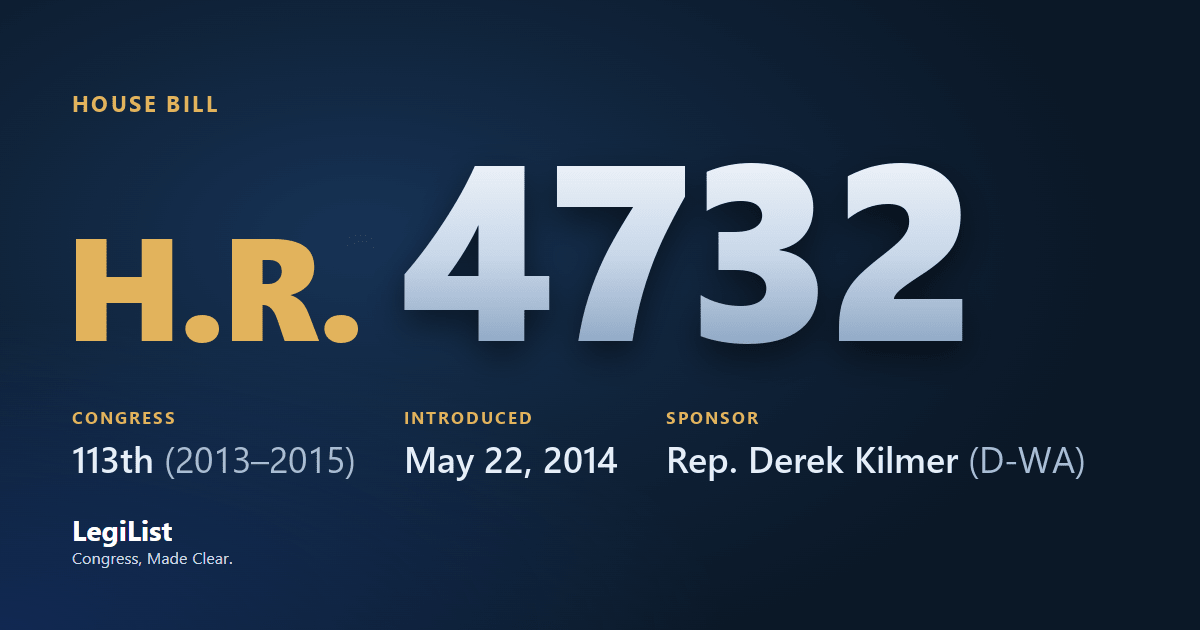
Ocean Acidification Innovation Act of 2014
Latest action · Jul 15, 2014 Referred to the Subcommittee on Environment.
Progress
Where this bill reached, and when. A stage with no date was not reached; one that failed a vote and later carried shows the date it carried.
- IntroducedMay 22, 2014
- Passed HouseNot reached
- Passed SenateNot reached
- To the PresidentNot reached
- Became lawNot reached
Summary
Ocean Acidification Innovation Act of 2014 - Amends the Federal Ocean Acidification Research and Monitoring Act of 2009 to authorize any federal agency with a representative serving on the Interagency Working Group on Ocean Acidification, either individually or in cooperation with other agencies, to carry out a program to award prizes competitively under the Stevenson-Wydler Technology Innovation Act of 1980 for the purpose of stimulating innovation to advance the nation's ability to understand, research, or monitor ocean acidification or its impacts or to develop management or adaptation options for responding to ocean acidification.
Grants priority to establishing programs that address communities, environments, or industries that are in distress due to the impacts of ocean acidification.
Cosponsors 13
Members who signed on, in the order they did. Signatures ran from May 22, 2014 to Jul 31, 2014; 6 are original cosponsors, there from the day it was introduced.
| Seat | Cosponsor | Signed on | |
|---|---|---|---|
| R-WA | David G. Reichert | Original | May 22, 2014 |
| D-WA | Denny Heck | Original | May 22, 2014 |
| R-WA | Jaime Herrera Beutler | Original | May 22, 2014 |
| D-CA | Jared Huffman | Original | May 22, 2014 |
| D-CA | Lois Capps | Original | May 22, 2014 |
| D-CA | Scott H. Peters | Original | May 22, 2014 |
| D-ME | Chellie Pingree | Jun 11, 2014 | |
| D-CA | Michael M. Honda | Jun 11, 2014 | |
| D-WA | Suzan K. DelBene | Jun 11, 2014 | |
| D-OR | Suzanne Bonamici | Jun 11, 2014 | |
| D-CA | Jerry McNerney | Jul 17, 2014 | |
| R-NY | Peter T. King | Jul 17, 2014 | |
| D-PA | Matt Cartwright | Jul 31, 2014 |
Committees 1
Where it was sent and what each committee and subcommittee did with it, in order.
| Chamber | Committee | What it did |
|---|---|---|
| House | Science, Space, and Technology Committee | Referred May 22, 2014 |
| Environment Subcommittee | Referred Jul 15, 2014 |
Actions 3
Everything that happened, newest first.
- Jul 15, 2014Referred to the Subcommittee on Environment.
- May 22, 2014Introduced in House
- May 22, 2014Referred to the House Committee on Science, Space, and Technology.
Research
What has been written about this bill: committee reports, cost estimates, the sponsor’s authority statement, printed hearings and the Congressional Research Service’s work.
Constitutional authority
The sponsor’s statement, as printed in the page H4830.
CRS reports 1
Congressional Research Service work that CRS links to this bill or the law it became, newest first.
Cite it 1
Products on other subjects that cite it, usually among other measures.
| Product | Title | Kind | Published |
|---|---|---|---|
| R43972 | Science and Technology Issues in the 114th Congress Archived | Report | Apr 7, 2015 |
Titles 2
Every title it has carried, official and short, at each stage.
- Official Title as Introduced
- To authorize Federal agencies to establish prize competitions for innovation or adaptation management development relating to ocean acidification.
- Short Titles as Introduced
- Ocean Acidification Innovation Act of 2014
Subjects
Assigned by the Library of Congress. Policy area: Science, Technology, Communications.
- Advanced technology and technological innovations
- Climate change and greenhouse gases
- Environmental assessment, monitoring, research
- Food industry and services
- Marine and coastal resources, fisheries
- Marine pollution
- Public contracts and procurement
- Research administration and funding
- Science, Technology, Communications
- Seafood
Text 1
Each version as it was printed, newest first.
- May 22, 2014Introduced in House
Support LegiList
This page is free, carries no paywall, and is built and maintained by one person. If the record here is useful to you, a few dollars keeps it going.
Everything here is as published by Congress: the summary is the Congressional Research Service's, the action wording is the clerks', and the subjects are the Library of Congress's. How far it got is read from the actions themselves, taking the most recent one of each kind, so a bill that failed a vote and later passed is shown as having passed. Records come from this bill on Congress.gov and govinfo.gov; cost estimates are the Congressional Budget Office's, and the hearings are the printed hearings GovInfo publishes, which can appear months after the hearing.