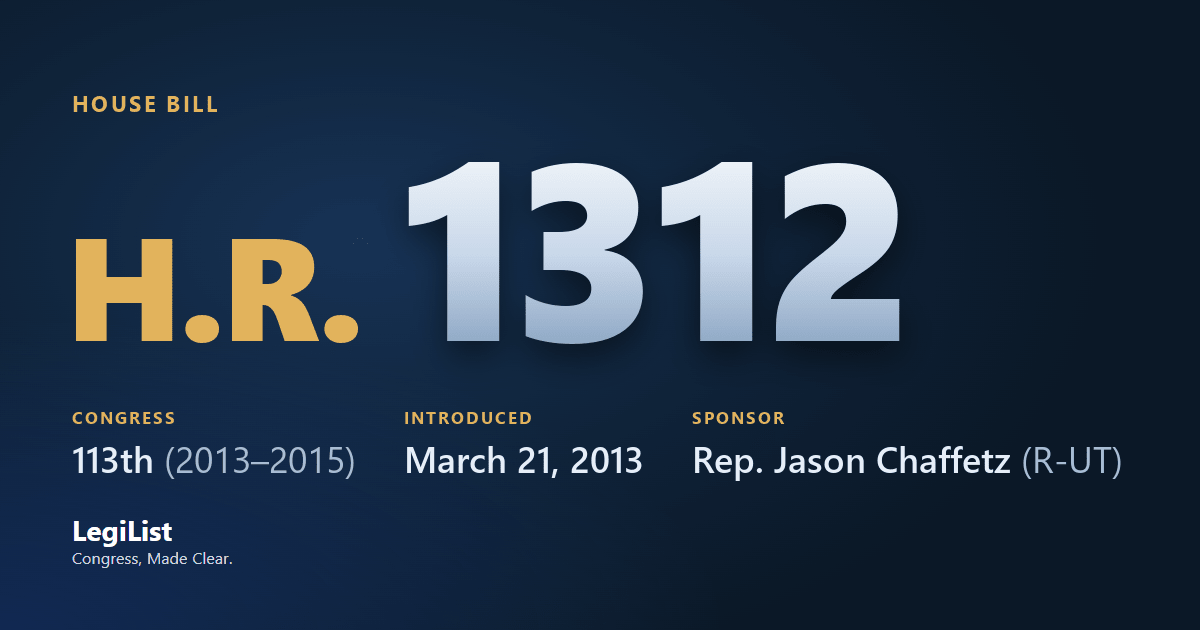
GPS Act
Latest action · Apr 15, 2013 Referred to the Subcommittee on Crime, Terrorism, Homeland Security, And Investigations.
Progress
Where this bill reached, and when. A stage with no date was not reached; one that failed a vote and later carried shows the date it carried.
- IntroducedMar 21, 2013
- Passed HouseNot reached
- Passed SenateNot reached
- To the PresidentNot reached
- Became lawNot reached
Summary
Geolocational Privacy and Surveillance Act or the GPS Act - Amends the federal criminal code to prohibit intentionally: (1) intercepting geolocation information pertaining to another person; (2) disclosing to any other person such information pertaining to another, knowing that the information was obtained in violation of this Act; (3) using geolocation information, knowing that the information was obtained in violation of this Act; or (4) disclosing to any other person the geolocation information pertaining to another person intercepted by means authorized under this Act, knowing that the information was obtained in connection with a criminal investigation, having obtained or received information in connection with a criminal investigation, with intent to improperly obstruct, impede, or interfere with a duly authorized criminal investigation. Sets penalties for violations.
Makes specified exceptions for interceptions involving: (1) information acquired by a provider of covered services (electronic communication service, remote computing service, or geolocation information service) in the normal course of business; (2) federal officers, employees, or agents conducting foreign intelligence surveillance; (3) persons having given prior consent; (4) public information; (5) emergency information; (6) theft; and (7) a warrant.
Prohibits: (1) a person providing covered services from intentionally divulging geolocation information pertaining to another person, with exceptions; and (2) the use of such information, and evidence derived from it, as evidence. Authorizes: (1) the use of geolocation information by investigative or law enforcement officers, or by a state's principal prosecuting attorney, to intercept such information under specified emergency circumstances; and (2) the recovery of civil damages by any person whose geolocation information is intercepted, disclosed, or intentionally used in violation of this Act.
Modifies the Federal Rules of Criminal Procedure to require a search warrant to acquire geolocation information.
Amends the federal criminal code to include any geolocation information service within the definition of a "covered entity" for purposes of provisions prohibiting obtaining confidential phone records information from such an entity by fraud or related activity.
Directs the United States Sentencing Commission to review the federal sentencing guidelines and policy statements applicable to persons convicted of fraud and related activity in connection with obtaining certain confidential phone records information.
Prohibits acquiring geolocation information of a person for protective activities or law enforcement or intelligence purposes except pursuant to a warrant issued under the Federal Rules of Criminal Procedure or the Foreign Intelligence Surveillance Act.
Cosponsors 20
Members who signed on, in the order they did. Signatures ran from Mar 21, 2013 to Dec 10, 2014; 10 are original cosponsors, there from the day it was introduced.
| Seat | Cosponsor | Signed on | |
|---|---|---|---|
| D-ME | Chellie Pingree | Original | Mar 21, 2013 |
| R-WI | F. James Sensenbrenner, Jr. | Original | Mar 21, 2013 |
| D-CO | Jared Polis | Original | Mar 21, 2013 |
| D-MI | John Conyers, Jr. | Original | Mar 21, 2013 |
| D-OR | Peter A. DeFazio | Original | Mar 21, 2013 |
| D-VT | Peter Welch | Original | Mar 21, 2013 |
| D-CA | Sam Farr | Original | Mar 21, 2013 |
| R-OH | Steve Chabot | Original | Mar 21, 2013 |
| R-TX | Ted Poe | Original | Mar 21, 2013 |
| D-CA | Zoe Lofgren | Original | Mar 21, 2013 |
| D-OR | Earl Blumenauer | Mar 25, 2013 | |
| D-AZ | Raúl M. Grijalva | Mar 25, 2013 | |
| R-SC | Trey Gowdy | Apr 11, 2013 | |
| D-WA | Suzan K. DelBene | Apr 12, 2013 | |
| R-IL | Rodney Davis | Apr 16, 2013 | |
| D-ME | Michael H. Michaud | Sep 20, 2013 | |
| R-AK | Don Young | Feb 11, 2014 | |
| R-OH | Jim Jordan | Mar 11, 2014 | |
| D-CA | Michael M. Honda | Mar 11, 2014 | |
| D-NY | Jerrold Nadler | Dec 10, 2014 |
Committees 2
Where it was sent and what each committee and subcommittee did with it, in order.
| Chamber | Committee | What it did |
|---|---|---|
| House | Judiciary Committee | Referred Mar 21, 2013 |
| Crime and Federal Government Surveillance Subcommittee | Referred Apr 15, 2013 | |
| House | Intelligence (Permanent Select) Committee | Referred Mar 21, 2013 |
Actions 3
Everything that happened, newest first.
- Apr 15, 2013Referred to the Subcommittee on Crime, Terrorism, Homeland Security, And Investigations.
- Mar 21, 2013Introduced in House
- Mar 21, 2013Referred to the Committee on the Judiciary, and in addition to the Committee on Intelligence (Permanent Select), for a period to be subsequently determined by the Speaker, in each case for consideration of such provisions as fall within the jurisdiction of the committee concerned.
In the Congressional Record 1
Days the Record’s own index lists this bill, newest first, with the pages and the members it names. Pages starting H are the House, S the Senate, E Extensions of Remarks.
| Where | In the Record | Members | Date |
|---|---|---|---|
| House | Debate and remarks H7569 | Jason Chaffetz R-UT | Dec 9, 2013 |
Research
What has been written about this bill: committee reports, cost estimates, the sponsor’s authority statement, printed hearings and the Congressional Research Service’s work.
Constitutional authority
The sponsor’s statement, as printed in the page H1826.
Printed hearings 1
Hearings whose printed record names this bill, newest first: hearings on it, and wider hearings where it came up.
| Number | Hearing | Committee | Held |
|---|---|---|---|
| Serial No. 113-34 | ELECTRONIC COMMUNICATIONS PRIVACY ACT (ECPA) (PART II): GEOLOCATION PRIVACY AND SURVEILLANCE167 pages | Judiciary Committee | Apr 25, 2013 |
CRS reports 1
Congressional Research Service work that CRS links to this bill or the law it became, newest first.
Cite it 1
Products on other subjects that cite it, usually among other measures.
| Product | Title | Kind | Published |
|---|---|---|---|
| R42114 | Federal Laws Relating to Cybersecurity: Overview of Major Issues, Current Laws, and Proposed Legislation Archived | Report | Dec 12, 2014 |
Related bills 2
Companion bills and other measures the record links to this one.
| Bill | Title | Relationship | Latest action |
|---|---|---|---|
| S 639 | GPS Act | Related bill | Mar 21, 2013 |
| HR 983 | Online Communications and Geolocation Protection Act | Related bill | Apr 8, 2013 |
Titles 3
Every title it has carried, official and short, at each stage.
- Official Title as Introduced
- To amend title 18, United States Code, to specify the circumstances in which a person may acquire geolocation information and for other purposes.
- Short Titles as Introduced
- Geolocational Privacy and Surveillance Act
- GPS Act
Subjects
Assigned by the Library of Congress. Policy area: Crime and Law Enforcement.
- Civil actions and liability
- Computers and information technology
- Crime and Law Enforcement
- Criminal investigation, prosecution, interrogation
- Criminal justice information and records
- Criminal procedure and sentencing
- Evidence and witnesses
- Fraud offenses and financial crimes
- Right of privacy
- Telephone and wireless communication
Text 1
Each version as it was printed, newest first.
- Mar 21, 2013Introduced in House
Everything here is as published by Congress: the summary is the Congressional Research Service's, the action wording is the clerks', and the subjects are the Library of Congress's. How far it got is read from the actions themselves, taking the most recent one of each kind, so a bill that failed a vote and later passed is shown as having passed. Records come from this bill on Congress.gov and govinfo.gov; cost estimates are the Congressional Budget Office's, and the hearings are the printed hearings GovInfo publishes, which can appear months after the hearing.