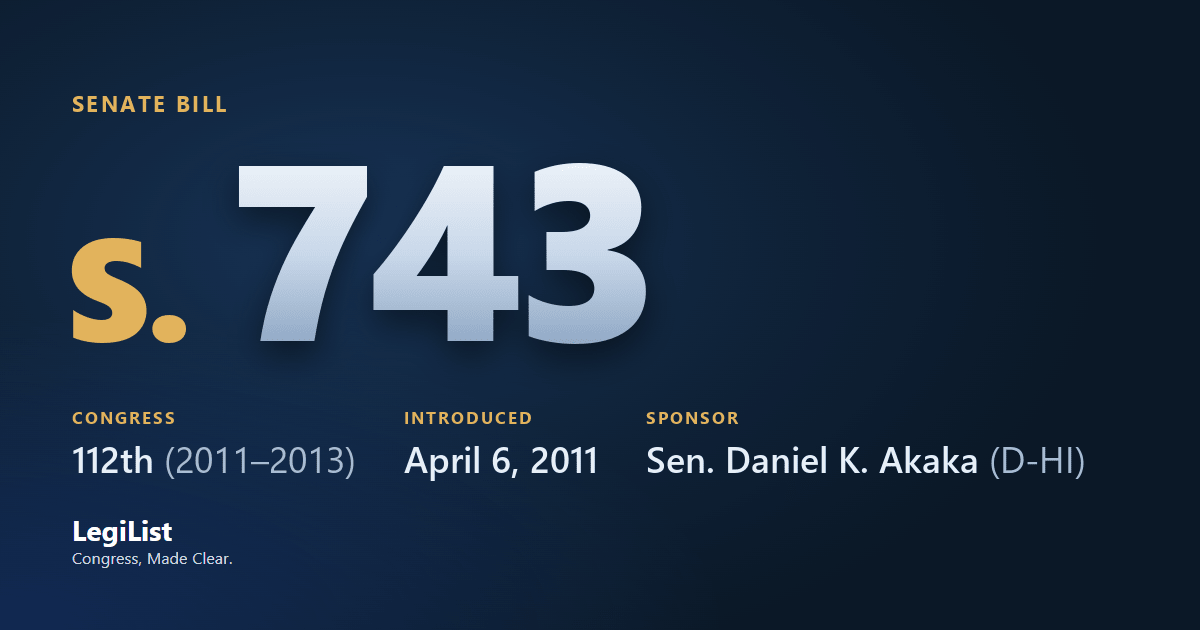
Whistleblower Protection Enhancement Act of 2012
Latest action · Nov 27, 2012 Became Public Law No: 112-199.
Progress
Where this bill reached, and when. A stage with no date was not reached; one that failed a vote and later carried shows the date it carried.
- IntroducedApr 6, 2011
- Passed SenateMay 8, 2012
- Passed HouseSep 28, 2012
- To the PresidentNov 16, 2012
- Became lawNov 27, 2012Public Law 112-199
Summary
(This measure has not been amended since it was passed by the House on September 28, 2012. The summary of that version is repeated here.)
Whistleblower Protection Enhancement Act of 2012 - Title I: Protection of Certain Disclosures of Information by Federal Employees - (Sec. 101) Amends federal personnel law relating to whistleblower protections to provide that such protections shall apply to a disclosure of any violation of law (currently, a violation of law).
Provides that a disclosure shall not be excluded from whistleblower protections because: (1) the disclosure was made to a supervisor or to a person who participated in an activity that the employee or applicant for employment reasonably believed to evidence gross mismanagement, gross waste of funds, abuse of authority, or a substantial and specific danger to public health or safety; (2) the disclosure revealed information that had been previously disclosed; (3) of the employee or applicant's motive for making the disclosure; (4) the disclosure was not made in writing; (5) the disclosure was made while the employee was off duty; or (6) of the amount of time which has passed since the occurrence of the events described in the disclosure.
Provides that a disclosure shall not be excluded from whistleblower protections if it is made during the normal course of duties of an employee with respect to whom another employee with authority took, failed to take, or threatened to take or fail to take a personnel action in reprisal for the disclosure.
(Sec. 102) Defines "disclosure" as a formal or informal communication or transmission, excluding a communication concerning policy decisions that lawfully exercise discretionary authority, unless the employee or applicant making the disclosure reasonably believes that it evidences: (1) any violation of any law, rule, or regulation; or (2) gross mismanagement, gross waste of funds, abuse of authority, or a substantial and specific danger to public health or safety.
(Sec. 103) Provides that any presumption regarding a public officer's performance of a duty may be rebutted by substantial evidence.
Establishes a "disinterested observer" standard for evaluating the validity of disclosures that evidence violations of law, gross mismanagement, gross waste of funds, an abuse of authority, or a substantial and specific danger to public health or safety.
(Sec. 104) Includes as a prohibited personnel practice the implementation or enforcement of any nondisclosure policy, form, or agreement that does not contain a specific statement that its provisions are consistent with and do not supersede, conflict with, or otherwise alter the employee obligations, rights, or liabilities created by existing statute or executive order relating to: (1) classified information; (2) communications to Congress; (3) the reporting to an Inspector General of a violation of any law, rule, or regulation or mismanagement, a gross waste of funds, an abuse of authority, or a substantial and specific danger to public health or safety; or (4) any other whistleblower protection.
Allows the enforcement of a nondisclosure policy, form, or agreement that was in effect prior to the effective date of this Act if the agency gives an affected employee notice of the statement required by this section.
Allows any action ordered to correct a prohibited personnel practice to include fees, costs, or damages reasonably incurred due to an agency investigation of an employee that was commenced, expanded, or extended in retaliation for the disclosure of protected activity that formed the basis of the corrective action.
(Sec. 105) Adds the Office of the Director of National Intelligence and the National Reconnaissance Office to the list of intelligence community entities excluded from coverage under the Whistleblower Protection Act of 1989 (WPA). Provides that a whistleblower cannot be deprived of WPA coverage unless the President removes the whistleblower's agency from coverage prior to a challenged personnel action taken against the whistleblower.
(Sec. 106) Revises the standard of proof in disciplinary proceedings against an agency employee who takes an adverse personnel action against a whistleblower to require the Office of Special Counsel to show that the whistleblower's protected disclosure was a significant motivating factor in the decision to take an adverse action, even if other factors also motivated the decision.
(Sec. 107) Authorizes: (1) the Merit Systems Protection Board (MSPB), in disciplinary actions, to require payment of reasonable attorney fees by the agency where the prevailing party is employed, or has applied for employment, if specified conditions apply; and (2) reasonable and foreseeable consequential and compensatory damages (including interest, reasonable expert witness fees, and costs) if MSPB orders corrective action.
(Sec. 108) Requires that, during the two-year period beginning on the effective date of this Act, a petition to review a final order or decision of the MSPB that raises no challenge to the MSPB's disposition of allegations of a prohibited personnel practice shall be filed in any court of appeals of competent jurisdiction (rather than exclusively in the Federal Circuit). Allows such court discretion to grant a petition for judicial review.
(Sec. 109) Extends whistleblower and other anti-discrimination protections to employees (and applicants for employment) of the Transportation Security Administration (TSA).
(Sec. 110) Extends whistleblower protections to any current or prospective federal employee for disclosures that such employee reasonably believes are evidence of censorship related to research, analysis, or technical information.
(Sec. 111) Amends the Homeland Security Act of 2002 to provide that a permissible use of independently obtained infrastructure information includes the disclosure of such information for whistleblower purposes.
(Sec. 112) Requires federal agency heads to advise their employees on how to make a lawful disclosure of information that is required to be kept classified in the interest of national defense or the conduct of foreign affairs.
(Sec. 113) Authorizes the Special Counsel to appear as amicus curiae in whistleblower actions.
(Sec. 114) Provides that corrective action relating to a prohibited personnel practice may not be ordered if, after a finding that a protected disclosure was a contributing factor in taking a personnel action, the agency demonstrates by clear and convincing evidence that it would have taken the same personnel action in the absence of such disclosure.
(Sec. 115) Requires each government nondisclosure policy, form, or agreement to contain a specific statement that its provisions are consistent with and do not supersede, conflict with, or otherwise alter the employee obligations, rights, or liabilities created by existing statute or executive order relating to: (1) classified information; (2) communications to Congress; (3) the reporting to an Inspector General of a violation of any law, rule, or regulation or mismanagement, a gross waste of funds, an abuse of authority, or a substantial and specific danger to public health or safety; or (4) any other whistleblower protection. Prohibits implementing or enforcing any nondisclosure policy, form, or agreementthat does not contain such statement to the extent such policy, form, or agreement is inconsistent with such statement..
Permits nondisclosure policies, forms, and agreements in effect before the enactment of this Act to continue to be enforced with respect to: (1) current employees if the agency provides notice of the statement to such employees, and (2) former employees if the agency posts notice of the statement on its website.
Provides that a nondisclosure policy, form, or agreement for a person who is not a federal employee, but who is connected with the conduct of intelligence or intelligence-related activity, shall contain appropriate provisions that: (1) require nondisclosure of classified information, and (2) make it clear that the forms do not bar disclosures to Congress or an authorized official that are essential to reporting a substantial violation of law.
(Sec. 116) Requires the Comptroller General (GAO), not later than four years after the enactment of this Act, to report to specified congressional committees on the implementation of this title, including an analysis of changes in the number of cases filed with MSPB alleging violations, the outcome of such cases, and the impact the process has had on MSPB and the federal court system.
Requires MSPB to include in its annual program performance reports information on the number and outcome of whistleblower cases filed.
(Sec. 117) Amends the Inspector General Act of 1978 to require each inspector general of a federal agency, except any agency that is an element of the intelligence community or whose principal function is the conduct of foreign intelligence or counter intelligence activities, to designate a Whistleblower Protection Ombudsman to educate agency employees about prohibitions on retaliation for protected disclosures and rights and remedies against such retaliation. Terminates the authority for such Ombudsman five years after the enactment of this Act.
Title II: Savings Clause; Effective Date - (Sec. 201) Declares that nothing in this Act shall be construed to imply any limitation on any protections afforded to employees and applicants for employment by any other provision of law.
(Sec. 202) Makes this Act effective 30 days after its enactment, except for provisions relating to TSA employees or applicants for employment, which shall be effective on the enactment date of this Act.
Cosponsors 14
Members who signed on, in the order they did. Signatures ran from Apr 6, 2011 to Sep 12, 2011; 13 are original cosponsors, there from the day it was introduced.
| Seat | Cosponsor | Signed on | |
|---|---|---|---|
| D-MD | Benjamin L. Cardin | Original | Apr 6, 2011 |
| D-MI | Carl Levin | Original | Apr 6, 2011 |
| R-IA | Chuck Grassley | Original | Apr 6, 2011 |
| D-MO | Claire McCaskill | Original | Apr 6, 2011 |
| D-MT | Jon Tester | Original | Apr 6, 2011 |
| I-CT | Joseph I. Lieberman | Original | Apr 6, 2011 |
| D-AK | Mark Begich | Original | Apr 6, 2011 |
| D-AR | Mark L. Pryor | Original | Apr 6, 2011 |
| D-LA | Mary L. Landrieu | Original | Apr 6, 2011 |
| D-VT | Patrick J. Leahy | Original | Apr 6, 2011 |
| R-ME | Susan M. Collins | Original | Apr 6, 2011 |
| D-DE | Thomas R. Carper | Original | Apr 6, 2011 |
| D-IA | Tom Harkin | Original | Apr 6, 2011 |
| D-DE | Christopher A. Coons | Sep 12, 2011 |
Committees 4
Where it was sent and what each committee and subcommittee did with it, in order.
| Chamber | Committee | What it did |
|---|---|---|
| Senate | Homeland Security and Governmental Affairs Committee | Referred Apr 6, 2011Markup Oct 19, 2011Reported Apr 19, 2012 |
| Oversight of Government Management, the Federal Workforce, and the District of Columbia Subcommittee | Referred May 9, 2011 | |
| House | Oversight and Government Reform Committee | Referred May 10, 2012Discharged Sep 28, 2012 |
| House | Intelligence (Permanent Select) Committee | Referred May 10, 2012Discharged Sep 28, 2012 |
| House | Homeland Security Committee | Referred May 10, 2012Discharged Sep 28, 2012 |
| Oversight, Investigations, and Accountability Subcommittee | Referred Jun 14, 2012 | |
| Counterterrorism and Intelligence Subcommittee | Referred Jun 14, 2012 |
Actions 27
Everything that happened, newest first.
- Nov 27, 2012Signed by President.
- Nov 27, 2012Became Public Law No: 112-199.
- Nov 16, 2012Presented to President.
- Nov 14, 2012Message on Senate action sent to the House.
- Nov 13, 2012Message on House action received in Senate and at desk: House amendment to Senate bill.
- Nov 13, 2012Resolving differences -- Senate actions: Senate agreed to House amendment to the bill (S.743) by Unanimous Consent. (consideration: CR S6761; text as Senate agreed to House amendment: CR S6761)
- Sep 28, 2012Mr. Lewis (CA) asked unanimous consent to discharge from committee and consider.
- Sep 28, 2012RESERVATION OF OBJECTION - Mr. Van Hollen reserved the right to object to the unanimous consent request. Subsequently, the reservation was withdrawn.
- Sep 28, 2012Committee on Oversight and Government discharged.
- Sep 28, 2012Committee on Intelligence (Permanent) discharged.
- Sep 28, 2012Committee on Homeland Security discharged.
- Sep 28, 2012Considered by unanimous consent. (consideration: CR H6286-6296; text as received in House: CR H6286-6293)
- Sep 28, 2012Passed/agreed to in House: On passage Passed without objection.
- Sep 28, 2012Motion to reconsider laid on the table Agreed to without objection.
- Jun 14, 2012Referred to the Subcommittee on Oversight, Investigations, and Management.
- Jun 14, 2012Referred to the Subcommittee on Counterterrorism and Intelligence.
- May 9, 2012Message on Senate action sent to the House.
- May 9, 2012Received in the House.
- May 9, 2012Referred to the Committee on Oversight and Government Reform, and in addition to the Committees on Intelligence (Permanent Select), and Homeland Security, for a period to be subsequently determined by the Speaker, in each case for consideration of such provisions as fall within the jurisdiction of the committee concerned.
- May 8, 2012Passed/agreed to in Senate: Passed Senate with amendments by Unanimous Consent. (consideration: CR S2978-2985; text as passed Senate: CR S2978-2985)
- Apr 19, 2012Committee on Homeland Security and Governmental Affairs. Reported by Senator Lieberman with amendments. With written report No. 112-155.
- Apr 19, 2012Placed on Senate Legislative Calendar under General Orders. Calendar No. 358.
- Oct 19, 2011Committee on Homeland Security and Governmental Affairs. Ordered to be reported with an amendment favorably.
- May 9, 2011Committee on Homeland Security and Governmental Affairs referred to Subcommittee on Oversight of Government Management, the Federal Workforce, and the District of Columbia.
- Apr 6, 2011Introduced in Senate
- Apr 6, 2011Sponsor introductory remarks on measure. (CR S2194)
- Apr 6, 2011Read twice and referred to the Committee on Homeland Security and Governmental Affairs. (text of measure as introduced: CR S2194-2201)
In the Congressional Record 5
Days the Record’s own index lists this bill, newest first, with the pages and the members it names. Pages starting H are the House, S the Senate, E Extensions of Remarks.
| Where | In the Record | Members | Date |
|---|---|---|---|
| Senate | Debate and remarks S6761 | Mark Udall D-CO | Nov 13, 2012 |
| House · Extensions | Debate and remarks E1664, E1665, H6286, H6296Text printed H6286, H6293–H6296Amendments H6293 | Chris Van Hollen D-MD, Elijah E. Cummings D-MD, Henry A. Waxman D-CA, Jerry Lewis R-CA (amendment), Todd Russell Platts R-PA | Sep 28, 2012 |
| Senate | Debate and remarks S2978, S2985Text printed S2978–S2985Amendments S2978 | Debbie Stabenow D-MI | May 8, 2012 |
| Senate | Debate and remarks S1707 | Chuck Grassley R-IA | Mar 15, 2012 |
| Senate | Debate and remarks S2194Text printed S2194–S2201 | Daniel K. Akaka D-HI (text) | Apr 6, 2011 |
Research
What has been written about this bill: committee reports, cost estimates, the sponsor’s authority statement, printed hearings and the Congressional Research Service’s work.
Committee report
Congressional Budget Office cost estimate
- Feb 7, 2012S. 743, Whistleblower Protection Enhancement Act of 2011Cost estimate for the bill as ordered reported by the Senate Committee on Homeland Security and Governmental Affairs on October 19, 2011
CRS reports 3
Congressional Research Service work that CRS links to this bill or the law it became, newest first.
Cite it 3
Products on other subjects that cite it, usually among other measures.
| Product | Title | Kind | Published |
|---|---|---|---|
| R48318 | The Whistleblower Protection Act (WPA): A Legal Overview | Report | Dec 30, 2024 |
| R43860 | Methane: An Introduction to Emission Sources and Reduction Strategies Archived | Report | Nov 18, 2016 |
| R41563 | Clean Air Issues in the 112th Congress Archived | Report | Dec 31, 2012 |
Amendments 1
Amendments offered to this bill.
| Amendment | Description | Offered by | Status |
|---|---|---|---|
| HAmdt 1496 | Amendment in the nature of a substitute inserts a complete new text entitled the "Whistleblower Protection Enhancement Act of 2012". | Jerry Lewis R-CA | On agreeing to the Lewis (CA) amendment (A001) Agreed to without objection. |
Related bills 1
Companion bills and other measures the record links to this one.
| Bill | Title | Relationship | Latest action |
|---|---|---|---|
| HR 3289 | Platts-Van Hollen Whistleblower Protection Enhancement Act of 2011 | Related bill | Oct 1, 2012 |
Titles 6
Every title it has carried, official and short, at each stage.
- Official Title as Introduced
- A bill to amend chapter 23 of title 5, United States Code, to clarify the disclosures of information protected from prohibited personnel practices, require a statement in nondisclosure policies, forms, and agreements that such policies, forms, and agreements conform with certain disclosure protections, provide certain authority for the Special Counsel, and for other purposes.
- Short Titles as Introduced
- Whistleblower Protection Enhancement Act of 2011
- Short Titles as Reported to Senate
- Whistleblower Protection Enhancement Act of 2012
- Short Titles as Passed House
- Whistleblower Protection Enhancement Act of 2012
- Short Titles as Passed Senate
- Whistleblower Protection Enhancement Act of 2012
- Short Titles as Enacted
- Whistleblower Protection Enhancement Act of 2012
Subjects
Assigned by the Library of Congress. Policy area: Government Operations and Politics.
- Administrative law and regulatory procedures
- Administrative remedies
- Central Intelligence Agency (CIA)
- Civil actions and liability
- Congressional oversight
- Department of Defense
- Department of Homeland Security
- Director of National Intelligence
- Due process and equal protection
- Employment discrimination and employee rights
- Evidence and witnesses
- Executive agency funding and structure
- Government employee pay, benefits, personnel management
- Government ethics and transparency, public corruption
- Government information and archives
- Government Operations and Politics
- Government studies and investigations
- Intelligence activities, surveillance, classified information
- Judicial review and appeals
- Legal fees and court costs
- Merit Systems Protection Board
- Office of Special Counsel
- Transportation safety and security
Text 6
Each version as it was printed, newest first.
- —Enrolled Bill
- Sep 28, 2012Engrossed Amendment House
- May 9, 2012Referred in House
- May 8, 2012Engrossed in Senate
- Apr 19, 2012Reported to Senate
- Apr 6, 2011Introduced in Senate
Everything here is as published by Congress: the summary is the Congressional Research Service's, the action wording is the clerks', and the subjects are the Library of Congress's. How far it got is read from the actions themselves, taking the most recent one of each kind, so a bill that failed a vote and later passed is shown as having passed. Records come from this bill on Congress.gov and govinfo.gov; cost estimates are the Congressional Budget Office's, and the hearings are the printed hearings GovInfo publishes, which can appear months after the hearing.