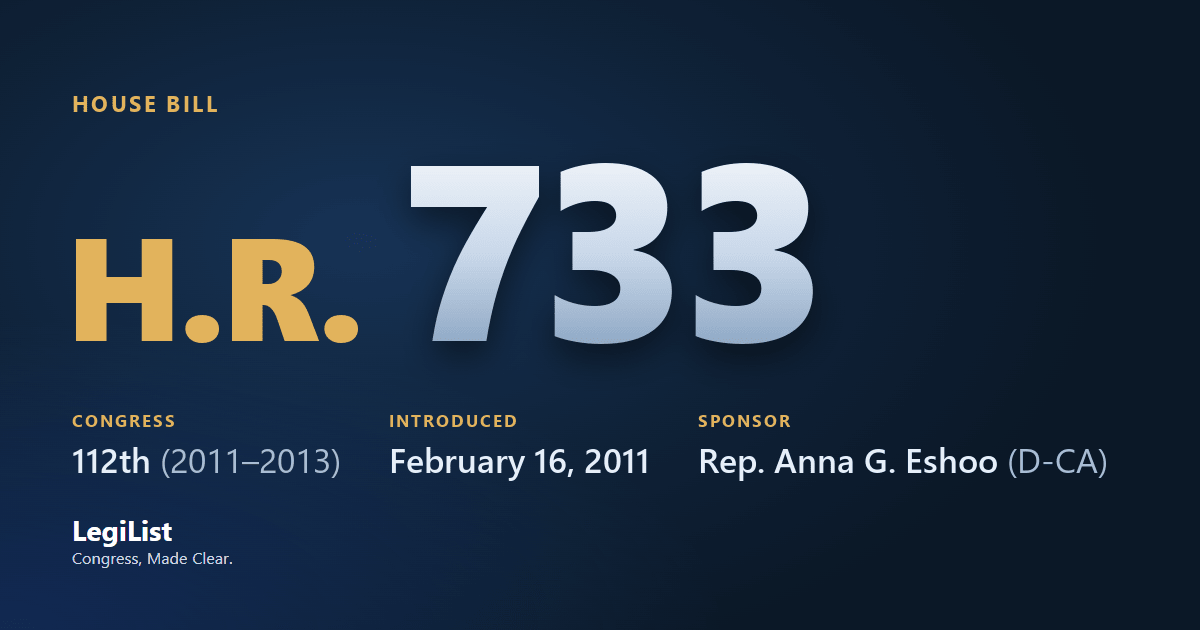
Recalcitrant Cancer Research Act of 2012
Latest action · Sep 20, 2012 Received in the Senate.
Progress
Where this bill reached, and when. A stage with no date was not reached; one that failed a vote and later carried shows the date it carried.
- IntroducedFeb 16, 2011
- Passed HouseSep 19, 2012
- Passed SenateNot reached
- To the PresidentNot reached
- Became lawNot reached
Summary
Recalcitrant Cancer Research Act of 2012 - Amends the Public Health Service Act to require the Director of the National Cancer Institute (NCI) to develop a scientific framework for research on recalcitrant cancers (cancer with a 5-year relative survival rate below 50%), which includes: (1) a review of the status of research, such as a summary of findings, identification of promising scientific advances, a description of the availability of qualified scientific researchers, and the identification of resources available to facilitate research; (2) identification of research questions that have not been adequately addressed; and (3) recommendations for actions to advance research and for appropriate benchmarks to measure progress on achieving such actions. Requires the Director to develop the framework within 18 months and review and update it every 5 years.
Requires the Director to identify within 6 months 2 or more recalcitrant cancers that have a 5-year relative survival rate of less than 20%, and are estimated to cause the death of at least 30,000 individuals in the United States per year. Authorizes the Director to identify additional such cancers and to consider additional metrics of progress (such as incidence and mortality rates) against such cancer.
Requires the Director to convene a working group for each identified cancer to provide expertise on, and assist in developing, a scientific framework under this Act.
Requires the Director to consider each relevant scientific framework developed under this Act when making recommendations for exception funding for grant applications.
Cosponsors 294
Members who signed on, in the order they did. Signatures ran from Feb 16, 2011 to Sep 19, 2012; 2 are original cosponsors, there from the day it was introduced.
| Seat | Cosponsor | Signed on | |
|---|---|---|---|
| R-WA | David G. Reichert | Original | Feb 16, 2011 |
| R-NJ | Leonard Lance | Original | Feb 16, 2011 |
| D-VA | James P. Moran | Feb 28, 2011 | |
| D-AR | Mike Ross | Feb 28, 2011 | |
| D-NJ | Rush Holt | Feb 28, 2011 | |
| D-MD | Elijah E. Cummings | Mar 4, 2011 | |
| D-CA | Grace F. Napolitano | Mar 4, 2011 | |
| R-PA | Jim Gerlach | Mar 8, 2011 | |
| D-MD | John P. Sarbanes | Mar 8, 2011 | |
| D-KY | John A. Yarmuth | Mar 9, 2011 | |
| R-IA | Tom Latham | Mar 9, 2011 | |
| D-CA | Barbara Lee | Mar 11, 2011 | |
| D-NY | Gary L. Ackerman | Mar 11, 2011 | |
| D-TN | Jim Cooper | Mar 11, 2011 | |
| D-CA | Jim Costa | Mar 11, 2011 |
Committees 1
Where it was sent and what each committee and subcommittee did with it, in order.
| Chamber | Committee | What it did |
|---|---|---|
| House | Energy and Commerce Committee | Referred Feb 16, 2011 |
| Health Subcommittee | Referred Feb 28, 2011Markup Sep 11, 2012Reported Sep 11, 2012 |
Actions 12
Everything that happened, newest first.
- Sep 20, 2012Received in the Senate.
- Sep 19, 2012Mr. Pitts moved to suspend the rules and pass the bill, as amended.
- Sep 19, 2012Considered under suspension of the rules. (consideration: CR H6144-6147)
- Sep 19, 2012DEBATE - The House proceeded with forty minutes of debate on H.R. 733.
- Sep 19, 2012Passed/agreed to in House: On motion to suspend the rules and pass the bill, as amended Agreed to by voice vote. (text: CR H6144-6145)
In the Congressional Record 5
Days the Record’s own index lists this bill, newest first, with the pages and the members it names. Pages starting H are the House, S the Senate, E Extensions of Remarks.
| Where | In the Record | Members | Date |
|---|---|---|---|
| Extensions | Debate and remarks E1684 | David G. Reichert R-WA | Oct 5, 2012 |
| Extensions | Debate and remarks E1612 | Martha Roby R-AL | Sep 21, 2012 |
| House | Debate and remarks H6144–H6147Text printed H6144 | Anna G. Eshoo D-CA, Chaka Fattah D-PA, Fred Upton R-MI, Henry A. Waxman D-CA, Joseph R. Pitts R-PA, Leonard Lance R-NJ | Sep 19, 2012 |
| House | Debate and remarks H7719 | Patrick Meehan R-PA | Nov 17, 2011 |
| House | Lists H1039, H1070H.R. 733-750 | — | Feb 16, 2011 |
Research
What has been written about this bill: committee reports, cost estimates, the sponsor’s authority statement, printed hearings and the Congressional Research Service’s work.
Constitutional authority
The sponsor’s statement, as printed in the page H1039.
Related bills 5
Companion bills and other measures the record links to this one.
| Bill | Title | Relationship | Latest action |
|---|---|---|---|
| S 362 | Pancreatic Cancer Research and Education Act | Related bill | Feb 16, 2011 |
| S 3254 | National Defense Authorization Act for Fiscal Year 2013 | Related bill | Dec 12, 2012 |
| S 3560 | Recalcitrant Cancer Research Act of 2012 | Related bill | Sep 19, 2012 |
| S 3566 | Recalcitrant Cancer Research Act of 2012 | Related bill | Sep 19, 2012 |
| HR 4310 | National Defense Authorization Act for Fiscal Year 2013 | Related bill | Jan 2, 2013 |
Titles 4
Every title it has carried, official and short, at each stage.
- Official Title as Introduced
- To amend the Public Health Service Act to provide for a Pancreatic Cancer Initiative, and for other purposes.
- Official Titles as Amended by House
- To provide for scientific frameworks with respect to recalcitrant cancers.
- Short Titles as Introduced
- Pancreatic Cancer Research and Education Act
- Short Titles as Passed House
- Recalcitrant Cancer Research Act of 2012
Subjects
Assigned by the Library of Congress. Policy area: Health.
- Advisory bodies
- Cancer
- Congressional oversight
- Department of Health and Human Services
- Digestive and metabolic diseases
- Drug therapy
- Health
- Health information and medical records
- Health programs administration and funding
- Health promotion and preventive care
- Health technology, devices, supplies
- Medical education
- Medical research
- Medical tests and diagnostic methods
- National Institutes of Health (NIH)
- Research administration and funding
- Research and development
Text 3
Each version as it was printed, newest first.
- Sep 20, 2012Received in Senate
- Sep 19, 2012Engrossed in House
- Feb 16, 2011Introduced in House
Support LegiList
This page is free, carries no paywall, and is built and maintained by one person. If the record here is useful to you, a few dollars keeps it going.
Everything here is as published by Congress: the summary is the Congressional Research Service's, the action wording is the clerks', and the subjects are the Library of Congress's. How far it got is read from the actions themselves, taking the most recent one of each kind, so a bill that failed a vote and later passed is shown as having passed. Records come from this bill on Congress.gov and govinfo.gov; cost estimates are the Congressional Budget Office's, and the hearings are the printed hearings GovInfo publishes, which can appear months after the hearing.