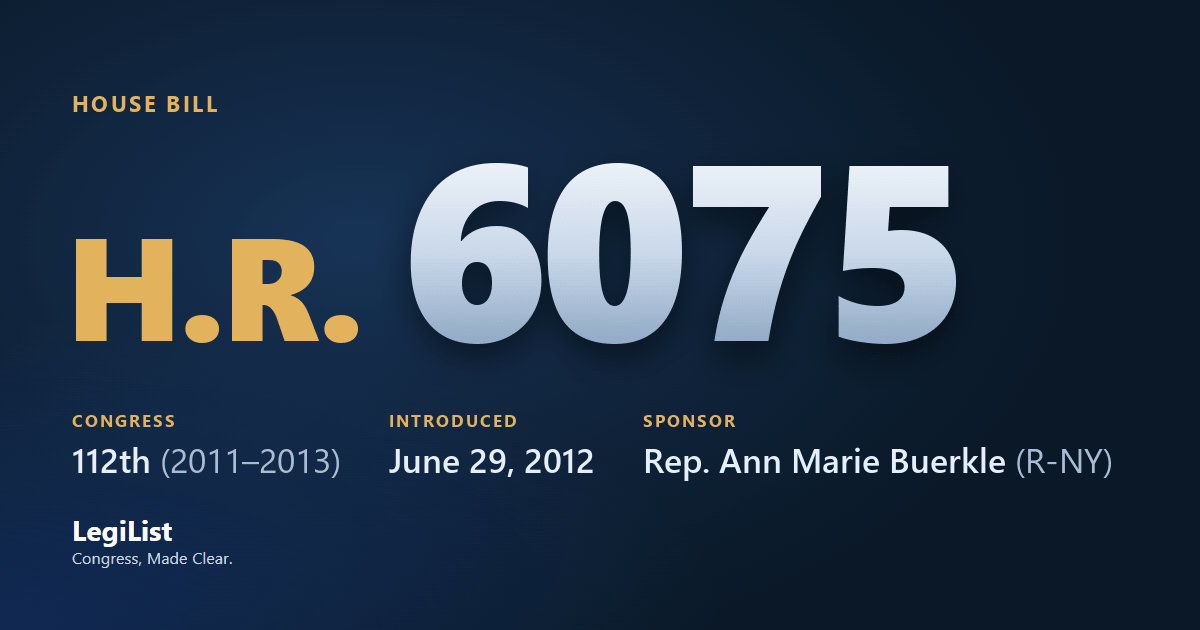
To permit the chief executive of a State to create an exemption from certain requirements of Federal environmental laws for producers of agricultural commodities, and for other purposes.
Latest action · Jul 2, 2012 Referred to the Subcommittee on Water Resources and Environment.
Progress
Where this bill reached, and when. A stage with no date was not reached; one that failed a vote and later carried shows the date it carried.
- IntroducedJun 29, 2012
- Passed HouseNot reached
- Passed SenateNot reached
- To the PresidentNot reached
- Became lawNot reached
Summary
Permits the chief executive of a state to exempt persons in the state acting in their capacity as farmers from a requirement of a covered federal environmental law by determining that such requirement is unduly burdensome to such persons.
Requires the chief executive to solicit and accept public comments for at least 90 days before finalizing any such determination.
Defines "covered federal environmental law" to mean the Clean Air Act insofar as it applies to emissions of air pollutants other than those resulting from the combustion of fossil fuel, the Federal Water Pollution Control Act (commonly known as the Clean Water Act), and the Solid Waste Disposal Act.
Cosponsors 12
Members who signed on, in the order they did. Signatures ran from Jun 29, 2012 to Jul 31, 2012; 6 are original cosponsors, there from the day it was introduced.
| Seat | Cosponsor | Signed on | |
|---|---|---|---|
| R-TN | David P. Roe | Original | Jun 29, 2012 |
| R-GA | Lynn A. Westmoreland | Original | Jun 29, 2012 |
| R-TN | Marsha Blackburn | Original | Jun 29, 2012 |
| R-PA | Mike Kelly | Original | Jun 29, 2012 |
| R-GA | Paul C. Broun | Original | Jun 29, 2012 |
| R-MO | Vicky Hartzler | Original | Jun 29, 2012 |
| R-OH | Bob Gibbs | Jul 12, 2012 | |
| R-TX | Ron Paul | Jul 17, 2012 | |
| R-AZ | Jeff Flake | Jul 23, 2012 | |
| R-IL | Randy Hultgren | Jul 26, 2012 | |
| R-UT | Rob Bishop | Jul 26, 2012 | |
| R-ID | Raul R. Labrador | Jul 31, 2012 |
Committees 2
Where it was sent and what each committee and subcommittee did with it, in order.
| Chamber | Committee | What it did |
|---|---|---|
| House | Energy and Commerce Committee | Referred Jun 29, 2012 |
| Energy Subcommittee | Referred Jun 29, 2012 | |
| House | Transportation and Infrastructure Committee | Referred Jun 29, 2012 |
| Water Resources and Environment Subcommittee | Referred Jul 2, 2012 |
Actions 4
Everything that happened, newest first.
- Jul 2, 2012Referred to the Subcommittee on Water Resources and Environment.
- Jun 29, 2012Introduced in House
- Jun 29, 2012Referred to the Committee on Energy and Commerce, and in addition to the Committee on Transportation and Infrastructure, for a period to be subsequently determined by the Speaker, in each case for consideration of such provisions as fall within the jurisdiction of the committee concerned.
- Jun 29, 2012Referred to the Subcommittee on Energy and Power.
Research
What has been written about this bill: committee reports, cost estimates, the sponsor’s authority statement, printed hearings and the Congressional Research Service’s work.
Constitutional authority
The sponsor’s statement, as printed in the page H4656.
Titles 1
Every title it has carried, official and short, at each stage.
- Official Title as Introduced
- To permit the chief executive of a State to create an exemption from certain requirements of Federal environmental laws for producers of agricultural commodities, and for other purposes.
Subjects
Assigned by the Library of Congress. Policy area: Environmental Protection.
- Administrative law and regulatory procedures
- Agricultural conservation and pollution
- Air quality
- Environmental Protection
- Environmental Protection Agency (EPA)
- Environmental regulatory procedures
- Intergovernmental relations
- Solid waste and recycling
- State and local government operations
- Water quality
Text 1
Each version as it was printed, newest first.
- Jun 29, 2012Introduced in House
Support LegiList
This page is free, carries no paywall, and is built and maintained by one person. If the record here is useful to you, a few dollars keeps it going.
Everything here is as published by Congress: the summary is the Congressional Research Service's, the action wording is the clerks', and the subjects are the Library of Congress's. How far it got is read from the actions themselves, taking the most recent one of each kind, so a bill that failed a vote and later passed is shown as having passed. Records come from this bill on Congress.gov and govinfo.gov; cost estimates are the Congressional Budget Office's, and the hearings are the printed hearings GovInfo publishes, which can appear months after the hearing.