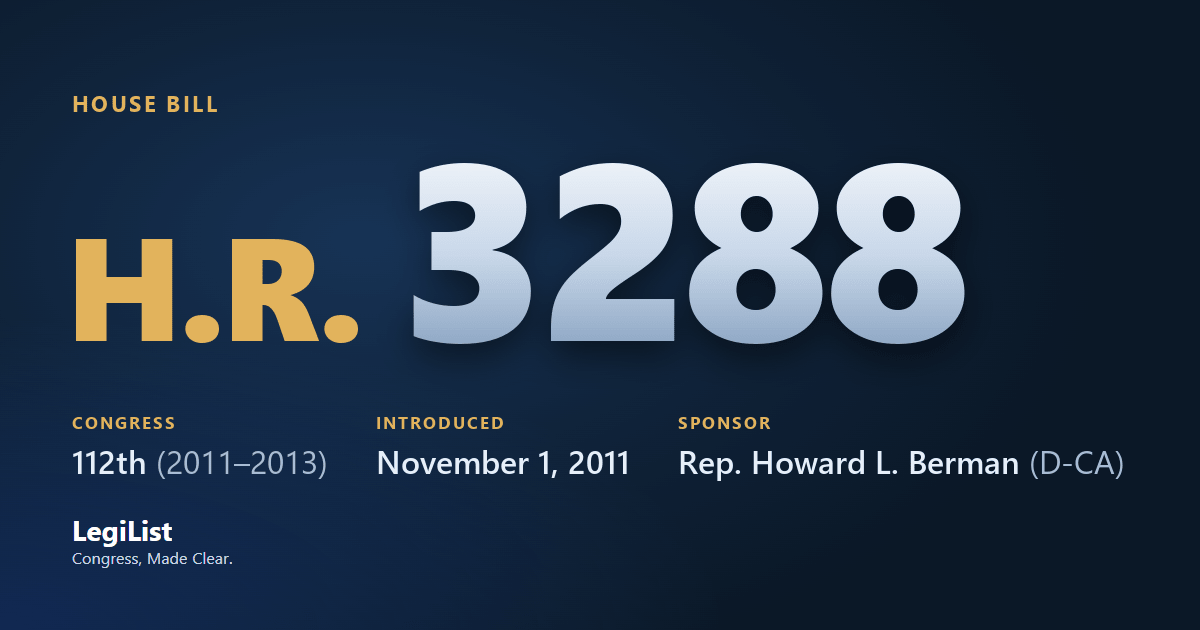
Safeguarding United States Satellite Leadership and Security Act of 2011
Latest action · Nov 1, 2011 Referred to the House Committee on Foreign Affairs.
Progress
Where this bill reached, and when. A stage with no date was not reached; one that failed a vote and later carried shows the date it carried.
- IntroducedNov 1, 2011
- Passed HouseNot reached
- Passed SenateNot reached
- To the PresidentNot reached
- Became lawNot reached
Summary
Safeguarding United States Satellite Leadership and Security Act of 2011 - Authorizes the President to remove commercial satellites and related components from the United States Munitions List.
Prohibits any satellite or related component from being transferred, directly or indirectly, to: (1) the government of China (PRC) or any PRC entity or person; or (2) the government of Cuba, Iran, Sudan, Syria, or North Korea or any entity or person of Cuba, Iran, Sudan, Syria, or North Korea.
Cosponsors 19
Members who signed on, in the order they did. Signatures ran from Nov 1, 2011 to May 16, 2012; 7 are original cosponsors, there from the day it was introduced.
| Seat | Cosponsor | Signed on | |
|---|---|---|---|
| D-WA | Adam Smith | Original | Nov 1, 2011 |
| D-MD | C. A. Dutch Ruppersberger | Original | Nov 1, 2011 |
| R-IL | Donald A. Manzullo | Original | Nov 1, 2011 |
| D-VA | Gerald E. Connolly | Original | Nov 1, 2011 |
| D-NM | Martin Heinrich | Original | Nov 1, 2011 |
| R-CO | Mike Coffman | Original | Nov 1, 2011 |
| R-UT | Rob Bishop | Original | Nov 1, 2011 |
| D-IL | Janice D. Schakowsky | Nov 16, 2011 | |
| D-MA | William R. Keating | Nov 16, 2011 | |
| R-MD | Andy Harris | Dec 16, 2011 | |
| D-CO | Diana DeGette | Dec 16, 2011 | |
| R-NV | Mark E. Amodei | Mar 6, 2012 | |
| R-FL | Bill Posey | Mar 28, 2012 | |
| R-IL | Aaron Schock | May 7, 2012 | |
| D-CO | Ed Perlmutter | May 7, 2012 | |
| D-WA | Rick Larsen | May 8, 2012 | |
| R-CA | Edward R. Royce | May 11, 2012 | |
| D-CA | Henry A. Waxman | May 15, 2012 | |
| D-CO | Jared Polis | May 16, 2012 |
Withdrew 1 Jason Chaffetz R-UT Apr 17, 2012
Committees 1
Where it was sent and what each committee and subcommittee did with it, in order.
| Chamber | Committee | What it did |
|---|---|---|
| House | Foreign Affairs Committee | Referred Nov 1, 2011 |
Actions 2
Everything that happened, newest first.
- Nov 1, 2011Introduced in House
- Nov 1, 2011Referred to the House Committee on Foreign Affairs.
Research
What has been written about this bill: committee reports, cost estimates, the sponsor’s authority statement, printed hearings and the Congressional Research Service’s work.
Constitutional authority
The sponsor’s statement, as printed in the page H7207.
Printed hearings 2
Hearings whose printed record names this bill, newest first: hearings on it, and wider hearings where it came up.
| Number | Hearing | Committee | Held |
|---|---|---|---|
| Serial No. 112-176 | SEMIANNUAL COMMITTEE ACTIVITY REPORT AND FOREIGN RELATIONS AUTHORIZATION ACT, FISCAL YEAR 2013115 pages | Foreign Affairs Committee | Jun 27, 2012 |
| Serial No. 112-127 | EXPORT CONTROLS, ARMS SALES, AND REFORM: BALANCING U.S. INTERESTS, PART II75 pages | Foreign Affairs Committee | Feb 7, 2012 |
Titles 2
Every title it has carried, official and short, at each stage.
- Official Title as Introduced
- To authorize the President to remove commercial satellites and related components from the United States Munitions List subject to certain restrictions, and for other purposes.
- Short Titles as Introduced
- Safeguarding United States Satellite Leadership and Security Act of 2011
Subjects
Assigned by the Library of Congress. Policy area: International Affairs.
Text 1
Each version as it was printed, newest first.
- Nov 1, 2011Introduced in House
Everything here is as published by Congress: the summary is the Congressional Research Service's, the action wording is the clerks', and the subjects are the Library of Congress's. How far it got is read from the actions themselves, taking the most recent one of each kind, so a bill that failed a vote and later passed is shown as having passed. Records come from this bill on Congress.gov and govinfo.gov; cost estimates are the Congressional Budget Office's, and the hearings are the printed hearings GovInfo publishes, which can appear months after the hearing.