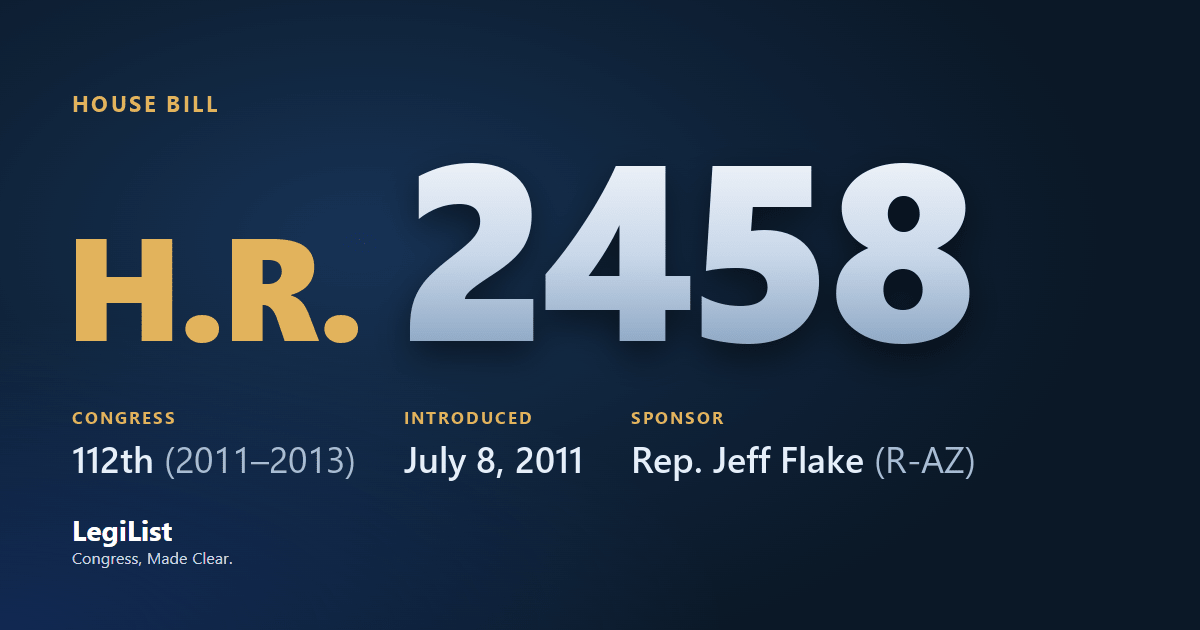
ARID Act of 2011
Latest action · Jul 15, 2011 Referred to the Subcommittee on Energy and Power.
Progress
Where this bill reached, and when. A stage with no date was not reached; one that failed a vote and later carried shows the date it carried.
- IntroducedJul 8, 2011
- Passed HouseNot reached
- Passed SenateNot reached
- To the PresidentNot reached
- Became lawNot reached
Summary
Air Quality Review Interval and Dust Act of 2011 or the ARID Act of 2011 - Amends the Clean Air Act to require the Administrator of the Environmental Protection Agency (EPA) to review at 10-year intervals (currently, five-year intervals) criteria and standards for national primary and secondary ambient air quality standards.
Prohibits the Administrator from finalizing, implementing, or enforcing such standards applicable to coarse particulate matter (PM10) prior to December 18, 2016.
Cosponsors 9
Members who signed on, in the order they did. Signatures ran from Jul 11, 2011 to Sep 13, 2011.
| Seat | Cosponsor | Signed on | |
|---|---|---|---|
| R-WA | Cathy McMorris Rodgers | Jul 11, 2011 | |
| R-IL | Randy Hultgren | Jul 11, 2011 | |
| R-OH | Robert E. Latta | Jul 11, 2011 | |
| R-CA | Tom McClintock | Jul 11, 2011 | |
| R-OK | James Lankford | Jul 13, 2011 | |
| R-UT | Jason Chaffetz | Jul 13, 2011 | |
| R-MO | Vicky Hartzler | Jul 20, 2011 | |
| R-TX | Jeb Hensarling | Jul 29, 2011 | |
| R-IL | Donald A. Manzullo | Sep 13, 2011 |
Committees 1
Where it was sent and what each committee and subcommittee did with it, in order.
| Chamber | Committee | What it did |
|---|---|---|
| House | Energy and Commerce Committee | Referred Jul 8, 2011 |
| Energy Subcommittee | Referred Jul 15, 2011 |
Actions 3
Everything that happened, newest first.
- Jul 15, 2011Referred to the Subcommittee on Energy and Power.
- Jul 8, 2011Introduced in House
- Jul 8, 2011Referred to the House Committee on Energy and Commerce.
In the Congressional Record 1
Days the Record’s own index lists this bill, newest first, with the pages and the members it names. Pages starting H are the House, S the Senate, E Extensions of Remarks.
| Where | In the Record | Members | Date |
|---|---|---|---|
| House | Lists H4793H.R. 2458-2481 | — | Jul 8, 2011 |
Research
What has been written about this bill: committee reports, cost estimates, the sponsor’s authority statement, printed hearings and the Congressional Research Service’s work.
Constitutional authority
The sponsor’s statement, as printed in the page H4793.
Printed hearings 1
Hearings whose printed record names this bill, newest first: hearings on it, and wider hearings where it came up.
| Number | Hearing | Committee | Held |
|---|---|---|---|
| Serial No. 112-74 | REGULATORY CHAOS: FINDING LEGISLATIVE SOLUTIONS TO BENEFIT JOBS AND THE ECONOMY98 pages | Energy and Commerce Committee | Jul 14, 2011 |
Titles 3
Every title it has carried, official and short, at each stage.
- Official Title as Introduced
- To amend the Clean Air Act to change the frequency of review of air quality criteria under section 108 of such Act and national primary and secondary ambient air quality standards under section 109 of such Act from 5-year intervals to 10-year intervals, and for other purposes.
- Short Titles as Introduced
- ARID Act of 2011
- Air Quality Review Interval and Dust Act of 2011
Subjects
Assigned by the Library of Congress. Policy area: Environmental Protection.
Text 1
Each version as it was printed, newest first.
- Jul 8, 2011Introduced in House
Support LegiList
This page is free, carries no paywall, and is built and maintained by one person. If the record here is useful to you, a few dollars keeps it going.
Everything here is as published by Congress: the summary is the Congressional Research Service's, the action wording is the clerks', and the subjects are the Library of Congress's. How far it got is read from the actions themselves, taking the most recent one of each kind, so a bill that failed a vote and later passed is shown as having passed. Records come from this bill on Congress.gov and govinfo.gov; cost estimates are the Congressional Budget Office's, and the hearings are the printed hearings GovInfo publishes, which can appear months after the hearing.