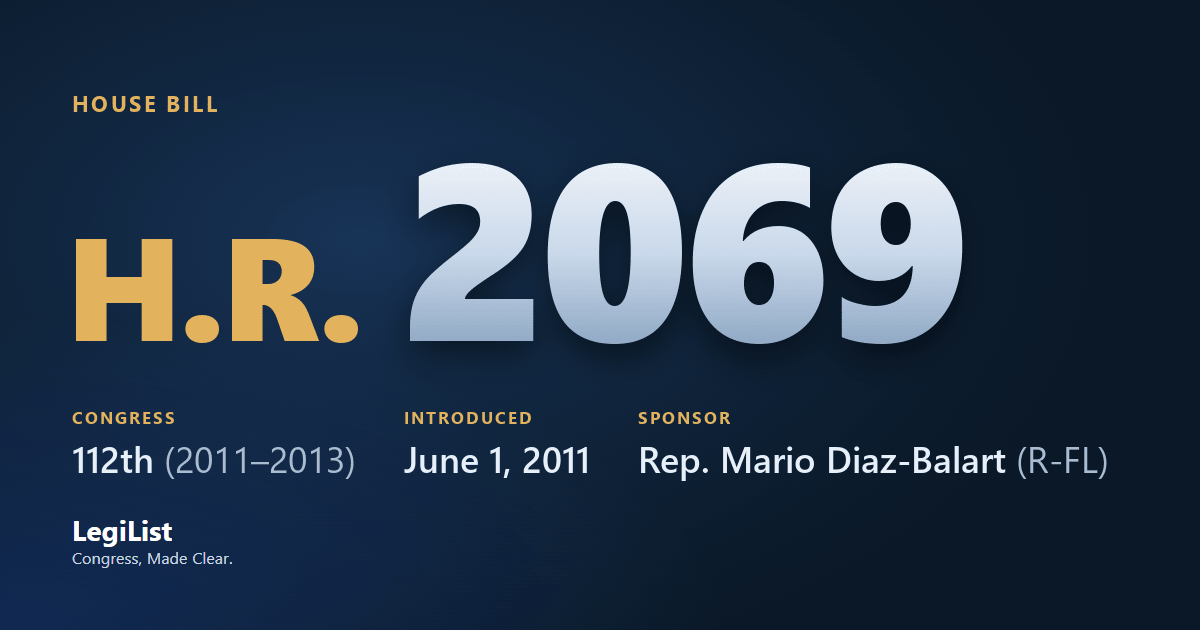
Safe Building Code Incentive Act of 2011
Latest action · Jun 2, 2011 Referred to the Subcommittee on Economic Development, Public Buildings and Emergency Management.
Progress
Where this bill reached, and when. A stage with no date was not reached; one that failed a vote and later carried shows the date it carried.
- IntroducedJun 1, 2011
- Passed HouseNot reached
- Passed SenateNot reached
- To the PresidentNot reached
- Became lawNot reached
Summary
Safe Building Code Incentive Act of 2011 - Amends the Robert T. Stafford Disaster Relief and Emergency Assistance Act to authorize the President to increase the maximum total of contributions for a major disaster by an amount equal to 4% of the estimated aggregate amount of grants to be made under the Act, if at the time of a declaration of a major disaster the affected state has in effect and is actively enforcing an approved state building code.
Requires a state, to be eligible for the increased federal share, to submit its state building code to the President for approval.
Directs the President to approve a state building code submitted upon determining that it: (1) is consistent with the most recent version of a nationally recognized model building code, (2) has been adopted by the state within six years of the most recent version of the nationally recognized code, and (3) uses the nationally recognized code as a minimum standard.
Requires the President, acting through the Administrator of the Federal Emergency Management Agency (FEMA), to set appropriate standards for the periodic update, resubmittal, and approval of state building codes, consistent with similar mitigation planning requirements under the Stafford Act.
Authorizes the use by states and local governments of technical and financial assistance to implement predisaster hazard mitigation measures to establish and operate a building department and carry out enforcement activities to implement an approved state building code.
Directs the President, in determining whether to provide technical and financial assistance to a state or local government, to take into account the extent to which that government is carrying out activities to implement an approved state building code.
Cosponsors 42
Members who signed on, in the order they did. Signatures ran from Jun 1, 2011 to Dec 20, 2012; 2 are original cosponsors, there from the day it was introduced.
| Seat | Cosponsor | Signed on | |
|---|---|---|---|
| D-NJ | Albio Sires | Original | Jun 1, 2011 |
| R-NY | Richard L. Hanna | Original | Jun 1, 2011 |
| R-FL | Steve Southerland II | Jun 2, 2011 | |
| D-CA | Bob Filner | Jun 23, 2011 | |
| R-FL | Jeff Miller | Jul 6, 2011 | |
| R-FL | Allen B. West | Jul 12, 2011 | |
| R-FL | David Rivera | Jul 12, 2011 | |
| D-DC | Eleanor Holmes Norton | Jul 25, 2011 | |
| R-NY | Christopher P. Gibson | Sep 8, 2011 | |
| D-WA | Rick Larsen | Sep 14, 2011 | |
| R-MI | Candice S. Miller | Oct 7, 2011 | |
| R-NY | Peter T. King | Oct 26, 2011 | |
| R-FL | Dennis A. Ross | Nov 3, 2011 | |
| D-NY | Paul Tonko | Nov 16, 2011 | |
| D-NY | Yvette D. Clarke | Nov 30, 2011 | |
| R-NY | Nan A. S. Hayworth | Dec 2, 2011 | |
| D-NY | Edolphus Towns | Dec 6, 2011 | |
| R-FL | Thomas J. Rooney | Dec 13, 2011 | |
| D-NY | William L. Owens | Dec 13, 2011 | |
| R-FL | Daniel Webster | Dec 14, 2011 | |
| R-NY | Michael G. Grimm | Dec 16, 2011 | |
| R-IN | Todd Young | Feb 15, 2012 | |
| D-MO | Russ Carnahan | Mar 5, 2012 | |
| D-NJ | Frank Pallone, Jr. | Apr 26, 2012 | |
| D-NJ | Robert E. Andrews | Apr 26, 2012 | |
| R-OH | James B. Renacci | May 8, 2012 | |
| D-PA | Tim Holden | May 15, 2012 | |
| D-VA | Gerald E. Connolly | May 17, 2012 | |
| D-IA | David Loebsack | Jun 21, 2012 | |
| D-WA | Adam Smith | Jun 28, 2012 | |
| D-NY | Charles B. Rangel | Jul 23, 2012 | |
| R-PA | Michael G. Fitzpatrick | Jul 23, 2012 | |
| R-NC | Howard Coble | Sep 10, 2012 | |
| D-NY | Steve Israel | Sep 10, 2012 | |
| R-CA | Jeff Denham | Sep 18, 2012 | |
| D-ME | Michael H. Michaud | Sep 18, 2012 | |
| D-CA | Doris O. Matsui | Sep 21, 2012 | |
| D-CT | Joe Courtney | Sep 21, 2012 | |
| D-OR | Earl Blumenauer | Nov 29, 2012 | |
| D-NJ | Bill Pascrell, Jr. | Dec 12, 2012 | |
| R-OH | Steve Stivers | Dec 12, 2012 | |
| D-OK | Dan Boren | Dec 20, 2012 |
Committees 1
Where it was sent and what each committee and subcommittee did with it, in order.
| Chamber | Committee | What it did |
|---|---|---|
| House | Transportation and Infrastructure Committee | Referred Jun 1, 2011 |
| Economic Development, Public Buildings, and Emergency Management Subcommittee | Referred Jun 2, 2011 |
Actions 3
Everything that happened, newest first.
- Jun 2, 2011Referred to the Subcommittee on Economic Development, Public Buildings and Emergency Management.
- Jun 1, 2011Introduced in House
- Jun 1, 2011Referred to the House Committee on Transportation and Infrastructure.
Research
What has been written about this bill: committee reports, cost estimates, the sponsor’s authority statement, printed hearings and the Congressional Research Service’s work.
Constitutional authority
The sponsor’s statement, as printed in the page H3869.
Printed hearings 2
Hearings whose printed record names this bill, newest first: hearings on it, and wider hearings where it came up.
| Number | Hearing | Committee | Held |
|---|---|---|---|
| Serial No. 112-94 | A REVIEW OF BUILDING CODES AND MITIGATION EFFORTS TO HELP MINIMIZE THE COSTS ASSOCIATED WITH NATURAL DISASTERS120 pages | Transportation and Infrastructure Committee | Jul 24, 2012 |
| Serial No. 112-96 | THE NATIONAL PREPAREDNESS REPORT: ASSESSING THE STATE OF PREPAREDNESS57 pages | Homeland Security Committee | Jun 6, 2012 |
Titles 2
Every title it has carried, official and short, at each stage.
- Official Title as Introduced
- To amend the Robert T. Stafford Disaster Relief and Emergency Assistance Act to enhance existing programs providing mitigation assistance by encouraging States to adopt and actively enforce State building codes, and for other purposes.
- Short Titles as Introduced
- Safe Building Code Incentive Act of 2011
Subjects
Assigned by the Library of Congress. Policy area: Emergency Management.
Text 1
Each version as it was printed, newest first.
- Jun 1, 2011Introduced in House
Support LegiList
This page is free, carries no paywall, and is built and maintained by one person. If the record here is useful to you, a few dollars keeps it going.
Everything here is as published by Congress: the summary is the Congressional Research Service's, the action wording is the clerks', and the subjects are the Library of Congress's. How far it got is read from the actions themselves, taking the most recent one of each kind, so a bill that failed a vote and later passed is shown as having passed. Records come from this bill on Congress.gov and govinfo.gov; cost estimates are the Congressional Budget Office's, and the hearings are the printed hearings GovInfo publishes, which can appear months after the hearing.