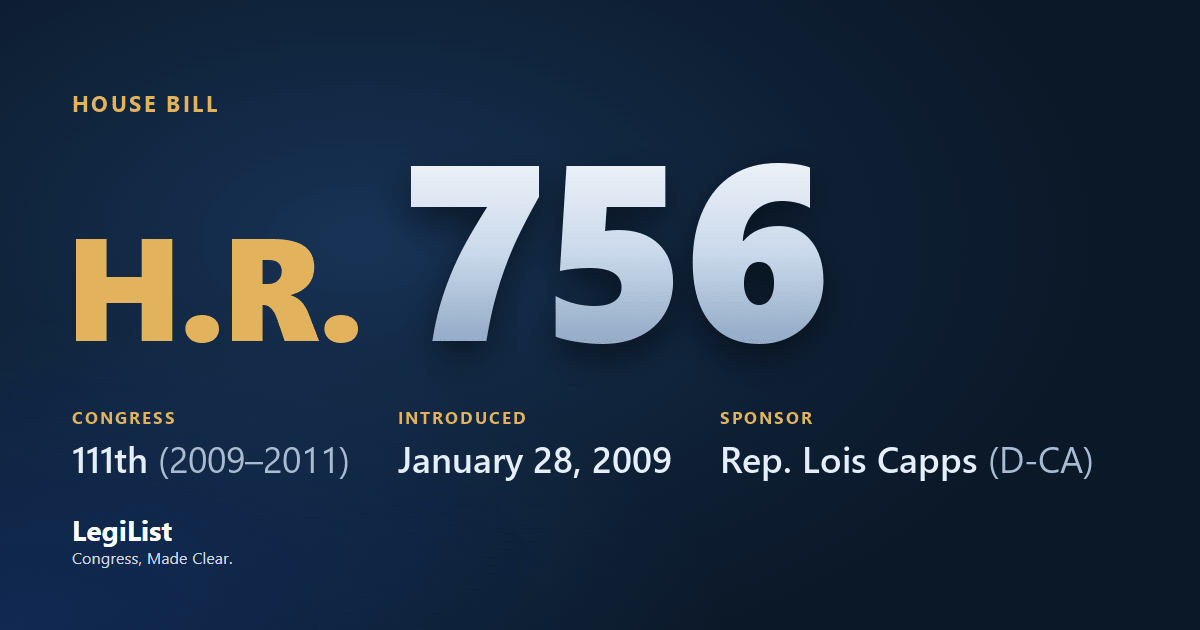
National Pain Care Policy Act of 2009
Latest action · Mar 31, 2009 Received in the Senate and Read twice and referred to the Committee on Health, Education, Labor, and Pensions.
Progress
Where this bill reached, and when. A stage with no date was not reached; one that failed a vote and later carried shows the date it carried.
- IntroducedJan 28, 2009
- Passed HouseMar 30, 2009
- Passed SenateNot reached
- To the PresidentNot reached
- Became lawNot reached
Summary
National Pain Care Policy Act of 2009 - (Sec. 2) Requires the Secretary of Health and Human Services to seek to enter into an agreement with the Institute of Medicine to convene a Conference on Pain to: (1) increase the recognition of pain as a significant public health problem in the United States; (2) evaluate the adequacy of assessment, diagnosis, treatment, and management of acute and chronic pain in the general population and in identified demographics groups that may be disproportionately affected by inadequacies; (3) identify barriers to appropriate pain care; and (4) establish an agenda for action to reduce such barriers and significantly improve the state of pain care research, education, and clinical care in the United States. Allows the Secretary to enter into an agreement with another appropriate entity if the Institute of Medicine declines. Requires a report summarizing the Conference's findings and recommendations to be submitted to Congress. Authorizes appropriations for FY2010-FY2011.
(Sec. 3) Amends the Public Health Service Act to require the Director of the National Institutes of Health (NIH) to continue and expand, through the Pain Consortium, an aggressive program of basic and clinical research on the causes of and potential treatments for pain. Requires the Pain Consortium to develop and submit to the Director of NIH recommendations on appropriate pain research initiatives that could be undertaken with funds available for such initiatives.
Requires the Secretary to establish the Interagency Pain Research Coordinating Committee to coordinate all efforts within Department of Health and Human Services (HHS) and other federal agencies that relate to pain research. Directs the Committee to: (1) develop a summary of advances in federal pain care research relevant to the diagnosis, prevention, and treatment of pain and diseases and disorders associated with pain; and (2) identify critical gaps in basic and clinical research on the symptoms and causes of pain. Requires the Secretary to review the necessity of the Committee at least once every two years.
(Sec. 4) Allows the Secretary to make awards of grants, cooperative agreements, and contracts to health professions schools, hospices, and other public and private entities for the development and implementation of programs to provide education and training to health care professionals in pain care. Sets forth information and education that must be included in the program as a condition for receiving a grant. Authorizes appropriations for FY2010-FY2012.
(Sec. 5) Requires the Secretary to establish and implement a national pain care education outreach and awareness campaign to educate consumers, patients, their families, and other caregivers with respect to: (1) the incidence and importance of pain as a national public health problem; (2) the adverse physical, psychological, emotional, societal, and financial consequences that can result if pain is not appropriately assessed, diagnosed, treated, or managed; (3) the availability, benefits, and risks of all pain treatment and management options; and (4) having pain promptly assessed, appropriately diagnosed, treated, and managed and regularly reassessed with treatment adjusted as needed. Requires the Secretary, in designing such campaign, to: (1) take into account the special needs of geographic areas and underserved demographic groups; and (2) provide resources that will reduce disparities in access to appropriate diagnosis, assessment, and treatment. Authorizes appropriations for FY2010-FY2012.
Cosponsors 15
Members who signed on, in the order they did. Signatures ran from Jan 28, 2009 to Mar 4, 2009; 1 is an original cosponsor, there from the day it was introduced.
| Seat | Cosponsor | Signed on | |
|---|---|---|---|
| R-MI | Mike Rogers | Original | Jan 28, 2009 |
| D-TN | Bart Gordon | Feb 24, 2009 | |
| R-MI | Thaddeus G. McCotter | Feb 24, 2009 | |
| D-OH | Betty Sutton | Mar 2, 2009 | |
| D-OH | Marcy Kaptur | Mar 2, 2009 | |
| D-WI | Tammy Baldwin | Mar 2, 2009 | |
| D-IA | David Loebsack | Mar 3, 2009 | |
| D-MA | Edward J. Markey | Mar 3, 2009 | |
| D-TX | Gene Green | Mar 3, 2009 | |
| D-MA | James P. McGovern | Mar 3, 2009 | |
| D-IL | Janice D. Schakowsky | Mar 3, 2009 | |
| D-PA | Joe Sestak | Mar 3, 2009 | |
| D-CA | Zoe Lofgren | Mar 3, 2009 | |
| D-TX | Charles A. Gonzalez | Mar 4, 2009 | |
| D-AZ | Raúl M. Grijalva | Mar 4, 2009 |
Committees 2
Where it was sent and what each committee and subcommittee did with it, in order.
| Chamber | Committee | What it did |
|---|---|---|
| House | Energy and Commerce Committee | Referred Jan 28, 2009Markup Mar 4, 2009Reported Mar 23, 2009 |
| Health Subcommittee | Referred Jan 29, 2009Discharged Mar 4, 2009 | |
| Senate | Health, Education, Labor, and Pensions Committee | Referred Mar 31, 2009 |
Actions 14
Everything that happened, newest first.
- Mar 31, 2009Received in the Senate and Read twice and referred to the Committee on Health, Education, Labor, and Pensions.
- Mar 30, 2009Mr. Pallone moved to suspend the rules and pass the bill, as amended.
- Mar 30, 2009Considered under suspension of the rules. (consideration: CR H4079-4081)
- Mar 30, 2009DEBATE - The House proceeded with forty minutes of debate on H.R. 756.
- Mar 30, 2009Passed/agreed to in House: On motion to suspend the rules and pass the bill, as amended Agreed to by voice vote. (text: CR H4079-4081)
- Mar 30, 2009Motion to reconsider laid on the table Agreed to without objection.
- Mar 23, 2009Reported by the Committee on Energy and Commerce. H. Rept. 111-47.
- Mar 23, 2009Placed on the Union Calendar, Calendar No. 17.
- Mar 4, 2009Subcommittee on Health Discharged.
- Mar 4, 2009Committee Consideration and Mark-up Session Held.
- Mar 4, 2009Ordered to be Reported by Voice Vote.
- Jan 29, 2009Referred to the Subcommittee on Health.
- Jan 28, 2009Introduced in House
- Jan 28, 2009Referred to the House Committee on Energy and Commerce.
In the Congressional Record 2
Days the Record’s own index lists this bill, newest first, with the pages and the members it names. Pages starting H are the House, S the Senate, E Extensions of Remarks.
| Where | In the Record | Members | Date |
|---|---|---|---|
| Extensions | Debate and remarks E832 | Sheila Jackson Lee D-TX | Mar 31, 2009 |
| House | Debate and remarks H4079–H4081Text printed H4079–H4081 | Frank Pallone, Jr. D-NJ, Lois Capps D-CA, Steve Scalise R-LA | Mar 30, 2009 |
Research
What has been written about this bill: committee reports, cost estimates, the sponsor’s authority statement, printed hearings and the Congressional Research Service’s work.
Committee report
Congressional Budget Office cost estimates 2
- Mar 20, 2009H.R. 756, National Pain Care Policy Act of 2009<p>Cost estimate for the bill as ordered reported by the House Committee on Energy and Commerce on March 4, 2009</p>
- Mar 20, 2009H.R. 756, National Pain Care Policy Act of 2009Cost estimate for the bill as ordered reported by the House Committee on Energy and Commerce on March 4, 2009
Related bills 1
Companion bills and other measures the record links to this one.
| Bill | Title | Relationship | Latest action |
|---|---|---|---|
| S 660 | National Pain Care Policy Act of 2009 | Related bill | Mar 19, 2009 |
Titles 4
Every title it has carried, official and short, at each stage.
- Official Title as Introduced
- To amend the Public Health Service Act with respect to pain care.
- Short Titles as Introduced
- National Pain Care Policy Act of 2009
- Short Titles as Reported to House
- National Pain Care Policy Act of 2009
- Short Titles as Passed House
- National Pain Care Policy Act of 2009
Subjects
Assigned by the Library of Congress. Policy area: Health.
- Department of Health and Human Services
- Education programs funding
- Executive agency funding and structure
- Government information and archives
- Health
- Health care coverage and access
- Health information and medical records
- Health programs administration and funding
- Health promotion and preventive care
- Medical education
- Medical research
- Neurological disorders
- Research administration and funding
Text 4
Each version as it was printed, newest first.
- Mar 31, 2009Referred in Senate
- Mar 30, 2009Engrossed in House
- Mar 23, 2009Reported in House
- Jan 28, 2009Introduced in House
Everything here is as published by Congress: the summary is the Congressional Research Service's, the action wording is the clerks', and the subjects are the Library of Congress's. How far it got is read from the actions themselves, taking the most recent one of each kind, so a bill that failed a vote and later passed is shown as having passed. Records come from this bill on Congress.gov and govinfo.gov; cost estimates are the Congressional Budget Office's, and the hearings are the printed hearings GovInfo publishes, which can appear months after the hearing.