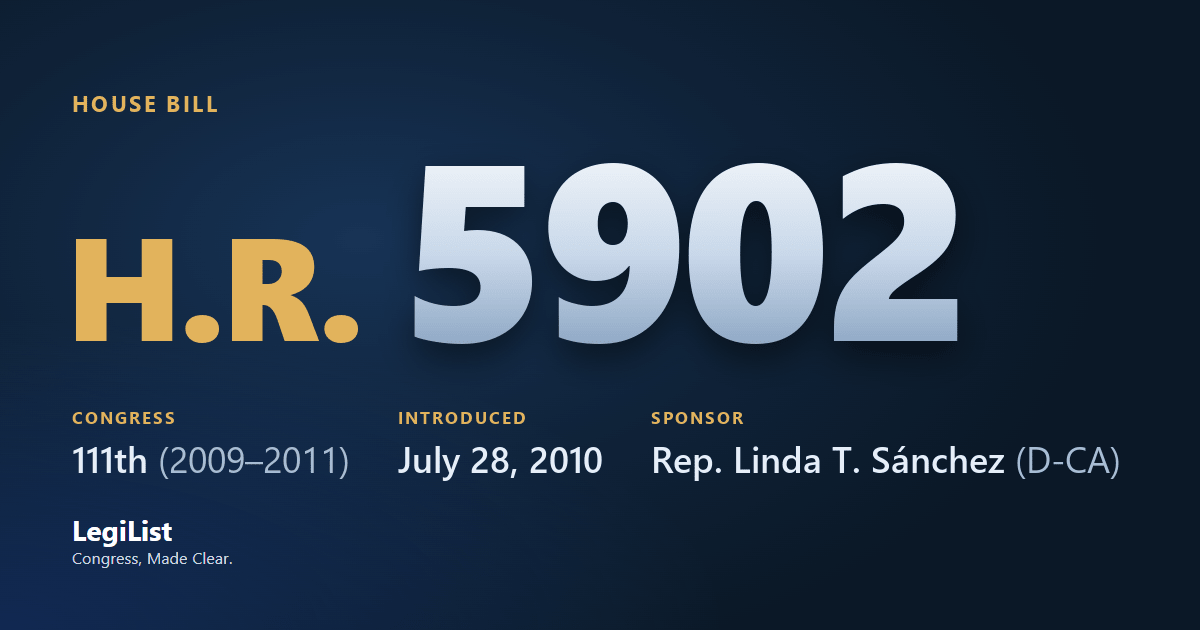
Direct Care Workforce Empowerment Act
Latest action · Oct 13, 2010 Referred to the Subcommittee on Workforce Protections.
Progress
Where this bill reached, and when. A stage with no date was not reached; one that failed a vote and later carried shows the date it carried.
- IntroducedJul 28, 2010
- Passed HouseNot reached
- Passed SenateNot reached
- To the PresidentNot reached
- Became lawNot reached
Summary
Direct Care Workforce Empowerment Act - Amends the Fair Labor Standards Act of 1938 to exempt from minimum wage and maximum hour requirements any employee employed on a casual basis in domestic service employment to provide companionship services for individuals who because of disability (or because of age or infirmity, as under current law) are unable to care for themselves.
Directs the Secretary of Health and Human Services (HHS) to establish: (1) a direct care workforce monitoring program; and (2) a National Advisory Council on the Direct Care Workforce.
Directs the Secretary to award three-year grants to states and other eligible entities to improve the recruitment, retention, and education of the direct care workforce.
Cosponsors 35
Members who signed on, in the order they did. Signatures ran from Jul 28, 2010 to Sep 29, 2010; 28 are original cosponsors, there from the day it was introduced.
| Seat | Cosponsor | Signed on | |
|---|---|---|---|
| D-NJ | Albio Sires | Original | Jul 28, 2010 |
| D-FL | Alcee L. Hastings | Original | Jul 28, 2010 |
| D-CA | Barbara Lee | Original | Jul 28, 2010 |
| D-OH | Betty Sutton | Original | Jul 28, 2010 |
| D-MA | Bill Delahunt | Original | Jul 28, 2010 |
| D-CA | Bob Filner | Original | Jul 28, 2010 |
| D-IA | Bruce L. Braley | Original | Jul 28, 2010 |
| D-PA | Chaka Fattah | Original | Jul 28, 2010 |
| D-ME | Chellie Pingree | Original | Jul 28, 2010 |
| D-IA | David Loebsack | Original | Jul 28, 2010 |
| D-OR | David Wu | Original | Jul 28, 2010 |
| D-MD | Donna F. Edwards | Original | Jul 28, 2010 |
| D-RI | James R. Langevin | Original | Jul 28, 2010 |
| D-IL | Janice D. Schakowsky | Original | Jul 28, 2010 |
| D-WA | Jim McDermott | Original | Jul 28, 2010 |
Committees 2
Where it was sent and what each committee and subcommittee did with it, in order.
| Chamber | Committee | What it did |
|---|---|---|
| House | Education and Workforce Committee | Referred Jul 28, 2010 |
| Workforce Protections Subcommittee | Referred Oct 13, 2010 | |
| House | Energy and Commerce Committee | Referred Jul 28, 2010 |
Actions 6
Everything that happened, newest first.
- Oct 13, 2010Referred to the Subcommittee on Workforce Protections.
- Jul 28, 2010Introduced in House
- Jul 28, 2010Sponsor introductory remarks on measure. (CR E1458)
- Jul 28, 2010Referred to House Education and Labor
- Jul 28, 2010Referred to the Committee on Education and Labor, and in addition to the Committee on Energy and Commerce, for a period to be subsequently determined by the Speaker, in each case for consideration of such provisions as fall within the jurisdiction of the committee concerned.
In the Congressional Record 1
Days the Record’s own index lists this bill, newest first, with the pages and the members it names. Pages starting H are the House, S the Senate, E Extensions of Remarks.
| Where | In the Record | Members | Date |
|---|---|---|---|
| Extensions | Debate and remarks E1458 | Linda T. Sánchez D-CA | Jul 28, 2010 |
Related bills 1
Companion bills and other measures the record links to this one.
| Bill | Title | Relationship | Latest action |
|---|---|---|---|
| S 3696 | Direct Care Workforce Empowerment Act | Identical bill | Aug 3, 2010 |
Titles 2
Every title it has carried, official and short, at each stage.
- Official Title as Introduced
- To amend the Fair Labor Standards Act with regard to certain exemptions under that Act for direct care workers and to improve the systems for the collection and reporting of data relating to the direct care workforce, and for other purposes.
- Short Titles as Introduced
- Direct Care Workforce Empowerment Act
Subjects
Assigned by the Library of Congress. Policy area: Health.
Text 1
Each version as it was printed, newest first.
- Jul 28, 2010Introduced in House
Support LegiList
This page is free, carries no paywall, and is built and maintained by one person. If the record here is useful to you, a few dollars keeps it going.
Everything here is as published by Congress: the summary is the Congressional Research Service's, the action wording is the clerks', and the subjects are the Library of Congress's. How far it got is read from the actions themselves, taking the most recent one of each kind, so a bill that failed a vote and later passed is shown as having passed. Records come from this bill on Congress.gov and govinfo.gov; cost estimates are the Congressional Budget Office's, and the hearings are the printed hearings GovInfo publishes, which can appear months after the hearing.