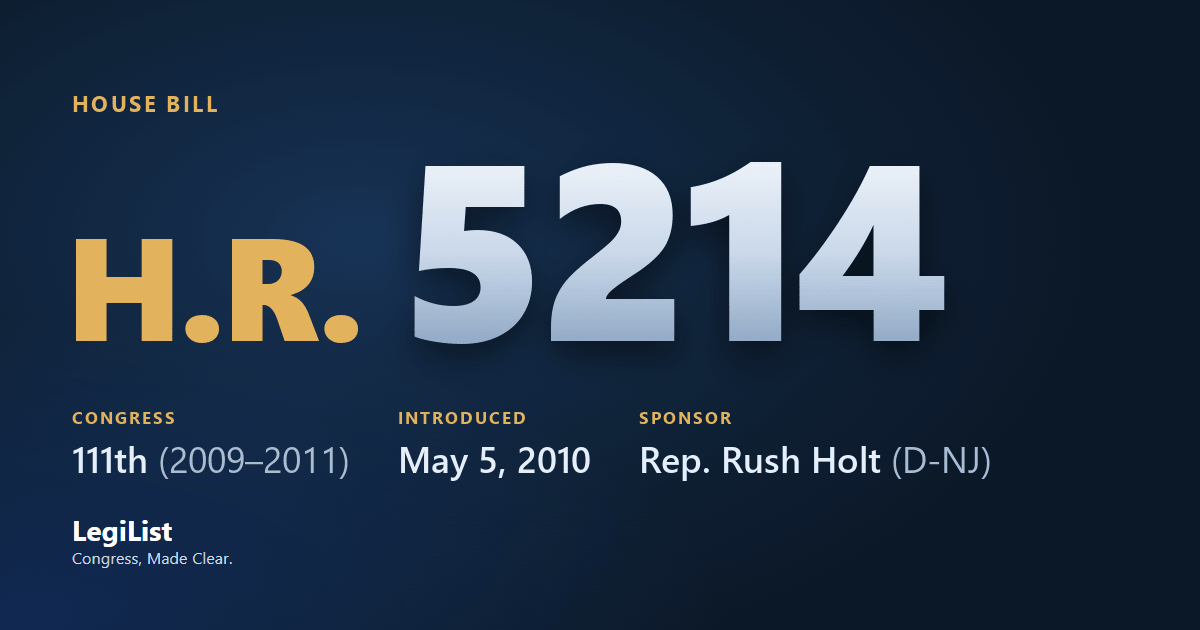
Big Oil Bailout Prevention Act of 2010
Latest action · May 6, 2010 Referred to the Subcommittee on Water Resources and Environment.
Progress
Where this bill reached, and when. A stage with no date was not reached; one that failed a vote and later carried shows the date it carried.
- IntroducedMay 5, 2010
- Passed HouseNot reached
- Passed SenateNot reached
- To the PresidentNot reached
- Became lawNot reached
Summary
Big Oil Bailout Prevention Act of 2010 - Amends the Oil Pollution Act of 1990 to: (1) increase the liability of the party responsible for an offshore facility, except a deepwater port, from which oil is discharged into or upon navigable waters or adjoining shorelines to the total of all discharge removal costs plus $10 billion (currently, $75 million) for each incident; and (2) direct the President to promulgate regulations to allow advance payments from the Oil Spill Liability Trust Fund to states and localities to prepare for and mitigate substantial threats from the discharge of oil.
Amends the Internal Revenue Code to eliminate: (1) the $1 billion per incident limitation on expenditures from the Oil Spill Liability Trust Fund for cleanup of oil spills: and (2) restrictions on the borrowing authority of such Trust Fund.
Makes this Act effective on April 15, 2010.
Cosponsors 85
Members who signed on, in the order they did. Signatures ran from May 5, 2010 to Jul 27, 2010; 9 are original cosponsors, there from the day it was introduced.
| Seat | Cosponsor | Signed on | |
|---|---|---|---|
| D-FL | Allen Boyd | Original | May 5, 2010 |
| D-AL | Artur Davis | Original | May 5, 2010 |
| D-IA | Bruce L. Braley | Original | May 5, 2010 |
| D-NJ | Frank Pallone, Jr. | Original | May 5, 2010 |
| D-WA | Jay Inslee | Original | May 5, 2010 |
| D-FL | Kendrick B. Meek | Original | May 5, 2010 |
| D-CA | Lois Capps | Original | May 5, 2010 |
| D-NH | Paul W. Hodes | Original | May 5, 2010 |
| D-FL | Suzanne M. Kosmas | Original | May 5, 2010 |
| D-KY | Ben Chandler | May 6, 2010 | |
| D-RI | James R. Langevin | May 6, 2010 | |
| D-NY | John J. Hall | May 6, 2010 | |
| D-MD | John P. Sarbanes | May 6, 2010 | |
| D-FL | Kathy Castor | May 6, 2010 | |
| D-NY | Maurice D. Hinchey | May 6, 2010 |
Committees 1
Where it was sent and what each committee and subcommittee did with it, in order.
| Chamber | Committee | What it did |
|---|---|---|
| House | Transportation and Infrastructure Committee | Referred May 5, 2010 |
| Coast Guard and Maritime Transportation Subcommittee | Referred May 6, 2010 | |
| Water Resources and Environment Subcommittee | Referred May 6, 2010 |
Actions 4
Everything that happened, newest first.
- May 6, 2010Referred to the Subcommittee on Coast Guard and Maritime Transportation.
- May 6, 2010Referred to the Subcommittee on Water Resources and Environment.
- May 5, 2010Introduced in House
- May 5, 2010Referred to the House Committee on Transportation and Infrastructure.
In the Congressional Record 2
Days the Record’s own index lists this bill, newest first, with the pages and the members it names. Pages starting H are the House, S the Senate, E Extensions of Remarks.
| Where | In the Record | Members | Date |
|---|---|---|---|
| House | Debate and remarks H6498 | Rush Holt D-NJ | Jul 30, 2010 |
| House | Debate and remarks H4381–H4383 | Earl Blumenauer D-OR, Gerald E. Connolly D-VA, Rush Holt D-NJ | Jun 10, 2010 |
Related bills 3
Companion bills and other measures the record links to this one.
| Bill | Title | Relationship | Latest action |
|---|---|---|---|
| S 3305 | Big Oil Bailout Prevention Unlimited Liability Act of 2010 | Related bill | Aug 5, 2010 |
| S 3306 | Big Oil Bailout Prevention Trust Fund Act of 2010 | Related bill | May 4, 2010 |
| S 3472 | Big Oil Bailout Prevention Unlimited Liability Act of 2010 | Related bill | Jun 9, 2010 |
Titles 2
Every title it has carried, official and short, at each stage.
- Official Title as Introduced
- To require oil polluters to pay the full cost of oil spills, and for other purposes.
- Short Titles as Introduced
- Big Oil Bailout Prevention Act of 2010
Subjects
Assigned by the Library of Congress. Policy area: Environmental Protection.
Text 1
Each version as it was printed, newest first.
- May 5, 2010Introduced in House
Support LegiList
This page is free, carries no paywall, and is built and maintained by one person. If the record here is useful to you, a few dollars keeps it going.
Everything here is as published by Congress: the summary is the Congressional Research Service's, the action wording is the clerks', and the subjects are the Library of Congress's. How far it got is read from the actions themselves, taking the most recent one of each kind, so a bill that failed a vote and later passed is shown as having passed. Records come from this bill on Congress.gov and govinfo.gov; cost estimates are the Congressional Budget Office's, and the hearings are the printed hearings GovInfo publishes, which can appear months after the hearing.