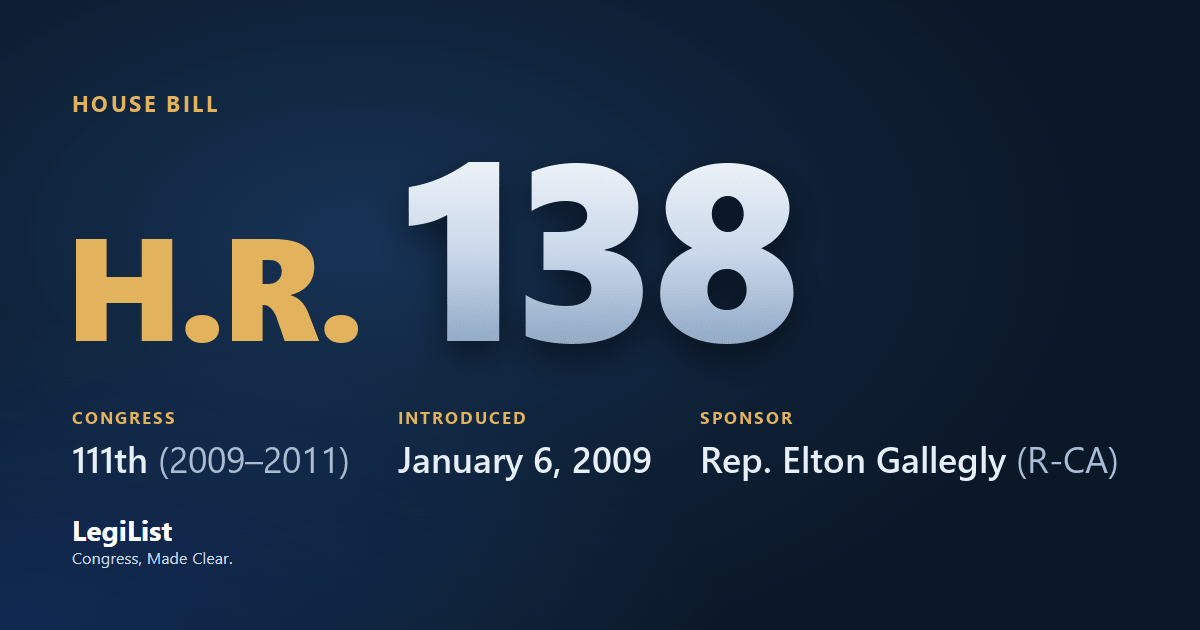
To require Federal contractors to participate in the basic pilot program for employment eligibility verification.
Latest action · Mar 16, 2009 Referred to the Subcommittee on Workforce Protections.
Progress
Where this bill reached, and when. A stage with no date was not reached; one that failed a vote and later carried shows the date it carried.
- IntroducedJan 6, 2009
- Passed HouseNot reached
- Passed SenateNot reached
- To the PresidentNot reached
- Became lawNot reached
Summary
Amends the the Illegal Immigration Reform and Immigrant Responsibility Act of 1996 to require federal contractors and subcontractors (as defined by this Act) to participate in the employment eligibility verification pilot program.
Directs the Attorney General to ensure that the pilot program is applied to all of the contractor's or subcontractor's employees and not just to those performing the contract or subcontract.
Cosponsors 15
Members who signed on, in the order they did. Signatures ran from Jan 7, 2009 to Jul 20, 2009.
| Seat | Cosponsor | Signed on | |
|---|---|---|---|
| R-CA | Brian P. Bilbray | Jan 7, 2009 | |
| R-CA | Dana Rohrabacher | Jan 7, 2009 | |
| R-CA | Edward R. Royce | Jan 7, 2009 | |
| R-TX | Michael T. McCaul | Jan 7, 2009 | |
| R-TX | Ted Poe | Jan 7, 2009 | |
| R-MI | Thaddeus G. McCotter | Jan 7, 2009 | |
| R-TN | Marsha Blackburn | Jan 9, 2009 | |
| R-NC | Sue Wilkins Myrick | Jan 9, 2009 | |
| R-GA | Jack Kingston | Jan 13, 2009 | |
| R-FL | Ginny Brown-Waite | Jan 15, 2009 | |
| R-AR | John Boozman | Jan 22, 2009 | |
| R-CA | Gary G. Miller | Jan 28, 2009 | |
| R-CA | Ken Calvert | Jan 28, 2009 | |
| R-LA | Rodney Alexander | Feb 23, 2009 | |
| R-KS | Jerry Moran | Jul 20, 2009 |
Committees 3
Where it was sent and what each committee and subcommittee did with it, in order.
| Chamber | Committee | What it did |
|---|---|---|
| House | Judiciary Committee | Referred Jan 6, 2009 |
| Immigration Integrity, Security, and Enforcement Subcommittee | Referred Feb 9, 2009 | |
| House | Education and Workforce Committee | Referred Jan 6, 2009 |
| Workforce Protections Subcommittee | Referred Mar 16, 2009 | |
| House | Homeland Security Committee | Exchange of letters Sep 22, 2010 |
Actions 6
Everything that happened, newest first.
- Mar 16, 2009Referred to the Subcommittee on Workforce Protections.
- Feb 9, 2009Referred to the Subcommittee on Immigration, Citizenship, Refugees, Border Security, and International Law.
- Jan 6, 2009Introduced in House
- Jan 6, 2009Referred to House Judiciary
- Jan 6, 2009Referred to the Committee on the Judiciary, and in addition to the Committee on Education and Labor, for a period to be subsequently determined by the Speaker, in each case for consideration of such provisions as fall within the jurisdiction of the committee concerned.
- Jan 6, 2009Referred to House Education and Labor
Research
What has been written about this bill: committee reports, cost estimates, the sponsor’s authority statement, printed hearings and the Congressional Research Service’s work.
Printed hearings 1
Hearings whose printed record names this bill, newest first: hearings on it, and wider hearings where it came up.
| Number | Hearing | Committee | Held |
|---|---|---|---|
| Serial No. 111-130 | EXAMINING LOCAL EFFORTS TO ADDRESS THE CONTINUING FORECLOSURE CRISIS: PERSPECTIVES FROM CLEVELAND, OH163 pages | Oversight and Government Reform Committee | Dec 7, 2009 |
Titles 1
Every title it has carried, official and short, at each stage.
- Official Title as Introduced
- To require Federal contractors to participate in the basic pilot program for employment eligibility verification.
Subjects
Assigned by the Library of Congress. Policy area: Immigration.
Text 1
Each version as it was printed, newest first.
- Jan 6, 2009Introduced in House
Support LegiList
This page is free, carries no paywall, and is built and maintained by one person. If the record here is useful to you, a few dollars keeps it going.
Everything here is as published by Congress: the summary is the Congressional Research Service's, the action wording is the clerks', and the subjects are the Library of Congress's. How far it got is read from the actions themselves, taking the most recent one of each kind, so a bill that failed a vote and later passed is shown as having passed. Records come from this bill on Congress.gov and govinfo.gov; cost estimates are the Congressional Budget Office's, and the hearings are the printed hearings GovInfo publishes, which can appear months after the hearing.