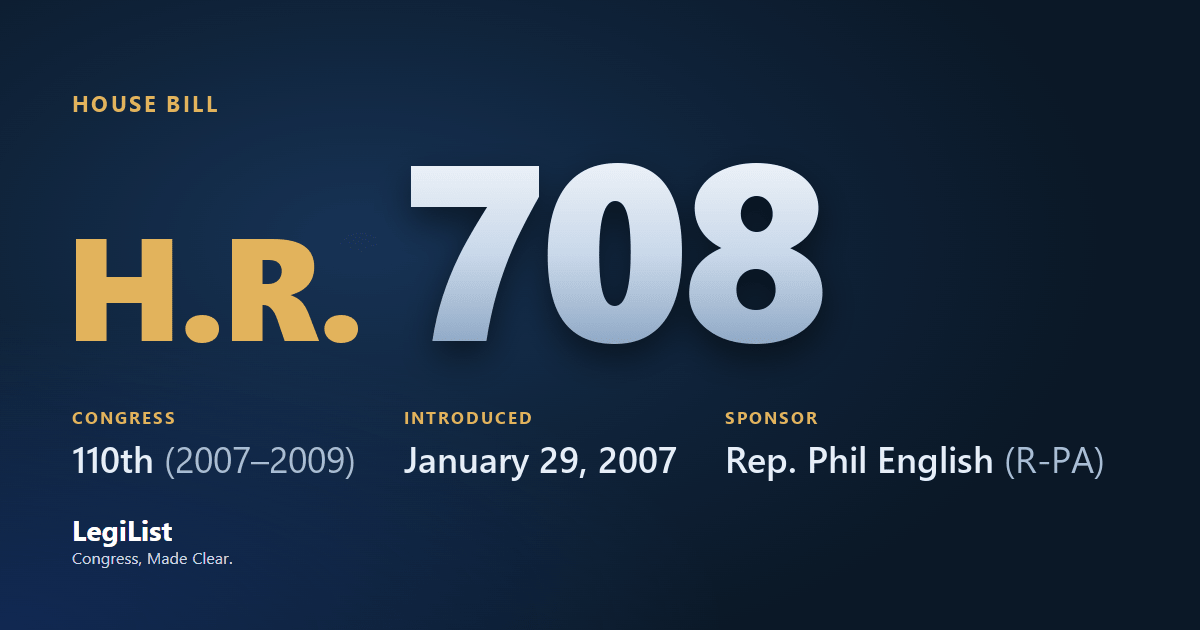
Trade Law Reform Act of 2007
Latest action · Jan 29, 2007 Referred to the Committee on Ways and Means, and in addition to the Committee on Rules, for a period to be subsequently determined by the Speaker, in each case for consideration of such provisions as fall within the jurisdiction of the committee concerned.
Progress
Where this bill reached, and when. A stage with no date was not reached; one that failed a vote and later carried shows the date it carried.
- IntroducedJan 29, 2007
- Passed HouseNot reached
- Passed SenateNot reached
- To the PresidentNot reached
- Became lawNot reached
Summary
Trade Law Reform Act of 2007 - Amends the Tariff Act of 1930 to revise factors that the International Trade Commission (ITC) must consider in making material injury determinations in countervailing duty and antidumping duty proceedings.
Repeals the one-year monitoring program for cases involving persistent dumping. Requires initiation of an expedited antidumping duty investigation in such cases.
Modifies certain factors used to value freight for imputs in nonmarket economy country antidumping calculations.
Requires enactment of a joint resolution by Congress before revocation of a foreign country as a nonmarket economy country. (Currently, the administering authority has power to make such a revocation without prior congressional approval.)
Applies countervailing duty provisions to nonmarket economy countries.
Requires the imposition of an antidumping duty on imported merchandise that is made up (downstream dumping) of one or more depressed-price products (a product purchased at a price that is lower than the generally available price of the product in the country of manufacture or at a price that is lower due to subsidies or sales at below foreign market for such product) if a U.S. industry producing a product used in the manufacture of such merchandise has been materially injured or threatened with material injury or the establishment of such industry has been materially retarded.
Amends the Trade Act of 1974 to change the standard for determining if an imported product is harming domestic producers by requiring a showing that the product causes or threatens to cause serious injury. (Current law requires a product to be a substantial cause of injury).
Amends the Trade Act of 2002 to: (1) urge the U.S. Trade Representative (USTR) to reject any trade agreement proposal, whether through the World Trade Organization (WTO) or with any country, that would weaken existing U.S. trade remedy laws; and (2) increase the President's reporting duties under such Act.
Congressional Advisory Commission on WTO Dispute Settlement Act - Establishes the Congressional Advisory Commission on WTO Dispute Settlement.
Makes permanent a certain steel import licensing and monitoring program.
Applies the amendments made by this Act to goods from Canada and Mexico.
Requires participation in WTO consultations and panel proceedings of certain private U.S. persons supportive of the government's position before a dispute settlement panel or Appellate Body of the WTO where the USTR seeks to: (1) enforce U.S. rights under a multilateral trade agreement; or (2) defend a challenged action or determination of the U.S. government.
Cosponsors 2
Members who signed on, in the order they did. Signatures ran from Mar 8, 2007 to Mar 28, 2007.
| Seat | Cosponsor | Signed on | |
|---|---|---|---|
| R-MI | Thaddeus G. McCotter | Mar 8, 2007 | |
| R-NY | John M. McHugh | Mar 28, 2007 |
Committees 2
Where it was sent and what each committee and subcommittee did with it, in order.
| Chamber | Committee | What it did |
|---|---|---|
| House | Ways and Means Committee | Referred Jan 29, 2007 |
| House | Rules Committee | Referred Jan 29, 2007 |
Actions 2
Everything that happened, newest first.
- Jan 29, 2007Introduced in House
- Jan 29, 2007Referred to the Committee on Ways and Means, and in addition to the Committee on Rules, for a period to be subsequently determined by the Speaker, in each case for consideration of such provisions as fall within the jurisdiction of the committee concerned.
Research
What has been written about this bill: committee reports, cost estimates, the sponsor’s authority statement, printed hearings and the Congressional Research Service’s work.
Printed hearings 1
Hearings whose printed record names this bill, newest first: hearings on it, and wider hearings where it came up.
| Number | Hearing | Committee | Held |
|---|---|---|---|
| Serial No. 110-52 | LEGISLATION RELATED TO TRADE WITH CHINA185 pages | Ways and Means Committee | Aug 2, 2007 |
CRS reports 1
Congressional Research Service work that CRS links to this bill or the law it became, newest first.
Cite it 1
Products on other subjects that cite it, usually among other measures.
| Product | Title | Kind | Published |
|---|---|---|---|
| RL34106 | U.S. Clothing and Textile Trade with China and the World: Trends Since the End of Quotas Archived | Report | Jul 10, 2007 |
Titles 3
Every title it has carried, official and short, at each stage.
- Official Title as Introduced
- To amend United States trade laws to address more effectively import crises, and for other purposes.
- Short Titles as Introduced
- Trade Law Reform Act of 2007
- Short Titles as Introduced for portions of this bill
- Congressional Advisory Commission on WTO Dispute Settlement Act
Subjects
Assigned by the Library of Congress. Policy area: Foreign Trade and International Finance.
- Administrative remedies
- Agriculture and Food
- Agriculture in foreign trade
- Armed Forces and National Security
- Canada
- Commerce
- Confidential communications
- Congress
- Congress and foreign policy
- Congressional oversight
- Congressional reporting requirements
- Costs
- Countervailing duties
- Dispute settlement
- Dumping
- Economics and Public Finance
- Evidence (Law)
- Expedited congressional procedure
- Federal advisory bodies
- Foreign Trade and International Finance
- Free trade
- Government Operations and Politics
- Government paperwork
- Government publicity
- Governmental investigations
- House rules and procedure
- Import relief
- Import restrictions
- Imports
- International Affairs
- International agencies
- Iron and steel industry
- Latin America
- Law
- Legislative resolutions
- Licenses
- Mexico
- Office of the U.S. Trade Representative
- Parties to actions
- President and foreign policy
- Prices
- Senate rules and procedure
- Steel
- Subsidies
- Tariff
- Trade agreements
- Trade negotiations
- Transportation and Public Works
- U.S. International Trade Commission
Text 1
Each version as it was printed, newest first.
- Jan 29, 2007Introduced in House
Support LegiList
This page is free, carries no paywall, and is built and maintained by one person. If the record here is useful to you, a few dollars keeps it going.
Everything here is as published by Congress: the summary is the Congressional Research Service's, the action wording is the clerks', and the subjects are the Library of Congress's. How far it got is read from the actions themselves, taking the most recent one of each kind, so a bill that failed a vote and later passed is shown as having passed. Records come from this bill on Congress.gov and govinfo.gov; cost estimates are the Congressional Budget Office's, and the hearings are the printed hearings GovInfo publishes, which can appear months after the hearing.