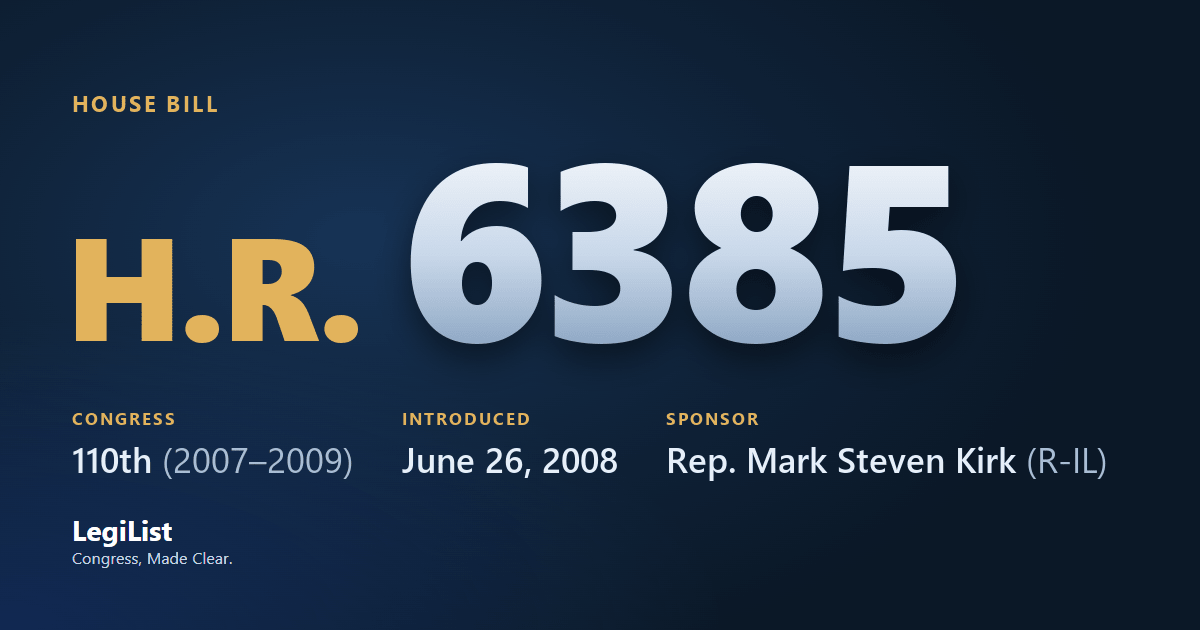
Apollo Energy Independence Act of 2008
Latest action · Nov 19, 2008 Referred to the Subcommittee on General Farm Commodities and Risk Management.
Progress
Where this bill reached, and when. A stage with no date was not reached; one that failed a vote and later carried shows the date it carried.
- IntroducedJun 26, 2008
- Passed HouseNot reached
- Passed SenateNot reached
- To the PresidentNot reached
- Became lawNot reached
Summary
Apollo Energy Independence Act of 2008 - Amends the Internal Revenue Code to provide tax incentives for energy conservation and production, including provisions to: (1) make permanent the tax credit for producing electricity from renewable resources and to include marine and hydrokinetic renewable energy as a resource for purposes of such credit; (2) make permanent the energy tax credit for solar energy, fuel cell, and microturbine property; (3) allow a new energy tax credit for combined heat and power system property; (4) provide for the issuance of new clean renewable energy bonds; (5) increase the tax credit for advanced nuclear power production; (6) make permanent the tax credits for residential energy efficient property, energy efficiency existing homes, the production of energy efficient household appliances, and the tax deduction for energy efficient commercial buildings; (7) allow tax credits for new alternative motor vehicles, including qualified plug-in electric drive motor vehicles, vehicles that achieve a fuel economy standard of 100 miles per gallon, and advanced technology motor vehicles; (8) allow tax credits for the production of cellulosic biofuel and for hydrogen infrastructure costs; (9) increase and make permanent the tax credit for alternative fuel vehicle refueling property expenditures; and (10) allow employers a tax credit for providing transit passes to employees.
Amends the Energy Policy Act of 2005 to provide full loan guarantees for the construction of advanced nuclear energy facilities.
Establishes in the Treasury the Petroleum Reduction Trust Fund. Allocates 90% of civil penalties for automobile fuel economy violations to such Fund for retail purchases of ethanol, biodiesel, and other alternative fuels.
Directs the Secretary of Energy to: (1) carry out research programs for onboard storage of hydrogen in light-duty motor vehicles and for the development of plug-in electric drive vehicle technology; and (2) study daily and seasonal energy costs in public schools.
Amends the Harmonized Tariff Schedule of the United States to extend the tariff duty on ethanol until December 31, 2010.
Directs the Administrator of the Environmental Protection Agency (EPA) to establish a grant program for green school construction and improvement.
Sets forth revenue offset provisions, including: (1) a moratorium on earmarks in the 110th Congress; (2) establishment of fees for oil and gas leases in the Gulf of Mexico and user fees for certain food safety and inspection services; (3) a reduction in payments under the Department of Agriculture commodity program; (4) consolidation of Department of Defense exchange stores system; and (5) a limitation of universal service fund support.
Cosponsors 3
Members who signed on, in the order they did. Signatures ran from Jun 26, 2008 to Sep 8, 2008; 2 are original cosponsors, there from the day it was introduced.
| Seat | Cosponsor | Signed on | |
|---|---|---|---|
| R-CT | Christopher Shays | Original | Jun 26, 2008 |
| R-IL | Judy Biggert | Original | Jun 26, 2008 |
| R-WA | David G. Reichert | Sep 8, 2008 |
Committees 9
Where it was sent and what each committee and subcommittee did with it, in order.
| Chamber | Committee | What it did |
|---|---|---|
| House | Energy and Commerce Committee | Referred Jun 26, 2008 |
| Energy Subcommittee | Referred Jun 26, 2008 | |
| House | Ways and Means Committee | Referred Jun 26, 2008 |
| House | Science, Space, and Technology Committee | Referred Jun 26, 2008 |
| House | Education and Workforce Committee | Referred Jun 26, 2008 |
| House | Rules Committee | Referred Jun 26, 2008 |
| House | Natural Resources Committee | Referred Jun 26, 2008 |
| Energy and Mineral Resources Subcommittee | Referred Jul 2, 2008 | |
| House | Agriculture Committee | Referred Jun 26, 2008 |
| General Farm Commodities, Risk Management, and Credit Subcommittee | Referred Nov 19, 2008 | |
| House | Armed Services Committee | Referred Jun 26, 2008 |
| Readiness Subcommittee | Referred Jul 16, 2008 | |
| House | Budget Committee | Referred Jun 26, 2008 |
Actions 7
Everything that happened, newest first.
- Nov 19, 2008Referred to the Subcommittee on General Farm Commodities and Risk Management.
- Jul 16, 2008Referred to the Subcommittee on Readiness.
- Jul 2, 2008Referred to the Subcommittee on Energy and Mineral Resources.
- Jun 26, 2008Introduced in House
- Jun 26, 2008Sponsor introductory remarks on measure. (CR E1366-1367)
In the Congressional Record 2
Days the Record’s own index lists this bill, newest first, with the pages and the members it names. Pages starting H are the House, S the Senate, E Extensions of Remarks.
Titles 2
Every title it has carried, official and short, at each stage.
- Official Title as Introduced
- To provide a large-scale national effort to improve the state of our national security, economy and environment by providing market incentives to produce and deploy alternative energy solutions and reduce our dependence on foreign oil.
- Short Titles as Introduced
- Apollo Energy Independence Act of 2008
Subjects
Assigned by the Library of Congress. Policy area: Energy.
- Agricultural subsidies
- Agricultural wastes
- Agriculture and Food
- Alcohol as fuel
- Alternative energy sources
- Armed Forces and National Security
- Biomass energy
- Bonds
- Building construction
- Cellulose
- Cogeneration of electric power and heat
- Commerce
- Commuting
- Cost accounting
- Diesel motor
- Economics and Public Finance
- Education
- Electric appliances
- Electric power production
- Electric vehicles
- Elementary and secondary education
- Employee benefit plans
- Energy
- Energy conservation
- Energy crops
- Energy development
- Energy efficiency
- Energy research
- Energy storage
- Environmental Protection
- Environmental technology
- Federal aid to education
- Federally-guaranteed loans
- Fees
- Finance and Financial Sector
- Fines (Penalties)
- Food safety
- Foreign Trade and International Finance
- Fuel cells
- Fuel consumption
- Government spending reductions
- Government trust funds
- Governmental investigations
- Green products
- Gulf of Mexico
- High technology
- Housing and Community Development
- Hydroelectric power
- Hydrogen
- Income tax
- Industrial buildings
- Labor and Employment
- Marine and coastal resources, fisheries
- Natural gas
- Natural gas vehicles
- Nuclear energy
- Nuclear power plants
- Ocean energy resources
- Oil and gas leases
- Oils and fats
- Petroleum
- Post exchanges
- Public schools
- Refuse as fuel
- Research and development
- School buildings
- Science, Technology, Communications
- Service stations
- Solar energy
- Tariff
- Tax credits
- Tax deductions
- Taxation
- Telecommunication rates
- Transportation and Public Works
- Travel costs
- User charges
Text 1
Each version as it was printed, newest first.
- Jun 26, 2008Introduced in House
Support LegiList
This page is free, carries no paywall, and is built and maintained by one person. If the record here is useful to you, a few dollars keeps it going.
Everything here is as published by Congress: the summary is the Congressional Research Service's, the action wording is the clerks', and the subjects are the Library of Congress's. How far it got is read from the actions themselves, taking the most recent one of each kind, so a bill that failed a vote and later passed is shown as having passed. Records come from this bill on Congress.gov and govinfo.gov; cost estimates are the Congressional Budget Office's, and the hearings are the printed hearings GovInfo publishes, which can appear months after the hearing.