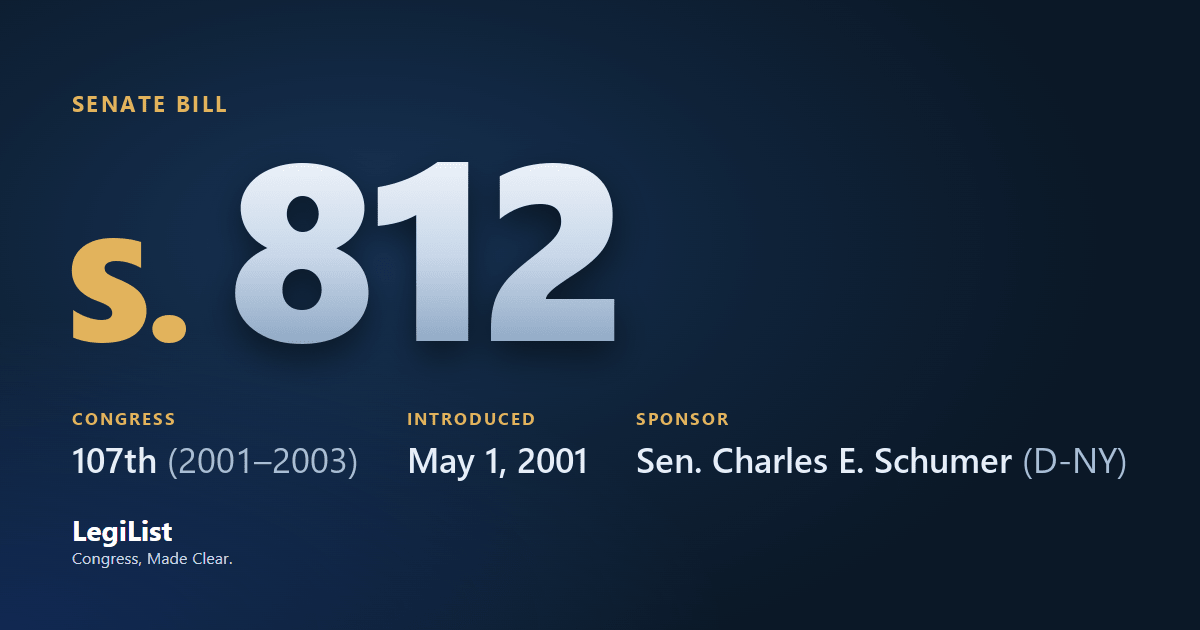
Greater Access to Affordable Pharmaceuticals Act of 2002
Latest action · Sep 4, 2002 Held at the desk.
Progress
Where this bill reached, and when. A stage with no date was not reached; one that failed a vote and later carried shows the date it carried.
- IntroducedMay 1, 2001
- Passed SenateJul 31, 2002
- Passed HouseNot reached
- To the PresidentNot reached
- Became lawNot reached
Summary
(Sec. 103) Requires applicants (pharmaceutical companies) to register their patents with the Food and Drug Administration (FDA) within 30 days of approval (or issuance for subsequently issued patents).
Makes failure to timely register a bar to civil actions for patent infringement.
Requires applications for new drugs (NDA) or abbreviated new drug applications (ANDA) which rely upon investigations not conducted by or for the applicant and which concern a patent that claims both the drug and a method of use or more than one method of use to include a certification on a claim-by-claim basis that the patent is invalid or will not be infringed (known as a Paragraph IV filing/certification) by the new drug's (generic) manufacture and a statement regarding the method(s) of use claim.
(Sec. 104) Prohibits (for subsequently issued patents) an extension of the 30 month stay of FDA approval for any new drug where an ANDA or NDA contains a Paragraph IV filing/certification and the patent holder indicates an intention to bring a patent infringement suit against the new (generic) drug's manufacturer.
Makes failure to timely file (within 45 days of notice of a Paragraph IV filing) a civil action for infringement a bar to later action.
(Sec. 105) Requires the first generic applicant with a Paragraph IV filing to forfeit the 180 day marketing exclusivity period to a subsequent generic applicant if the first generic applicant engages in certain behaviors which cause the generic drug not to be brought timely to market.
(Sec. 106) Revises notice requirements for Paragraph IV filings to include and protect certain proposed formulation, composition, or method of use information.
Excludes an applicants's ability to pay damages from a court's consideration of whether or not to provide injunctive relief before the expiration of the 30 month stay of approval period.
(Sec. 107) Continues existing regulations and authorities regarding the bioequivalence of drugs and biological products.
(Sec. 108) Requires the Federal Trade Commission to report to Congress on how this Act has brought generic drugs to market faster.
(Sec. 109) Makes technical and conforming amendments.
Title II: Importation of Prescription Drugs - Amends the Federal Food, Drug, and Cosmetic Act to permit pharmacists and wholesalers to import (reimport) U.S. made prescription drugs into the United States from Canada.
Requires an importer to keep detailed records, including a drug's formulation, lot or control number, chain of distribution, and laboratory records.
Requires Canadian sellers to register with the Secretary. Directs the Secretary to suspend the importation of a drug or importations by a particular importer if a pattern emerges which suggests a risk to public health through counterfeit or other violations.
Prohibits drug manufacturers from offering pharmacists and wholesalers terms less favorable than those offered to a foreign purchaser. Prohibits a manufacturer from restricting access to a prescription drug that is permitted to be imported into the United States.
Declares that enforcement efforts concerning importation of prescription drugs by individuals should focus on significant threats to public health rather than importation that is clearly for personal use, particularly importation from Canada.
Provides for studies and reports to Congress by the National Academy of Sciences' Institute of Medicine and the Comptroller General concerning the effects of this Act, addressing compliance issues as well as its effect on trade, patent rights, and pricing.
Authorizes appropriations.
(Sec. 202) Amends title IX of the Social Security Act (Medicaid ) to permit States to enter into Medicaid-like drug rebate agreements with drug manufacturers on behalf of non-Medicaid residents.
(Sec. 203) Provides additional, temporary funding to States through the Medicaid FMAP (Federal medical assistance percentage) if a State plan's eligibility requirements are no more restrictive than those in effect on January 1, 2002. Increases the cap on Medicaid payments to the territories.
Amends title XX (Block Grants to States for Social Services) to provide State fiscal relief allotments, available through FY 2004.
Recorded votes 3
Newest first. Open one to see how every member voted.
| Roll call | Question | Result | Date |
|---|---|---|---|
| Senate 201 | On Passage of the Bill S. 812 | Bill Passed78–21 | Jul 31, 2002 |
| Senate 200 | On the Cloture Motion S. 812 | Cloture Motion Agreed to66–33 | Jul 31, 2002 |
| Senate 178 | On the Cloture Motion S. 812 | Cloture Motion Agreed to99–0 | Jul 17, 2002 |
Cosponsors 12
Members who signed on, in the order they did. Signatures ran from May 1, 2001 to Jul 23, 2002; 1 is an original cosponsor, there from the day it was introduced.
| Seat | Cosponsor | Signed on | |
|---|---|---|---|
| R-AZ | John McCain | Original | May 1, 2001 |
| D-SD | Tim Johnson | Jun 8, 2001 | |
| D-NY | Hillary Rodham Clinton | Apr 10, 2002 | |
| D-MI | Debbie Stabenow | Apr 23, 2002 | |
| D-WI | Herb Kohl | Apr 23, 2002 | |
| D-MO | Jean Carnahan | Apr 23, 2002 | |
| D-IL | Richard J. Durbin | May 1, 2002 | |
| D-SD | Thomas A. Daschle | May 1, 2002 | |
| D-MN | Paul D. Wellstone | May 22, 2002 | |
| D-NC | John Edwards | Jun 4, 2002 | |
| D-GA | Zell Miller | Jun 19, 2002 | |
| D-WI | Russell D. Feingold | Jul 23, 2002 |
Committees 1
Where it was sent and what each committee and subcommittee did with it, in order.
| Chamber | Committee | What it did |
|---|---|---|
| Senate | Health, Education, Labor, and Pensions Committee | Referred May 1, 2001Markup Jul 11, 2002Reported Jul 11, 2002 |
Actions 28
Everything that happened, newest first.
- Sep 4, 2002Message on Senate action sent to the House.
- Sep 4, 2002Received in the House.
- Sep 4, 2002Held at the desk.
- Jul 31, 2002Considered by Senate. (consideration: CR S7618-7651)
- Jul 31, 2002Cloture invoked in Senate by Yea-Nay Vote. 66 - 33. Record Vote Number: 200.
- Jul 31, 2002Passed/agreed to in Senate: Passed Senate with an amendment by Yea-Nay Vote. 78 - 21. Record Vote Number: 201.
- Jul 30, 2002Considered by Senate. (consideration: CR S7516-7551)
- Jul 29, 2002Considered by Senate. (consideration: CR S7462)
- Jul 29, 2002Cloture motion on the measure presented in Senate. (consideration: CR S7462)
- Jul 26, 2002Considered by Senate. (consideration: CR S7398-7413)
- Jul 25, 2002Considered by Senate. (consideration: CR S7327-7336, S7342-7350)
- Jul 24, 2002Considered by Senate. (consideration: CR S7249-7263, S7282-7291, S7292-7299)
- Jul 23, 2002Considered by Senate. (consideration: CR S7194-7218)
- Jul 22, 2002Considered by Senate. (consideration: CR S7127, S7134-7158)
- Jul 18, 2002Considered by Senate. (consideration: CR S6977-7016, S7019-7028)
- Jul 17, 2002Motion to proceed to measure considered in Senate. (consideration: CR S6878-6931; text of measure as reported in Senate: CR S6884-6887)
- Jul 17, 2002Cloture on the motion to proceed invoked in Senate by Yea-Nay Vote. 99 - 0. Record Vote Number: 178.
- Jul 17, 2002Motion to proceed to consideration of measure agreed to in Senate by Unanimous Consent.
- Jul 17, 2002Measure laid before Senate by motion.
- Jul 16, 2002Motion to proceed to measure considered in Senate. (consideration: CR S6818-6829, S6831-6853)
- Jul 15, 2002Motion to proceed to consideration of measure made in Senate. (consideration: CR S6797-6801)
- Jul 15, 2002Cloture motion on the motion to proceed to the measure presented in Senate.
- Jul 11, 2002Committee on Health, Education, Labor, and Pensions. Ordered to be reported with an amendment favorably.
- Jul 11, 2002Committee on Health, Education, Labor, and Pensions. Reported by Senator Kennedy with an amendment. Without written report.
- Jul 11, 2002Placed on Senate Legislative Calendar under General Orders. Calendar No. 491.
- May 1, 2001Introduced in Senate
- May 1, 2001Sponsor introductory remarks on measure. (CR S3590-3591)
- May 1, 2001Read twice and referred to the Committee on Health, Education, Labor, and Pensions.
In the Congressional Record 18
Days the Record’s own index lists this bill, newest first, with the pages and the members it names. Pages starting H are the House, S the Senate, E Extensions of Remarks.
| Where | In the Record | Members | Date |
|---|---|---|---|
| Senate | Debate and remarks S10407 | Debbie Stabenow D-MI | Oct 15, 2002 |
| Senate | Debate and remarks S9182 | Debbie Stabenow D-MI | Sep 25, 2002 |
| Senate | Debate and remarks S8630, S8631 | Debbie Stabenow D-MI, Richard J. Durbin D-IL | Sep 17, 2002 |
| Senate | Amendments S8093 | Debbie Stabenow D-MI (amendment) | Sep 3, 2002 |
| Senate | Debate and remarks S7849–S7851, S7853–S7858, S7875–S7878Text printed S8007–S8012 | Bill Nelson D-FL, Bob Graham D-FL, Don Nickles R-OK, Orrin G. Hatch R-UT | Aug 1, 2002 |
Research
What has been written about this bill: committee reports, cost estimates, the sponsor’s authority statement, printed hearings and the Congressional Research Service’s work.
Printed hearings 9
Hearings whose printed record names this bill, newest first: hearings on it, and wider hearings where it came up.
| Number | Hearing | Committee | Held |
|---|---|---|---|
| Serial No. 107-140 | EXAMINING ISSUES RELATED TO COMPETITION IN THE PHARMACEUTICAL MARKETPLACE: A REVIEW OF THE FTC REPORT, GENERIC DRUG ENTRY PRIOR TO PATENT EXPIRATION146 pages | Energy and Commerce Committee | Oct 9, 2002 |
| S. Hrg. 107-730 | NOMINATION60 pages | Health, Education, Labor, and Pensions Committee | Oct 7, 2002 |
| S. Hrg. 107-942 | OVERSIGHT OF ENFORCEMENT OF THE ANTITRUST LAWS179 pages | Judiciary Committee | Sep 19, 2002 |
| Serial No. 107-136 | THE STEEL INDUSTRY LEGACY RELIEF ACT OF 200259 pages | Energy and Commerce Committee | Sep 10, 2002 |
| S. Hrg. 107-450 | CLOSING THE GAPS IN HATCH-WAXMAN: ASSURING GREATER ACCESS TO AFFORDABLE PHARMACEUTICALS65 pages | Health, Education, Labor, and Pensions Committee | May 8, 2002 |
Amendments 39
Amendments offered to this bill.
| Amendment | Description | Offered by | Status |
|---|---|---|---|
| SA 4299 | To permit commercial importation of prescription drugs from Canada. | Byron L. Dorgan D-ND | Amendment SA 4299 agreed to in Senate by Unanimous Consent. |
| SA 4300 | Of a perfecting nature. | Byron L. Dorgan D-ND | Amendment SA 4300 agreed to in Senate by Yea-Nay Vote. 69 - 30. Record Vote Number: 179. |
| SA 4301 | To protect the health and safety of Americans. | Thad Cochran R-MS | Amendment SA 4301 agreed to in Senate by Yea-Nay Vote. 99 - 0. Record Vote Number: 180. |
| SA 4302 | No description on file | Craig Thomas R-WY | Senate amendment submitted |
| SA 4303 | No description on file | Dianne Feinstein D-CA | Senate amendment submitted |
Related bills 1
Companion bills and other measures the record links to this one.
| Bill | Title | Relationship | Latest action |
|---|---|---|---|
| HR 1862 | Greater Access to Affordable Pharmaceuticals Act of 2001 | Identical bill | May 7, 2002 |
Titles 4
Every title it has carried, official and short, at each stage.
- Official Title as Introduced
- A bill to amend the Federal Food, Drug, and Cosmetic Act to provide greater access to affordable pharmaceuticals.
- Short Titles as Introduced
- Greater Access to Affordable Pharmaceuticals Act of 2001
- Short Titles as Passed Senate
- Greater Access to Affordable Pharmaceuticals Act of 2002
- Popular Titles
- Schumer-Edwards bill
Subjects
Assigned by the Library of Congress. Policy area: Health.
- Administrative procedure
- Administrative remedies
- Civil actions and liability
- Commerce
- Competition
- Congress
- Congressional reporting requirements
- Consent decrees
- Department of Health and Human Services
- Drug approvals
- Drug industry
- Generic drugs
- Government Operations and Politics
- Government paperwork
- Governmental investigations
- Health
- Intellectual property
- Judicial opinions
- Law
- Patents
- Pharmaceutical research
- Prescription pricing
- Restrictive trade practices
- Right of petition
- Science, Technology, Communications
Text 3
Each version as it was printed, newest first.
- Jul 31, 2002Engrossed in Senate
- Jul 11, 2002Reported to Senate
- May 1, 2001Introduced in Senate
Everything here is as published by Congress: the summary is the Congressional Research Service's, the action wording is the clerks', and the subjects are the Library of Congress's. How far it got is read from the actions themselves, taking the most recent one of each kind, so a bill that failed a vote and later passed is shown as having passed. Records come from this bill on Congress.gov and govinfo.gov; cost estimates are the Congressional Budget Office's, and the hearings are the printed hearings GovInfo publishes, which can appear months after the hearing.