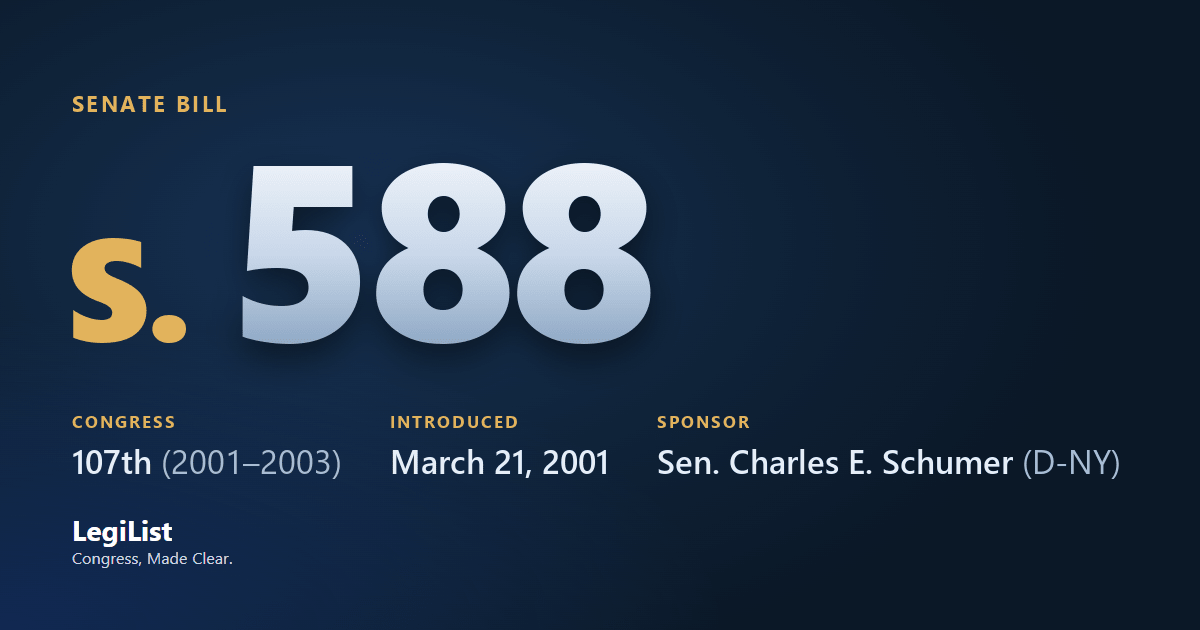
Acid Rain Control Act
Latest action · Mar 21, 2001 Read twice and referred to the Committee on Environment and Public Works.
Progress
Where this bill reached, and when. A stage with no date was not reached; one that failed a vote and later carried shows the date it carried.
- IntroducedMar 21, 2001
- Passed SenateNot reached
- Passed HouseNot reached
- To the PresidentNot reached
- Became lawNot reached
Summary
Makes it unlawful, after January 1, 2002, for: (1) the owner or operator of an affected facility to emit nitrogen oxides exceeding the amount of allowances held; or (2) any person to hold, use, or transfer such allowances, except as provided under this Act.
Repeals the nitrogen oxides emission reduction program under the Clean Air Act.
Imposes penalties for emissions in excess of allowances. Requires offsets of allowances in the calendar year following the one in which excess emissions occurred.
Decreases the amount of sulfur dioxide authorized to be emitted under an existing allowance program for 2007 and subsequent years.
Provides for regulations to: (1) protect specified regional ecosystems, including those modifying nitrogen oxide and sulfur dioxide allowance allocations; and (2) control electric utility and industrial source mercury emissions.
Directs the Administrator to establish a competitive grant program to fund research related to the effects of nitrogen deposition on sensitive watersheds and coastal estuaries in the eastern United States.
Cosponsors 2
Members who signed on, in the order they did. Signatures ran from Mar 21, 2001 to Jul 9, 2001; 1 is an original cosponsor, there from the day it was introduced.
| Seat | Cosponsor | Signed on | |
|---|---|---|---|
| D-NY | Hillary Rodham Clinton | Original | Mar 21, 2001 |
| D-MA | Edward M. Kennedy | Jul 9, 2001 |
Committees 1
Where it was sent and what each committee and subcommittee did with it, in order.
| Chamber | Committee | What it did |
|---|---|---|
| Senate | Environment and Public Works Committee | Referred Mar 21, 2001 |
Actions 2
Everything that happened, newest first.
- Mar 21, 2001Introduced in Senate
- Mar 21, 2001Read twice and referred to the Committee on Environment and Public Works.
Titles 2
Every title it has carried, official and short, at each stage.
- Official Title as Introduced
- A bill to reduce acid deposition under the Clean Air Act, and for other purposes.
- Short Titles as Introduced
- Acid Rain Control Act
Subjects
Assigned by the Library of Congress. Policy area: Environmental Protection.
- Acid pollution of rivers, lakes, etc.
- Acid precipitation (Meteorology)
- Acid rain
- Administrative procedure
- Air pollution control
- Air pollution measurement
- Air quality
- Appalachia
- Auctions
- Chesapeake Bay
- Commerce
- Congress
- Congressional reporting requirements
- District of Columbia
- Economics and Public Finance
- Ecosystem management
- Electric power production
- Emissions trading
- Energy
- Environmental Protection
- Environmental Protection Agency
- Environmental research
- Estuarine area conservation
- Estuarine ecology
- Estuarine pollution
- Federal aid to air pollution control
- Federal aid to water pollution control
- Fines (Penalties)
- Government Operations and Politics
- Government paperwork
- Great Lakes
- Industrial pollution
- Judicial review of administrative acts
- Lakes
- Law
- Licenses
- Long Island Sound
- Marine and coastal resources, fisheries
- Maryland
- Mercury
- Mountains
- New York State
- Nitrogen oxides
- Pennsylvania
- Public Lands and Natural Resources
- Research grants
- Science, Technology, Communications
- Standards
- Stream conservation
- Sulphur dioxide
- Vermont
- Virginia
- Water pollution measurement
- Water quality
- Water Resources Development
- Watershed management
Text 1
Each version as it was printed, newest first.
- Mar 21, 2001Introduced in Senate
Support LegiList
This page is free, carries no paywall, and is built and maintained by one person. If the record here is useful to you, a few dollars keeps it going.
Everything here is as published by Congress: the summary is the Congressional Research Service's, the action wording is the clerks', and the subjects are the Library of Congress's. How far it got is read from the actions themselves, taking the most recent one of each kind, so a bill that failed a vote and later passed is shown as having passed. Records come from this bill on Congress.gov and govinfo.gov; cost estimates are the Congressional Budget Office's, and the hearings are the printed hearings GovInfo publishes, which can appear months after the hearing.