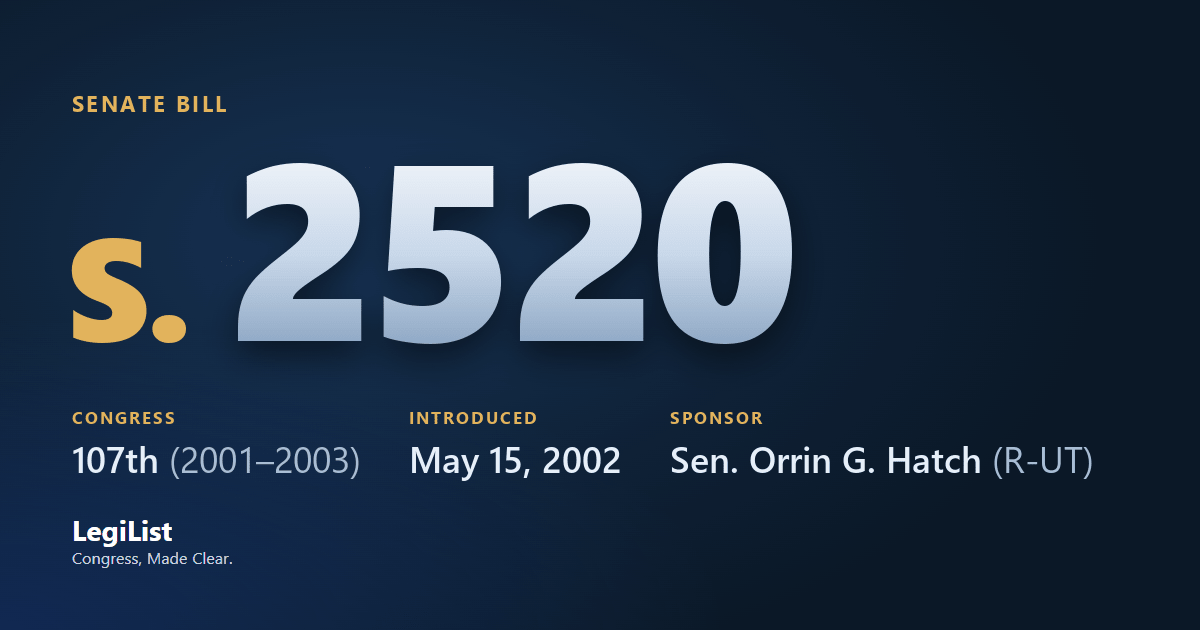
Prosecutorial Remedies and Tools Against the Exploitation of Children Today Act of 2002 (PROTECT Act)
Latest action · Nov 15, 2002 Message on Senate action sent to the House.
Progress
Where this bill reached, and when. A stage with no date was not reached; one that failed a vote and later carried shows the date it carried.
- IntroducedMay 15, 2002
- Passed SenateNov 14, 2002
- Passed HouseNot reached
- To the PresidentNot reached
- Became lawNot reached
Summary
(Sec. 4) Makes certain information identifying minors depicted in child pornography, on motion of the Government, except for good cause shown, inadmissible and subject to redaction from any otherwise admissible evidence in any prosecution of such an act. Increases penalties for violation of record-keeping requirements.
(Sec. 5) Modifies the definition of "minor" to provide that it shall not be construed to require proof of the actual identity of the person under age 18. Revises the definition of "child pornography" to include any visual depiction of sexually explicit conduct: (1) that is, or appears to be, of a minor actually engaging in bestiality, sadistic or masochistic abuse, or sexual intercourse, whether between persons of the same or opposite sex; and (2) that lacks serious literary, artistic, political, or scientific value; or (3) the production of which involves the use of an identifiable minor engaging in sexually explicit conduct. Amends the definition of "identifiable minor" to include a computer or computer generated image that is virtually indistinguishable from an actual minor. Defines "virtually indistinguishable" to mean that the depiction is such that an ordinary person viewing the depiction would conclude that the depiction is of an actual minor.
(Sec. 6) Revises the definition of "produces" to cover computer generated images or pictures. Increases penalties for violating prohibitions against sexual exploitation of children.
(Sec. 7) Amends the Victims of Child Abuse Act of 1990 to: (1) authorize disclosure to State officials by a law enforcement agency of a report of child pornography by an electronic communication service provider indicating a violation of State criminal law; and (2) authorize disclosure of child pornography by such a service provider to the National Center for Missing and Exploited Children.
(Sec. 9) Sets penalties for employing, using, persuading, inducing, enticing, or coercing a minor to engage in, or having a minor assist any other person to engage in, sexually explicit conduct outside of the United States for the purpose of producing any visual depiction of such conduct, intending that such depiction be transported to, or transporting it to, the United States.
(Sec. 10) Authorizes civil remedies for offenses relating to material constituting or containing child pornography.
(Sec. 11) Makes persons previously convicted of obscenity eligible for enhanced recidivist penalties for sexual child exploitation.
(Sec. 12) Directs the United States Sentencing Commission to review the Federal sentencing guidelines to ensure that penalties are adequate in cases that involve interstate travel with intent to engage in a sexual act with a juvenile.
(Sec. 13) Directs the Attorney General to: (1) appoint 25 additional trial attorneys to focus on the investigation and prosecution of Federal child pornography laws (authorizes appropriations); and (2) report to specified congressional officials on Federal enforcement actions regarding sexual exploitation of children, including an evaluation of prosecutions brought, an outcome-based measurement of performance, and an analysis of the technology being used by the child pornography industry.
Directs the Commission to review and amend sentencing guidelines and policy statements to ensure that such guidelines are adequate to deter and punish conduct involving a violation under this Act.
Cosponsors 9
Members who signed on, in the order they did. Signatures ran from May 15, 2002 to Oct 17, 2002; 6 are original cosponsors, there from the day it was introduced.
| Seat | Cosponsor | Signed on | |
|---|---|---|---|
| R-AL | Jeff Sessions | Original | May 15, 2002 |
| D-NC | John Edwards | Original | May 15, 2002 |
| R-OH | Mike DeWine | Original | May 15, 2002 |
| D-VT | Patrick J. Leahy | Original | May 15, 2002 |
| R-KS | Sam Brownback | Original | May 15, 2002 |
| R-AR | Tim Hutchinson | Original | May 15, 2002 |
| R-IA | Chuck Grassley | Jun 11, 2002 | |
| D-AR | Blanche L. Lincoln | Jun 18, 2002 | |
| R-UT | Robert F. Bennett | Oct 17, 2002 |
Committees 1
Where it was sent and what each committee and subcommittee did with it, in order.
| Chamber | Committee | What it did |
|---|---|---|
| Senate | Judiciary Committee | Referred May 15, 2002Hearings Oct 2, 2002Markup Nov 14, 2002Reported Nov 14, 2002 |
Actions 12
Everything that happened, newest first.
- Nov 15, 2002Received in the House.
- Nov 15, 2002Held at the desk.
- Nov 15, 2002Message on Senate action sent to the House.
- Nov 14, 2002Committee on the Judiciary. Ordered to be reported with an amendment in the nature of a substitute favorably.
- Nov 14, 2002Committee on the Judiciary. Reported with an amendment in the nature of a substitute. Without written report.
In the Congressional Record 5
Days the Record’s own index lists this bill, newest first, with the pages and the members it names. Pages starting H are the House, S the Senate, E Extensions of Remarks.
| Where | In the Record | Members | Date |
|---|---|---|---|
| Senate | Debate and remarks S11199–S11204 | Patrick J. Leahy D-VT | Nov 15, 2002 |
| Senate | Debate and remarks S11150–S11153Text printed S11150–S11153Amendments S11150 | Harry Reid D-NV | Nov 14, 2002 |
| Senate | Debate and remarks S10796 | Patrick J. Leahy D-VT | Oct 28, 2002 |
| Senate | Debate and remarks S10487 | Patrick J. Leahy D-VT | Oct 16, 2002 |
| Senate | Debate and remarks S4391–S4397Text printed S4392 | Orrin G. Hatch R-UT (text), Patrick J. Leahy D-VT, Tim Hutchinson R-AR | May 15, 2002 |
Research
What has been written about this bill: committee reports, cost estimates, the sponsor’s authority statement, printed hearings and the Congressional Research Service’s work.
Printed hearings 1
Hearings whose printed record names this bill, newest first: hearings on it, and wider hearings where it came up.
| Number | Hearing | Committee | Held |
|---|---|---|---|
| S. Hrg. 107-974 | STOPPING CHILD PORNOGRAPHY: PROTECTING OUR CHILDREN AND THE CONSTITUTION160 pages | Judiciary Committee | Oct 2, 2002 |
Titles 3
Every title it has carried, official and short, at each stage.
- Official Title as Introduced
- A bill to amend title 18, United States Code, with respect to the sexual exploitation of children.
- Short Titles as Introduced
- Prosecutorial Remedies and Tools Against the Exploitation of Children Today Act of 2002
- Short Titles as Passed Senate
- Prosecutorial Remedies and Tools Against the Exploitation of Children Today Act of 2002 (PROTECT Act)
Subjects
Assigned by the Library of Congress. Policy area: Crime and Law Enforcement.
- Administrative procedure
- Advertising
- Business records
- Child pornography
- Child sexual abuse
- Civil actions and liability
- Commerce
- Computer crimes
- Computer simulation
- Congress
- Congressional reporting requirements
- Crime and Law Enforcement
- Criminal investigation
- Criminal justice information systems
- Criminal liability
- Damages
- Data banks
- Department of Justice
- Electronic mail systems
- Evidence (Law)
- Expert witnesses
- Families
- Federal employees
- Foreign Trade and International Finance
- Government Operations and Politics
- Government paperwork
- Identification devices
- Imports
- Injunctions
- Internet
- Internet service providers
- Interstate commerce
- Juries
- Law
- Legal fees
- Missing children
- Performance measurement
- Postal crimes
- Prosecution
- Public prosecutors
- Punitive damages
- Recidivists
- Science, Technology, Communications
- Sentences (Criminal procedure)
- Sentencing guidelines
- Sex-oriented businesses
- State laws
- Technology assessment
- Transportation and Public Works
- U.S. Sentencing Commission
- Witnesses
Text 3
Each version as it was printed, newest first.
- Nov 15, 2002Engrossed in Senate
- Nov 14, 2002Reported to Senate
- May 18, 2002Introduced in Senate
Support LegiList
This page is free, carries no paywall, and is built and maintained by one person. If the record here is useful to you, a few dollars keeps it going.
Everything here is as published by Congress: the summary is the Congressional Research Service's, the action wording is the clerks', and the subjects are the Library of Congress's. How far it got is read from the actions themselves, taking the most recent one of each kind, so a bill that failed a vote and later passed is shown as having passed. Records come from this bill on Congress.gov and govinfo.gov; cost estimates are the Congressional Budget Office's, and the hearings are the printed hearings GovInfo publishes, which can appear months after the hearing.