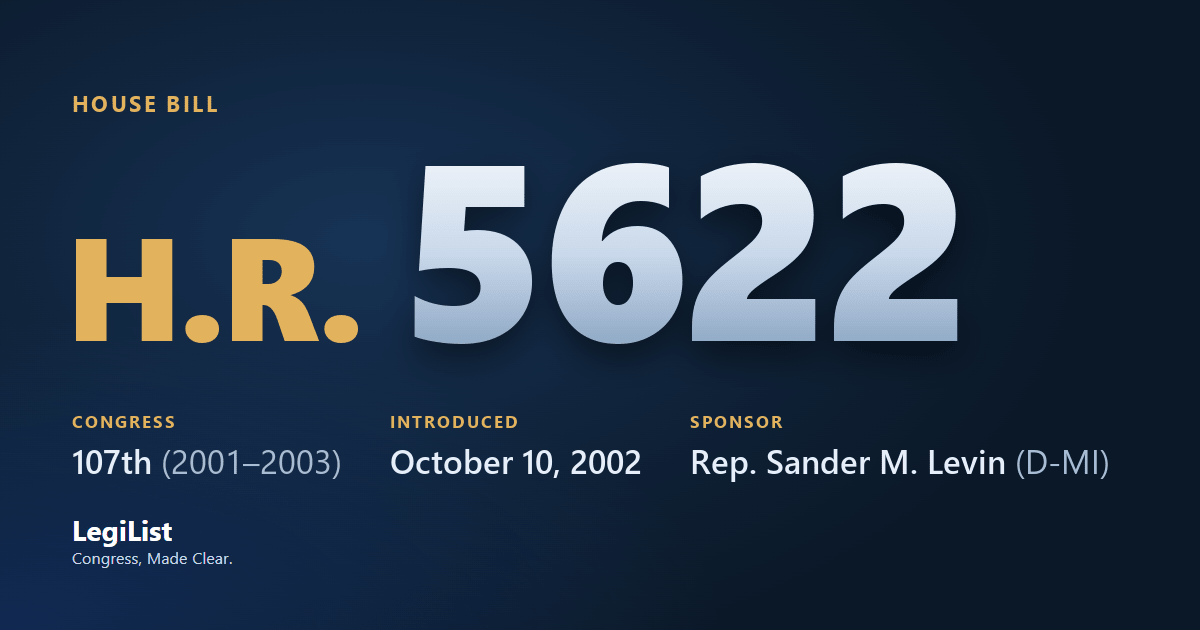
Trade Enhancement Act of 2002
Latest action · Oct 10, 2002 Referred to the Committee on Ways and Means, and in addition to the Committee on the Judiciary, for a period to be subsequently determined by the Speaker, in each case for consideration of such provisions as fall within the jurisdiction of the committee concerned.
Progress
Where this bill reached, and when. A stage with no date was not reached; one that failed a vote and later carried shows the date it carried.
- IntroducedOct 10, 2002
- Passed HouseNot reached
- Passed SenateNot reached
- To the PresidentNot reached
- Became lawNot reached
Summary
Requires the United States Trade Representative (USTR), in addition to determining what action to take with respect to any act, policy, or practice found unjustifiable or unreasonable, to: (1) further determine whether there is reason to believe that the conduct of the foreign country concerned involves anticompetitive conduct engaged in by any natural or corporate person or persons; and (2) if so, refer the matter to the Attorney General for investigation into whether such conduct violates the Sherman Act.
Amends the Sherman Act to require the Attorney General to: (1) conduct such an investigation if the USTR refers such a matter; and (2) commence an action in a U.S. district court seeking injunctive and other relief if an investigation results in an affirmative determination.
Amends the Trade Act of 1974 to authorize the USTR to use, if it has a reasonable basis, an inference adverse to the interests of any foreign government which has failed to cooperate by not acting to the best of its ability to: (1) comply with a reasonable request for information; or (2) require a party within its jurisdiction to comply with a reasonable request for information.
Cosponsors 3
Members who signed on, in the order they did. All signed on Oct 10, 2002.
| Seat | Cosponsor | Signed on | |
|---|---|---|---|
| R-NY | Amo Houghton | Original | Oct 10, 2002 |
| D-ND | Earl Pomeroy | Original | Oct 10, 2002 |
| D-FL | Karen L. Thurman | Original | Oct 10, 2002 |
Committees 2
Where it was sent and what each committee and subcommittee did with it, in order.
| Chamber | Committee | What it did |
|---|---|---|
| House | Ways and Means Committee | Referred Oct 10, 2002 |
| House | Judiciary Committee | Referred Oct 10, 2002 |
Actions 2
Everything that happened, newest first.
- Oct 10, 2002Introduced in House
- Oct 10, 2002Referred to the Committee on Ways and Means, and in addition to the Committee on the Judiciary, for a period to be subsequently determined by the Speaker, in each case for consideration of such provisions as fall within the jurisdiction of the committee concerned.
Titles 2
Every title it has carried, official and short, at each stage.
- Official Title as Introduced
- To amend the Trade Act of 1974 and the Sherman Act to address foreign private and joint public-private market access barriers that harm United States trade, and to amend the Trade Act of 1974 to address the failure of foreign governments to cooperate in the provision of information relating to certain investigations.
- Short Titles as Introduced
- Trade Enhancement Act of 2002
Subjects
Assigned by the Library of Congress. Policy area: Foreign Trade and International Finance.
- Administrative remedies
- Antitrust actions
- Antitrust law
- Commerce
- Congress
- Congressional reporting requirements
- Department of Justice
- Evidence (Law)
- Foreign Trade and International Finance
- Government Operations and Politics
- Government publicity
- Governmental investigations
- Injunctions
- International Affairs
- International cooperation
- Law
- Nontariff trade barriers
- Office of the U.S. Trade Representative
- Restrictive trade practices
Text 1
Each version as it was printed, newest first.
- Oct 10, 2002Introduced in House
Support LegiList
This page is free, carries no paywall, and is built and maintained by one person. If the record here is useful to you, a few dollars keeps it going.
Everything here is as published by Congress: the summary is the Congressional Research Service's, the action wording is the clerks', and the subjects are the Library of Congress's. How far it got is read from the actions themselves, taking the most recent one of each kind, so a bill that failed a vote and later passed is shown as having passed. Records come from this bill on Congress.gov and govinfo.gov; cost estimates are the Congressional Budget Office's, and the hearings are the printed hearings GovInfo publishes, which can appear months after the hearing.