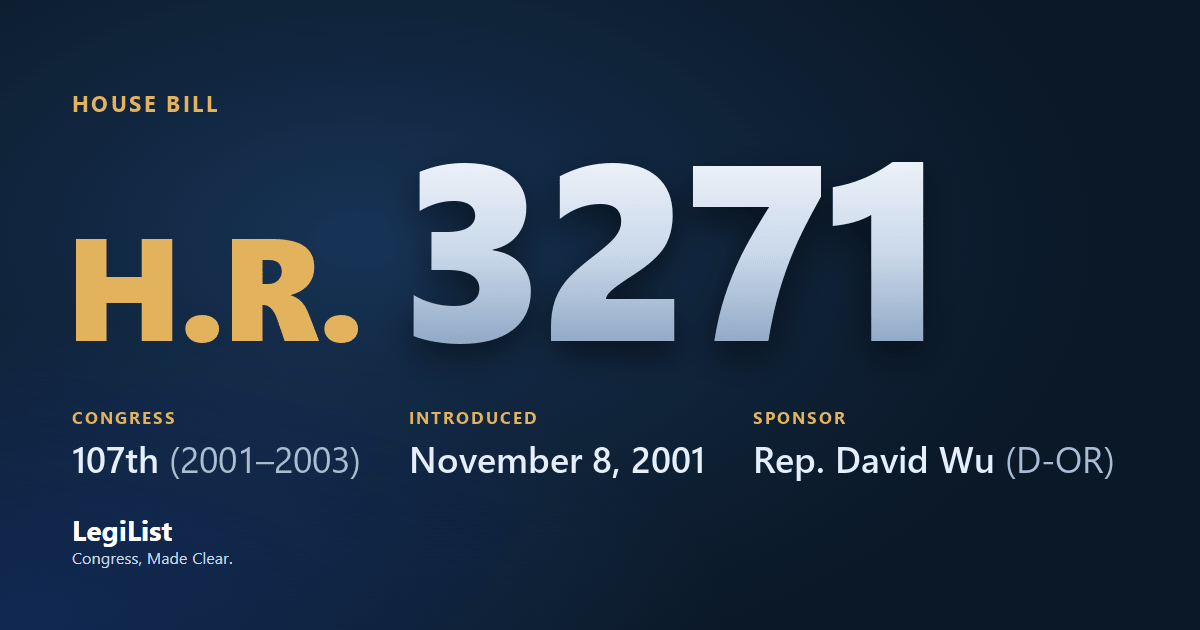
Bruce Vento Stand Down Act
Latest action · Dec 21, 2001 Referred to the Subcommittee on Benefits.
Progress
Where this bill reached, and when. A stage with no date was not reached; one that failed a vote and later carried shows the date it carried.
- IntroducedNov 8, 2001
- Passed HouseNot reached
- Passed SenateNot reached
- To the PresidentNot reached
- Became lawNot reached
Summary
Authorizes the Secretary of Veterans Affairs to provide outreach and other services as well as property and resources in support of these events. Requires the Secretary to establish a pilot program to conduct (alone or collaboratively) at least one Stand Down event in each State each year.
Cosponsors 23
Members who signed on, in the order they did. Signatures ran from Nov 8, 2001 to Feb 26, 2002; 16 are original cosponsors, there from the day it was introduced.
| Seat | Cosponsor | Signed on | |
|---|---|---|---|
| D-CA | Barbara Lee | Original | Nov 8, 2001 |
| I-VT | Bernard Sanders | Original | Nov 8, 2001 |
| D-MN | Betty McCollum | Original | Nov 8, 2001 |
| D-CA | Bob Filner | Original | Nov 8, 2001 |
| D-GA | Cynthia A. McKinney | Original | Nov 8, 2001 |
| D-TX | Eddie Bernice Johnson | Original | Nov 8, 2001 |
| D-CA | Ellen O. Tauscher | Original | Nov 8, 2001 |
| R-MN | Gil Gutknecht | Original | Nov 8, 2001 |
| D-MA | James P. McGovern | Original | Nov 8, 2001 |
| D-IN | Julia Carson | Original | Nov 8, 2001 |
| D-IL | Lane Evans | Original | Nov 8, 2001 |
| D-CA | Lucille Roybal-Allard | Original | Nov 8, 2001 |
| D-CA | Michael M. Honda | Original | Nov 8, 2001 |
| D-PA | Robert A. Brady | Original | Nov 8, 2001 |
| D-MS | Ronnie Shows | Original | Nov 8, 2001 |
| D-OH | Stephanie Tubbs Jones | Original | Nov 8, 2001 |
| D-AS | Eni F. H. Faleomavaega | Nov 15, 2001 | |
| D-CA | Hilda L. Solis | Nov 15, 2001 | |
| D-HI | Patsy T. Mink | Nov 15, 2001 | |
| D-MI | Dale E. Kildee | Dec 5, 2001 | |
| D-VI | Donna M. Christensen | Dec 5, 2001 | |
| R-FL | Mark Foley | Feb 26, 2002 | |
| D-CA | Tom Lantos | Feb 26, 2002 |
Committees 1
Where it was sent and what each committee and subcommittee did with it, in order.
| Chamber | Committee | What it did |
|---|---|---|
| House | Veterans' Affairs Committee | Referred Nov 8, 2001 |
| Benefits Subcommittee | Referred Dec 21, 2001 |
Actions 3
Everything that happened, newest first.
- Dec 21, 2001Referred to the Subcommittee on Benefits.
- Nov 8, 2001Introduced in House
- Nov 8, 2001Referred to the House Committee on Veterans' Affairs.
In the Congressional Record 1
Days the Record’s own index lists this bill, newest first, with the pages and the members it names. Pages starting H are the House, S the Senate, E Extensions of Remarks.
| Where | In the Record | Members | Date |
|---|---|---|---|
| Extensions | Debate and remarks E1442 | Betty McCollum D-MN | Jul 29, 2002 |
Titles 2
Every title it has carried, official and short, at each stage.
- Official Title as Introduced
- To amend title 38, United States Code, to authorize the Secretary of Veterans Affairs to conduct veterans outreach programs known as Stand Down events and to establish a pilot program to provide for an annual Stand Down event in each State.
- Short Titles as Introduced
- Bruce Vento Stand Down Act
Subjects
Assigned by the Library of Congress. Policy area: Armed Forces and National Security.
- Agriculture and Food
- Armed Forces and National Security
- Commemorations
- Congress
- Congressional reporting requirements
- Congressional tributes
- Food relief
- Government Operations and Politics
- Health
- Homeless veterans
- Housing and Community Development
- Labor and Employment
- Legislation
- Shelters for the homeless
- Social Welfare
- Surplus government property
- Unemployed
- Veterans' benefits
- Veterans' medical care
- Veterans' organizations
- Volunteer workers in social service
Text 1
Each version as it was printed, newest first.
- Nov 8, 2001Introduced in House
Everything here is as published by Congress: the summary is the Congressional Research Service's, the action wording is the clerks', and the subjects are the Library of Congress's. How far it got is read from the actions themselves, taking the most recent one of each kind, so a bill that failed a vote and later passed is shown as having passed. Records come from this bill on Congress.gov and govinfo.gov; cost estimates are the Congressional Budget Office's, and the hearings are the printed hearings GovInfo publishes, which can appear months after the hearing.