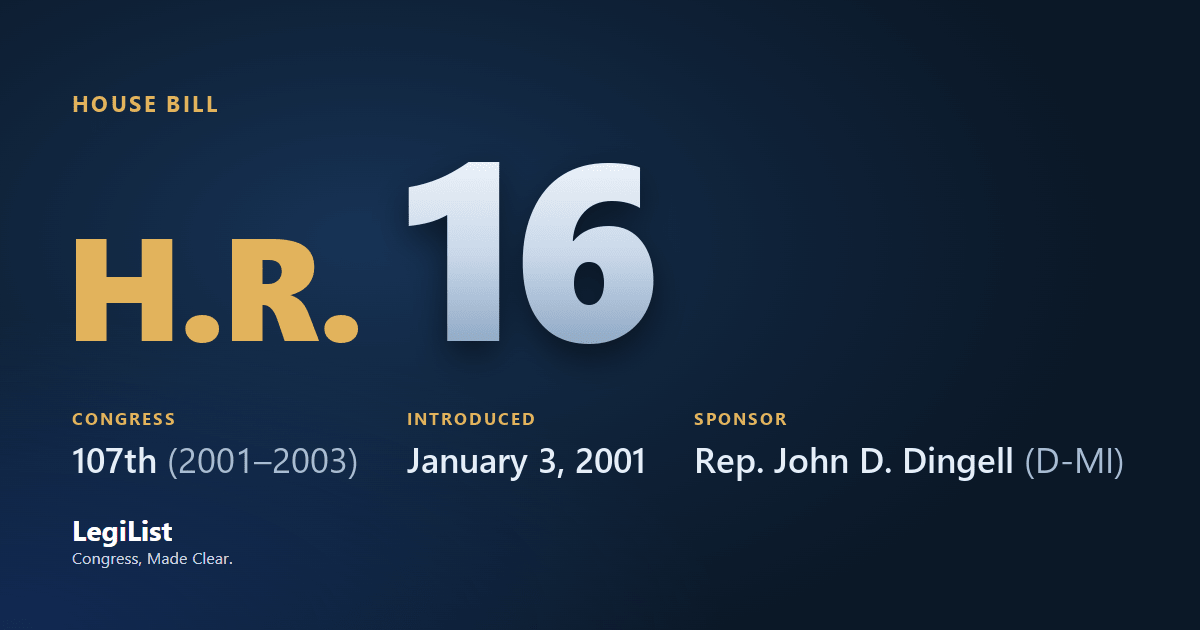
National Health Insurance Act
Latest action · Feb 7, 2001 Referred to the Subcommittee on Health.
Progress
Where this bill reached, and when. A stage with no date was not reached; one that failed a vote and later carried shows the date it carried.
- IntroducedJan 3, 2001
- Passed HouseNot reached
- Passed SenateNot reached
- To the PresidentNot reached
- Became lawNot reached
Summary
(Sec. 102) Authorizes the National Health Insurance Board to limit services when personnel, facilities, or funds are inadequate.
(Sec. 103) Allows patient choice of physicians and hospitals.
(Sec. 105) Makes Federal grants to States under the Social Security Act available to the States for services for uninsured needy individuals.
Title II: Participation of Physicians, Dentists, Nurses, Hospitals, and Others - Authorizes State agreements with individuals or organizations for service provision.
(Sec. 208) Regulates payment bases and rates, requiring local adjustments.
(Sec. 210) Allows providers to choose their practice locality and, consistent with State law and professional ethics, reject patients.
Title III: Local Administration - Decentralizes administration to local administrative committees or officers.
(Sec. 303) Requires establishment in each health service area of a local area committee and local professional committees.
Title IV: State Administration - Expresses the intent of the Congress that benefit provisions be administered by each State. Provides for Board administration if State plans are not approved and complied with.
Title V: National Health Insurance Board; National Advisory Medical Policy Council; General Administrative Provisions - Establishes: (1) in the Department of Health and Human Services the National Health Insurance Board; and (2) the National Advisory Medical Policy Council.
Title VI: Eligibility Determinations, Complaints, Hearings, and Judicial Review - Requires that the Secretary of Health and Human Services determine benefit eligibility.
(Sec. 602) Describes complaint investigation procedures.
Title VII: Application of Act to Individuals Covered Under Medicare Program - Limits, for individuals entitled to benefits under title XVIII (Medicare) of the Social Security Act, benefits under this Act to services for which the individual is not eligible under Medicare.
(Sec. 702) Mandates a study of the relationship of this Act's program and Medicare.
Title VIII: Fiscal Provisions - Makes National Health Care Trust Fund amounts available for expenditures under this Act.
(Sec. 802) Directs the Board to determine amounts to be made available from the Fund and allotments to the States.
(Sec. 803) Authorizes grants to: (1) educational institutions regarding the training of personnel providing or administering benefits; and (2) individuals in courses regarding the provision or administration of benefits. Requires that funds be made available.
Title IX: Miscellaneous Provisions - Requires that benefits first become available on a specified date.
Title X: Value Added Tax and National Health Care Trust Fund - Amends the Internal Revenue Code to impose a tax on each taxable transaction (the sale of property, performance of services, and importing of property by a taxable person in a commercial-type transaction). Sets the tax rate at zero for: (1) retail food, principal residence housing (sale and rental), and medical care; (2) certain transactions involving governmental entities; and (3) certain tax-exempt organizations. Makes the person selling the property or services liable for the tax.
(Sec. 1002) Establishes the National Health Care Trust Fund. Appropriates to the Fund amounts received from the value added tax. Allows the Fund to be used only to carry out the program under this Act.
Title XI: Study and Development of Cost Control Mechanisms - Directs the Secretary of Health and Human Services to: (1) conduct a study on controlling benefit costs, including malpractice claims and malpractice insurance costs; (2) report to the Congress; and (3) implement the report's recommendations.
Cosponsors 1
Members who signed on, in the order they did. All signed on Mar 20, 2001.
| Seat | Cosponsor | Signed on | |
|---|---|---|---|
| D-IL | Danny K. Davis | Mar 20, 2001 |
Committees 2
Where it was sent and what each committee and subcommittee did with it, in order.
| Chamber | Committee | What it did |
|---|---|---|
| House | Energy and Commerce Committee | Referred Jan 3, 2001 |
| Health Subcommittee | Referred Feb 7, 2001 | |
| House | Ways and Means Committee | Referred Jan 3, 2001 |
| Health Subcommittee | Referred Feb 7, 2001 |
Actions 3
Everything that happened, newest first.
- Feb 7, 2001Referred to the Subcommittee on Health.
- Jan 3, 2001Introduced in House
- Jan 3, 2001Referred to the Committee on Energy and Commerce, and in addition to the Committee on Ways and Means, for a period to be subsequently determined by the Speaker, in each case for consideration of such provisions as fall within the jurisdiction of the committee concerned.
Research
What has been written about this bill: committee reports, cost estimates, the sponsor’s authority statement, printed hearings and the Congressional Research Service’s work.
Printed hearings 1
Hearings whose printed record names this bill, newest first: hearings on it, and wider hearings where it came up.
| Number | Hearing | Committee | Held |
|---|---|---|---|
| Serial No. 107-98 | THE UNINSURED AND AFFORDABLE HEALTH CARE COVERAGE136 pages | Energy and Commerce Committee | Feb 28, 2002 |
Titles 2
Every title it has carried, official and short, at each stage.
- Official Title as Introduced
- To provide a program of national health insurance, and for other purposes.
- Short Titles as Introduced
- National Health Insurance Act
Subjects
Assigned by the Library of Congress. Policy area: Health.
- Access to health care
- Administrative procedure
- Administrative remedies
- Advice and consent of the Senate
- Agriculture and Food
- Aid to dependent children
- Civil Rights and Liberties, Minority Issues
- Commerce
- Confidential communications
- Congress
- Congressional reporting requirements
- Consumer complaints
- Cost control
- Costs
- Dental care
- Dentists
- Department of Health and Human Services
- Discrimination in insurance
- Discrimination in medical care
- Economics and Public Finance
- Education
- Executive reorganization
- Exports
- Families
- Federal advisory bodies
- Federal aid to medical education
- Federal employees
- Federal-local relations
- Federal-state relations
- Finance and Financial Sector
- Foreign Trade and International Finance
- Gifts
- Government employees' health insurance
- Government Operations and Politics
- Government paperwork
- Government trust funds
- Governmental investigations
- Health
- Health insurance
- Health services administration
- Higher education
- Home nursing
- Home ownership
- Hospital care
- Hospitals
- Housing and Community Development
- Housing finance
- Imports
- Insurance
- Interest
- Judicial review of administrative acts
- Labor and Employment
- Law
- Medical associations
- Medical economics
- Medical fees
- Medical malpractice
- Medical malpractice insurance
- Medical records
- Medically uninsured
- Medicare
- National health insurance
- Nurses
- Old age, survivors and disability insurance
- Physicians
- Poor
- Presidential appointments
- Real property
- Social Welfare
- Standards
- Surveys
- Tax administration
- Tax credits
- Tax exemption
- Tax returns
- Tax-exempt organizations
- Taxation
- Value-added tax
- Wages
- Workers' compensation
Text 1
Each version as it was printed, newest first.
- Jan 3, 2001Introduced in House
Everything here is as published by Congress: the summary is the Congressional Research Service's, the action wording is the clerks', and the subjects are the Library of Congress's. How far it got is read from the actions themselves, taking the most recent one of each kind, so a bill that failed a vote and later passed is shown as having passed. Records come from this bill on Congress.gov and govinfo.gov; cost estimates are the Congressional Budget Office's, and the hearings are the printed hearings GovInfo publishes, which can appear months after the hearing.