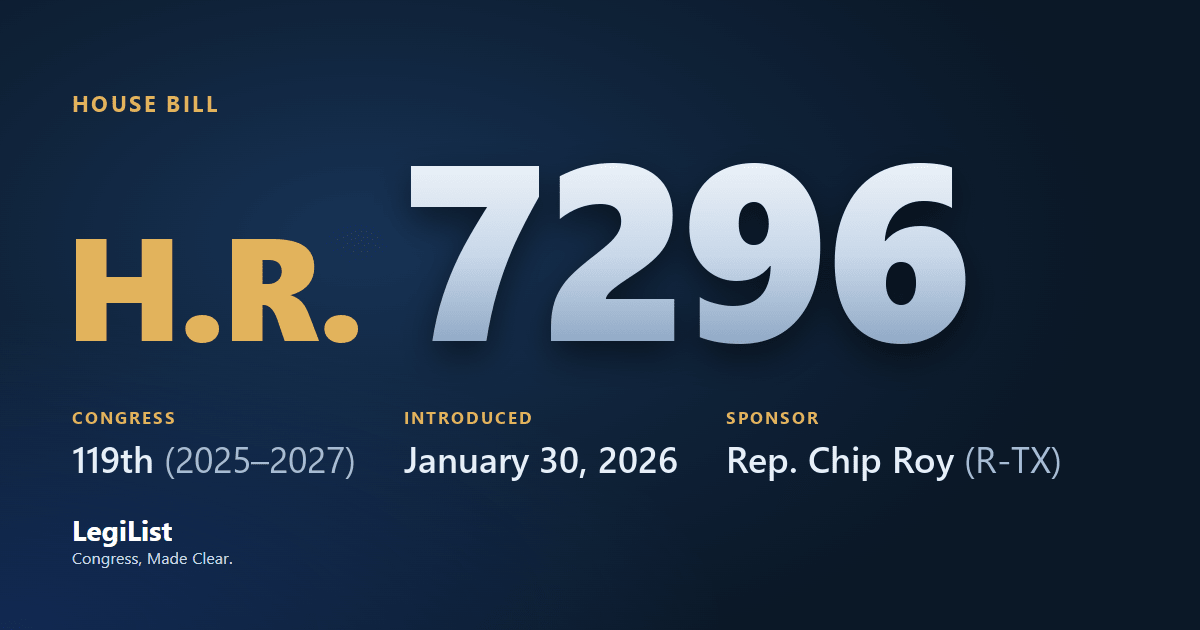
SAVE America Act
Latest action · Jan 30, 2026 Referred to the House Committee on House Administration.
Progress
Where this bill reached, and when. A stage with no date was not reached; one that failed a vote and later carried shows the date it carried.
- IntroducedJan 30, 2026
- Passed HouseNot reached
- Passed SenateNot reached
- To the PresidentNot reached
- Became lawNot reached
Summary
Safeguard American Voter Eligibility Act or the SAVE America Act
This bill requires individuals to provide documentary proof of U.S. citizenship when registering to vote, and requires photo identification to vote, in federal elections.
Specifically, the bill prohibits states from accepting and processing an application to register to vote in a federal election unless the applicant presents documentary proof of U.S. citizenship. The bill specifies what documents are considered acceptable proof of U.S. citizenship, such as identification that complies with the REAL ID Act of 2005 that indicates U.S. citizenship.
Further, the bill (1) prohibits states from registering an individual to vote in a federal election unless, at the time the individual applies to register to vote, the individual provides documentary proof of U.S. citizenship; and (2) requires states to establish an alternative process to demonstrate U.S. citizenship.
Each state must take affirmative steps on an ongoing basis to ensure that only U.S. citizens are registered to vote, which shall include establishing a program to identify individuals who are not U.S. citizens using information supplied by certain sources.
Additionally, states must remove noncitizens from their official lists of eligible voters.
The bill (1) provides for a private right of action for certain violations, and (2) establishes criminal penalties for certain offenses.
Individuals voting in federal elections must present an eligible photo identification document. An individual who votes by absentee ballot must submit a copy of their identification document with both the request for, and the submission of, the absentee ballot.
Cosponsors 111
Members who signed on, in the order they did. Signatures ran from Feb 3, 2026 to Apr 15, 2026.
| Seat | Cosponsor | Signed on | |
|---|---|---|---|
| R-FL | Aaron Bean | Feb 3, 2026 | |
| R-GA | Andrew S. Clyde | Feb 3, 2026 | |
| R-FL | Anna Paulina Luna | Feb 3, 2026 | |
| R-AL | Barry Moore | Feb 3, 2026 | |
| R-UT | Burgess Owens | Feb 3, 2026 | |
| R-WY | Harriet M. Hageman | Feb 3, 2026 | |
| D-NJ | Jefferson Van Drew | Feb 3, 2026 | |
| R-CO | Lauren Boebert | Feb 3, 2026 | |
| R-IN | Mark B. Messmer | Feb 3, 2026 | |
| R-TX | Pete Sessions | Feb 3, 2026 | |
| R-PA | Scott Perry | Feb 3, 2026 | |
| R-LA | Steve Scalise | Feb 3, 2026 | |
| R-TN | Tim Burchett | Feb 3, 2026 | |
| R-TN | Andrew Ogles | Feb 4, 2026 | |
| R-AZ | Andy Biggs | Feb 4, 2026 |
Committees 1
Where it was sent and what each committee and subcommittee did with it, in order.
| Chamber | Committee | What it did |
|---|---|---|
| House | Committee on House Administration | Referred Jan 30, 2026 |
Actions 2
Everything that happened, newest first.
- Jan 30, 2026Introduced in House
- Jan 30, 2026Referred to the House Committee on House Administration.
In the Congressional Record 7
Days the Record’s own index lists this bill, newest first, with the pages and the members it names. Pages starting H are the House, S the Senate, E Extensions of Remarks.
| Where | In the Record | Members | Date |
|---|---|---|---|
| House | Debate and remarks H4228, H4239 | Chip Roy R-TX, Marlin A. Stutzman R-IN | Jun 24, 2026 |
| House | Debate and remarks H2719, H2721 | Adriano Espaillat D-NY, Kevin Mullin D-CA | Mar 26, 2026 |
| House | Debate and remarks H2639 | Randy Fine R-FL | Mar 24, 2026 |
| House | Debate and remarks H2462 | Chip Roy R-TX | Mar 5, 2026 |
| House | Debate and remarks H2107 | Joe Wilson R-SC | Feb 10, 2026 |
| House · Senate | Debate and remarks H2044, S521–S523 | Charles E. Schumer D-NY, John Joyce R-PA, Tommy Tuberville R-AL | Feb 9, 2026 |
| House | Debate and remarks H2025 | Chip Roy R-TX, David Schweikert R-AZ | Feb 4, 2026 |
Research
What has been written about this bill: committee reports, cost estimates, the sponsor’s authority statement, printed hearings and the Congressional Research Service’s work.
Constitutional authority
The sponsor’s statement, as printed in the Congressional Record, vol. 172, no. 22, January 30, 2026, page H1922.
CRS reports 5
Congressional Research Service work that CRS links to this bill or the law it became, newest first.
About this bill 1
Products that name it in their title: its number, its law number or one of its short titles.
| Product | Title | Kind | Published |
|---|---|---|---|
| IF12902 | Safeguard American Voter Eligibility Act (SAVE America Act) and Federal Voter Registration Policy and Law | Resource | Feb 24, 2026 |
Also cite it 4
Products on other subjects that cite it, usually among other measures.
| Product | Title | Kind | Published |
|---|---|---|---|
| R46406 | Voter Registration: Recent Developments and Issues for Congress | Report | Oct 30, 2026 |
| R46943 | Voter Registration Records and List Maintenance for Federal Elections | Report | Oct 30, 2026 |
| R45030 | Federal Role in Voter Registration: The National Voter Registration Act of 1993 (NVRA) and Subsequent Developments | Report | Oct 29, 2026 |
| R46949 | The Help America Vote Act of 2002 (HAVA): Overview and Ongoing Role in Election Administration Policy | Report | Mar 20, 2026 |
Related bills 5
Companion bills and other measures the record links to this one.
| Bill | Title | Relationship | Latest action |
|---|---|---|---|
| HR 22 | SAVE Act | Related bill | Apr 10, 2025 |
| S 128 | SAVE Act | Related bill | Jan 16, 2025 |
| S 3752 | SAVE America Act | Identical bill | Jan 29, 2026 |
| HR 8206 | Homeland Security and Further Additional Continuing Appropriations Act, 2026 | Related bill | Apr 6, 2026 |
| HR 8595 | Making appropriations for national security, Department of State, and related programs for the fiscal year ending September 30, 2027, and for other purposes. | Related bill | Jul 29, 2026 |
Titles 3
Every title it has carried, official and short, at each stage.
- Official Title as Introduced
- To amend the National Voter Registration Act of 1993 to require proof of United States citizenship to register an individual to vote in elections for Federal office, and for other purposes.
- Short Title(s) as Introduced
- SAVE America Act
- Safeguard American Voter Eligibility Act
Subjects
Assigned by the Library of Congress. Policy area: Government Operations and Politics.
Text 1
Each version as it was printed, newest first.
- Jan 30, 2026Introduced in House
Support LegiList
This page is free, carries no paywall, and is built and maintained by one person. If the record here is useful to you, a few dollars keeps it going.
Everything here is as published by Congress: the summary is the Congressional Research Service's, the action wording is the clerks', and the subjects are the Library of Congress's. How far it got is read from the actions themselves, taking the most recent one of each kind, so a bill that failed a vote and later passed is shown as having passed. Records come from this bill on Congress.gov and govinfo.gov; cost estimates are the Congressional Budget Office's, and the hearings are the printed hearings GovInfo publishes, which can appear months after the hearing.