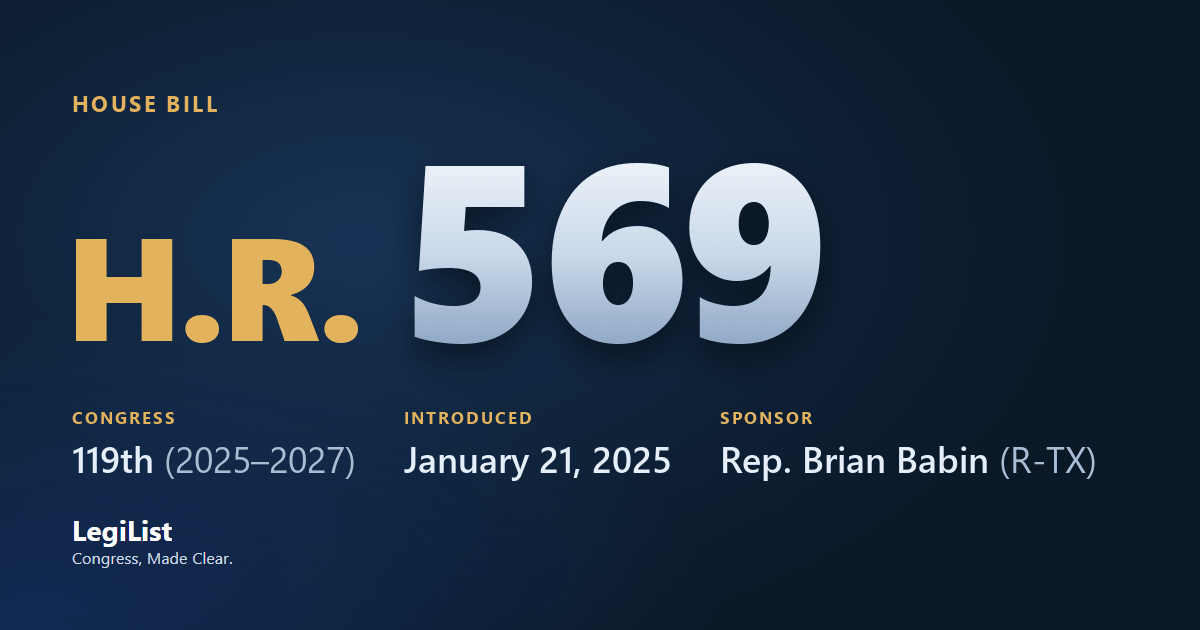
Birthright Citizenship Act of 2025
Latest action · Jan 21, 2025 Referred to the House Committee on the Judiciary.
Progress
Where this bill reached, and when. A stage with no date was not reached; one that failed a vote and later carried shows the date it carried.
- IntroducedJan 21, 2025
- Passed HouseNot reached
- Passed SenateNot reached
- To the PresidentNot reached
- Became lawNot reached
Summary
Birthright Citizenship Act of 2025
This bill limits birthright citizenship by redefining what it means to be subject to the jurisdiction of the United States.
Currently, a person born in the United States and subject to U.S. jurisdiction is entitled to citizenship. Under the bill, a person is subject to U.S. jurisdiction if he or she is born to a parent who is (1) a U.S. citizen or national, (2) a lawful permanent resident residing in the United States, or (3) a non-U.S. national (alien under federal law) with a lawful immigration status who is performing active service in the Armed Forces.
The bill does not affect the citizenship or nationality status of any person born before the bill's enactment date.
Cosponsors 95
Members who signed on, in the order they did. Signatures ran from Jan 21, 2025 to Oct 1, 2026; 35 are original cosponsors, there from the day it was introduced.
| Seat | Cosponsor | Signed on | |
|---|---|---|---|
| R-FL | Aaron Bean | Original | Jan 21, 2025 |
| R-TN | Andrew Ogles | Original | Jan 21, 2025 |
| R-GA | Andrew S. Clyde | Original | Jan 21, 2025 |
| R-AZ | Andy Biggs | Original | Jan 21, 2025 |
| R-GA | Austin Scott | Original | Jan 21, 2025 |
| R-VA | Ben Cline | Original | Jan 21, 2025 |
| R-TX | Brandon Gill | Original | Jan 21, 2025 |
| R-TX | Chip Roy | Original | Jan 21, 2025 |
| R-AL | Dale W. Strong | Original | Jan 21, 2025 |
| R-TX | Dan Crenshaw | Original | Jan 21, 2025 |
| R-NC | David Rouzer | Original | Jan 21, 2025 |
| R-WI | Derrick Van Orden | Original | Jan 21, 2025 |
| R-TN | Diana Harshbarger | Original | Jan 21, 2025 |
| R-CA | Doug LaMalfa | Original | Jan 21, 2025 |
| R-GA | Earl L. "Buddy" Carter | Original | Jan 21, 2025 |
Committees 1
Where it was sent and what each committee and subcommittee did with it, in order.
| Chamber | Committee | What it did |
|---|---|---|
| House | Judiciary Committee | Referred Jan 21, 2025 |
Actions 2
Everything that happened, newest first.
- Jan 21, 2025Introduced in House
- Jan 21, 2025Referred to the House Committee on the Judiciary.
In the Congressional Record 2
Days the Record’s own index lists this bill, newest first, with the pages and the members it names. Pages starting H are the House, S the Senate, E Extensions of Remarks.
| Where | In the Record | Members | Date |
|---|---|---|---|
| House | Debate and remarks H312 | Doug LaMalfa R-CA | Jan 23, 2025 |
| House | Lists H258H.R. 569–598 | — | Jan 21, 2025 |
Research
What has been written about this bill: committee reports, cost estimates, the sponsor’s authority statement, printed hearings and the Congressional Research Service’s work.
Constitutional authority
The sponsor’s statement, as printed in the Congressional Record, vol. 171, no. 12, January 21, 2025, page H258.
Related bills 2
Companion bills and other measures the record links to this one.
| Bill | Title | Relationship | Latest action |
|---|---|---|---|
| S 304 | Birthright Citizenship Act of 2025 | Related bill | Jan 29, 2025 |
| HR 9562 | Anchors Away Act | Related bill | Jun 30, 2026 |
Titles 2
Every title it has carried, official and short, at each stage.
- Official Title as Introduced
- To amend section 301 of the Immigration and Nationality Act to clarify those classes of individuals born in the United States who are nationals and citizens of the United States at birth.
- Short Title(s) as Introduced
- Birthright Citizenship Act of 2025
Subjects
Assigned by the Library of Congress. Policy area: Immigration.
Text 1
Each version as it was printed, newest first.
- Jan 21, 2025Introduced in House
Everything here is as published by Congress: the summary is the Congressional Research Service's, the action wording is the clerks', and the subjects are the Library of Congress's. How far it got is read from the actions themselves, taking the most recent one of each kind, so a bill that failed a vote and later passed is shown as having passed. Records come from this bill on Congress.gov and govinfo.gov; cost estimates are the Congressional Budget Office's, and the hearings are the printed hearings GovInfo publishes, which can appear months after the hearing.