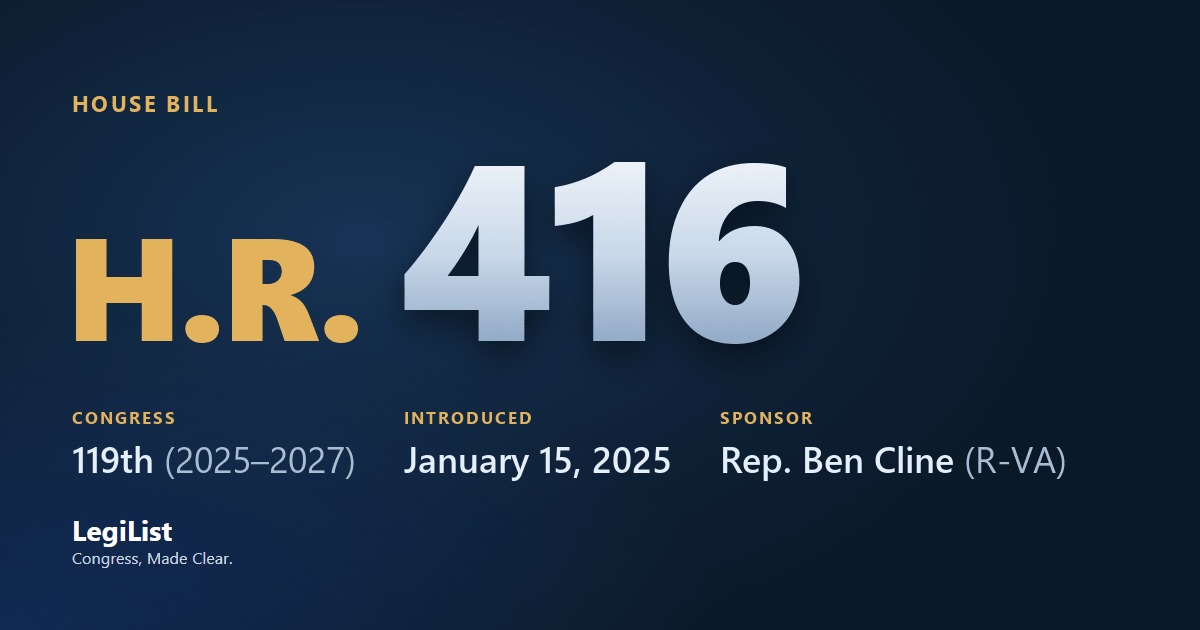
No Welfare for the Wealthy Act of 2025
Latest action · Feb 14, 2025 Referred to the Subcommittee on Nutrition and Foreign Agriculture.
Progress
Where this bill reached, and when. A stage with no date was not reached; one that failed a vote and later carried shows the date it carried.
- IntroducedJan 15, 2025
- Passed HouseNot reached
- Passed SenateNot reached
- To the PresidentNot reached
- Became lawNot reached
Summary
No Welfare for the Wealthy Act of 2025
This bill requires all households participating in the Supplemental Nutrition Assistance Program (SNAP) to meet the program's income and asset requirements, thereby eliminating certain alternative SNAP eligibility pathways.
Currently, a household may be eligible for SNAP by meeting program-specific federal eligibility requirements, which include both income and asset tests. A household may also be automatically or categorically eligible for SNAP based on eligibility for or receiving cash benefits from other specified low-income assistance programs (e.g., Temporary Assistance for Needy Families [TANF]). Under this categorical eligibility, households that already meet financial eligibility rules in a program like TANF are not required to go through a SNAP financial eligibility determination.
A majority of states also provide broad-based categorical eligibility (BBCE), a policy that makes most households with an income below a certain threshold categorically eligible for SNAP. Under BBCE, these states typically make households categorically eligible through receiving or being authorized to receive a minimal non-cash TANF benefit or service (e.g., a pamphlet). A state may set its own BBCE financial eligibility requirements for a household so long as the gross income requirement is below a certain level. A state's requirements do not have to match SNAP program-specific eligibility requirements. For example, most states that provide BBCE do not have an asset test for SNAP eligibility.
The bill requires all SNAP households, including those that qualify under categorical eligibility, to meet the program's income and asset requirements.
Cosponsors 11
Members who signed on, in the order they did. Signatures ran from Jan 15, 2025 to Apr 9, 2026; 4 are original cosponsors, there from the day it was introduced.
| Seat | Cosponsor | Signed on | |
|---|---|---|---|
| R-LA | Clay Higgins | Original | Jan 15, 2025 |
| R-TX | Jake Ellzey | Original | Jan 15, 2025 |
| R-OK | Josh Brecheen | Original | Jan 15, 2025 |
| R-TN | Mark E. Green | Original | Jan 15, 2025 |
| R-TX | Keith Self | Jan 21, 2025 | |
| D-NJ | Jefferson Van Drew | Mar 10, 2025 | |
| R-TX | Michael Cloud | May 7, 2025 | |
| R-NC | Mark Harris | Oct 3, 2025 | |
| R-MS | Michael Guest | Apr 2, 2026 | |
| R-PA | Scott Perry | Apr 2, 2026 | |
| R-WI | Thomas P. Tiffany | Apr 9, 2026 |
Committees 1
Where it was sent and what each committee and subcommittee did with it, in order.
| Chamber | Committee | What it did |
|---|---|---|
| House | Agriculture Committee | Referred Jan 15, 2025 |
| Nutrition and Foreign Agriculture Subcommittee | Referred Feb 14, 2025 |
Actions 3
Everything that happened, newest first.
- Feb 14, 2025Referred to the Subcommittee on Nutrition and Foreign Agriculture.
- Jan 15, 2025Introduced in House
- Jan 15, 2025Referred to the House Committee on Agriculture.
Research
What has been written about this bill: committee reports, cost estimates, the sponsor’s authority statement, printed hearings and the Congressional Research Service’s work.
Constitutional authority
The sponsor’s statement, as printed in the Congressional Record, vol. 171, no. 8, January 15, 2025, page H186.
Titles 2
Every title it has carried, official and short, at each stage.
- Official Title as Introduced
- To amend the Food and Nutrition Act of 2008 to close the nominal benefits loophole.
- Short Title(s) as Introduced
- No Welfare for the Wealthy Act of 2025
Subjects
Assigned by the Library of Congress. Policy area: Agriculture and Food.
Text 1
Each version as it was printed, newest first.
- Jan 15, 2025Introduced in House
Support LegiList
This page is free, carries no paywall, and is built and maintained by one person. If the record here is useful to you, a few dollars keeps it going.
Everything here is as published by Congress: the summary is the Congressional Research Service's, the action wording is the clerks', and the subjects are the Library of Congress's. How far it got is read from the actions themselves, taking the most recent one of each kind, so a bill that failed a vote and later passed is shown as having passed. Records come from this bill on Congress.gov and govinfo.gov; cost estimates are the Congressional Budget Office's, and the hearings are the printed hearings GovInfo publishes, which can appear months after the hearing.