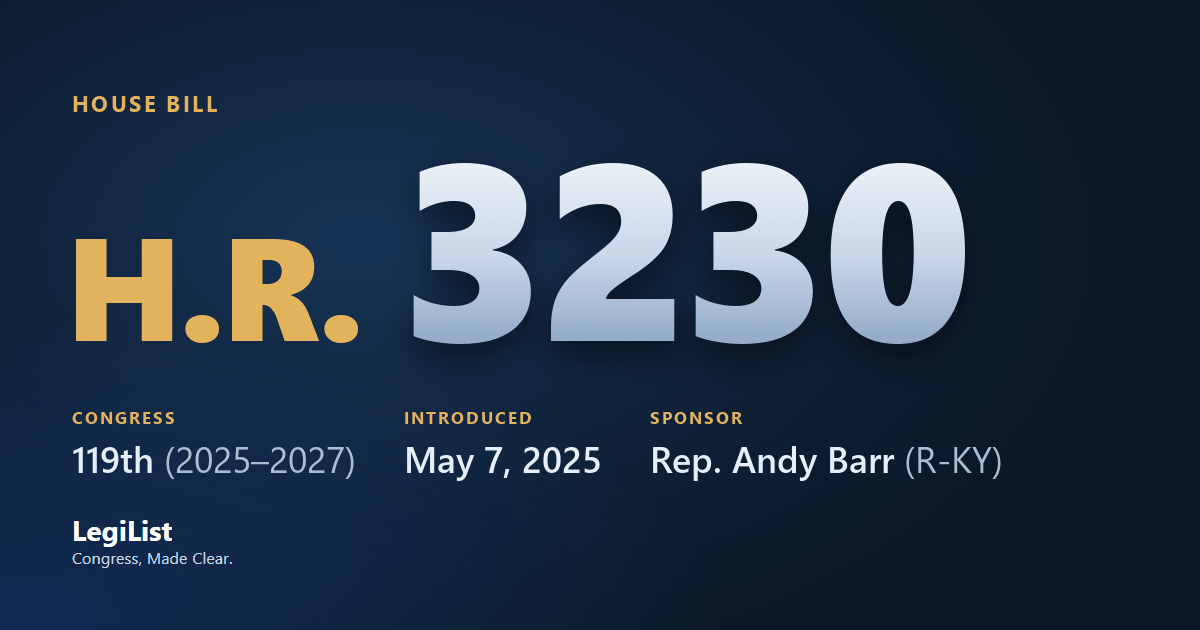
Financial Institution Regulatory Tailoring Enhancement Act
Latest action · Jun 20, 2025 Placed on the Union Calendar, Calendar No. 132.
Progress
Where this bill reached, and when. A stage with no date was not reached; one that failed a vote and later carried shows the date it carried.
- IntroducedMay 7, 2025
- Passed HouseNot reached
- Passed SenateNot reached
- To the PresidentNot reached
- Became lawNot reached
Summary
Financial Institution Regulatory Tailoring Enhancement Act
This bill limits the regulations applicable to certain financial institutions by increasing several different asset levels.
The bill raises the asset level above which insured depository institutions and credit unions become subject to supervision by the Consumer Financial Protection Bureau for purposes of compliance with consumer financial laws and for risk assessments of products and services.
The bill raises the asset level above which banks must comply with the Volcker Rule, which prohibits banks from proprietary trading and having an ownership interest in private funds.
The bill raises the asset level below which financial institutions must comply with less prescriptive ability-to-repay determinations for residential mortgages.
Finally, the bill raises the asset level below which certain depository institutions and depository institution holding companies qualify as community banks and are therefore subject to a simplified leverage ratio.
Cosponsors 2
Members who signed on, in the order they did. Signatures ran from May 7, 2025 to May 19, 2025; 1 is an original cosponsor, there from the day it was introduced.
| Seat | Cosponsor | Signed on | |
|---|---|---|---|
| R-PA | Daniel Meuser | Original | May 7, 2025 |
| R-TX | Pete Sessions | May 19, 2025 |
Committees 1
Where it was sent and what each committee and subcommittee did with it, in order.
| Chamber | Committee | What it did |
|---|---|---|
| House | Financial Services Committee | Referred May 7, 2025Markup May 21, 2025Reported Jun 20, 2025 |
Actions 6
Everything that happened, newest first.
- Jun 20, 2025Reported (Amended) by the Committee on Financial Services. H. Rept. 119-165.
- Jun 20, 2025Placed on the Union Calendar, Calendar No. 132.
- May 21, 2025Committee Consideration and Mark-up Session Held
- May 21, 2025Ordered to be Reported (Amended) by the Yeas and Nays: 29 - 23.
- May 7, 2025Introduced in House
Research
What has been written about this bill: committee reports, cost estimates, the sponsor’s authority statement, printed hearings and the Congressional Research Service’s work.
Committee report
Congressional Budget Office cost estimate
- Oct 8, 2025H.R. 3230, Financial Institution Regulatory Tailoring Enhancement ActAs reported by the House Committee on Financial Services on June 20, 2025
Constitutional authority
The sponsor’s statement, as printed in the Congressional Record, vol. 171, no. 76, May 7, 2025, page H1910.
CRS reports 1
Congressional Research Service work that CRS links to this bill or the law it became, newest first.
Cite it 1
Products on other subjects that cite it, usually among other measures.
| Product | Title | Kind | Published |
|---|---|---|---|
| R48743 | Housing Issues in the 119th Congress | Report | Sep 25, 2026 |
Titles 3
Every title it has carried, official and short, at each stage.
- Official Title as Introduced
- To increase the asset thresholds at which financial institutions become subject to certain requirements, and for other purposes.
- Short Title(s) as Introduced
- Financial Institution Regulatory Tailoring Enhancement Act
- Short Title(s) as Reported to House
- Financial Institution Regulatory Tailoring Enhancement Act
Subjects
Assigned by the Library of Congress. Policy area: Finance and Financial Sector.
Text 2
Each version as it was printed, newest first.
- Jun 20, 2025Reported in House
- May 7, 2025Introduced in House
Everything here is as published by Congress: the summary is the Congressional Research Service's, the action wording is the clerks', and the subjects are the Library of Congress's. How far it got is read from the actions themselves, taking the most recent one of each kind, so a bill that failed a vote and later passed is shown as having passed. Records come from this bill on Congress.gov and govinfo.gov; cost estimates are the Congressional Budget Office's, and the hearings are the printed hearings GovInfo publishes, which can appear months after the hearing.