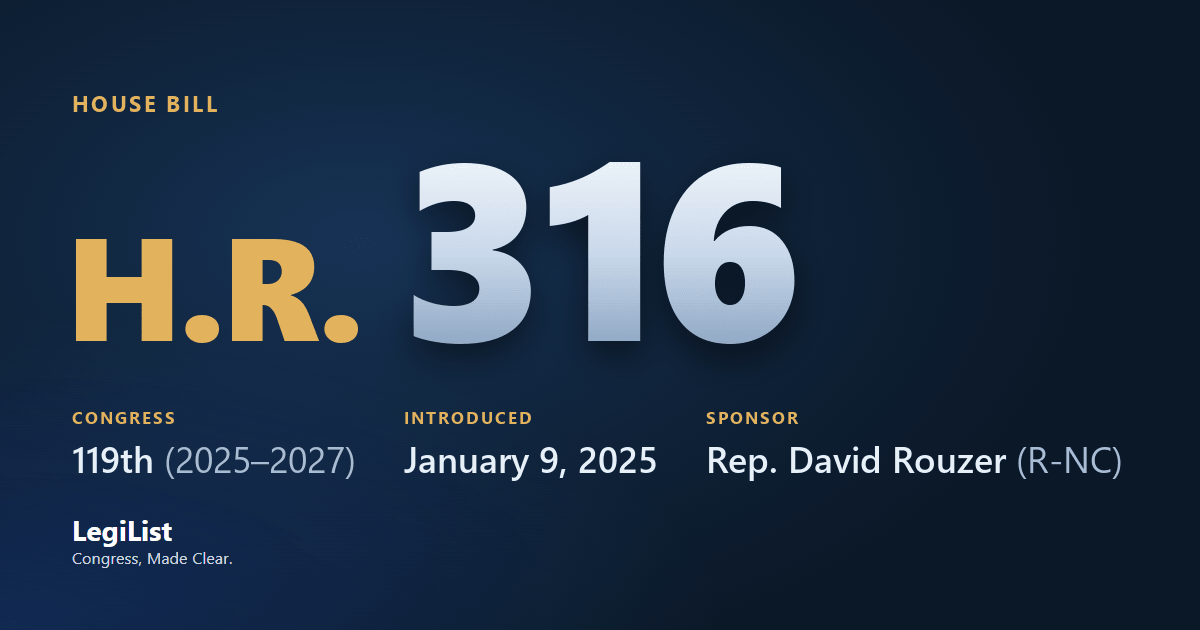
Natural Disaster Recovery Program Act of 2025
Latest action · Jan 10, 2025 Referred to the Subcommittee on Economic Development, Public Buildings, and Emergency Management.
Progress
Where this bill reached, and when. A stage with no date was not reached; one that failed a vote and later carried shows the date it carried.
- IntroducedJan 9, 2025
- Passed HouseNot reached
- Passed SenateNot reached
- To the PresidentNot reached
- Became lawNot reached
Summary
Natural Disaster Recovery Program Act of 2025
This bill establishes Federal Emergency Management Agency (FEMA) funding sources for unmet needs caused by major disasters, expands FEMA’s assistance for housing and home repair, and requires certain considerations in FEMA’s recommendations on presidential emergency/disaster declarations.
The bill establishes the National Disaster Recovery Reserve Fund for FEMA to provide grants to states and Indian tribal governments for unmet need. The bill defines unmet need as any necessary expense for activities related to a declared major disaster, including disaster relief or resilience activities. In addition, the bill authorizes FEMA to set aside funding from the Disaster Relief Fund to provide grants to states and Indian tribal governments for unmet needs resulting from a declared disaster, including home repair, economic recovery measures, and other services assisting disaster victims.
Also, the bill makes the following changes regarding housing assistance:
- authorizes FEMA’s Individuals and Households Program (IHP) to provide home repair assistance directly to homeowners when there is a lack of available housing resources,
- expands IHP home repair assistance for persons with disabilities,
- extends the maximum duration of IHP’s direct housing assistance from 18 to 24 months,
- authorizes IHP permanent housing construction where FEMA considers it a cost-effective alternative, and
- authorizes minor home repairs in the essential assistance federal agencies may provide following a disaster.
Additionally, the bill requires FEMA to give greater weight to local impacts, and events over the past five years, when making recommendations to the President regarding emergency or major disaster declarations.
Cosponsors
Members who signed on, in the order they did.
Committees 1
Where it was sent and what each committee and subcommittee did with it, in order.
| Chamber | Committee | What it did |
|---|---|---|
| House | Transportation and Infrastructure Committee | Referred Jan 9, 2025 |
| Economic Development, Public Buildings, and Emergency Management Subcommittee | Referred Jan 10, 2025 |
Actions 3
Everything that happened, newest first.
- Jan 10, 2025Referred to the Subcommittee on Economic Development, Public Buildings, and Emergency Management.
- Jan 9, 2025Introduced in House
- Jan 9, 2025Referred to the House Committee on Transportation and Infrastructure.
Research
What has been written about this bill: committee reports, cost estimates, the sponsor’s authority statement, printed hearings and the Congressional Research Service’s work.
Constitutional authority
The sponsor’s statement, as printed in the Congressional Record, vol. 171, no. 5, January 9, 2025, page H93.
CRS reports 6
Congressional Research Service work that CRS links to this bill or the law it became, newest first.
Cite it 6
Products on other subjects that cite it, usually among other measures.
| Product | Title | Kind | Published |
|---|---|---|---|
| R49028 | Fixing Emergency Management for Americans (FEMA) Act of 2025: Context, Overview, and Summary of Provisions | Report | Jul 10, 2026 |
| TE10123 | Examining Local Needs in Disaster Recovery | Testimony | Jun 10, 2026 |
| IN12693 | FEMA Review Council: Final Report | Insight | May 15, 2026 |
| IF13221 | Community Development Block Grants for Disaster Recovery: A Primer | Resource | May 8, 2026 |
| R48856 | The FEMA Act of 2025: An Overview | Report | Jan 29, 2026 |
| IN12191 | CDBG-DR Process Standardization: Selected HUD Actions and Legislative Proposals | Insight | Jul 10, 2025 |
Titles 2
Every title it has carried, official and short, at each stage.
- Official Title as Introduced
- To authorize the President to provide disaster assistance to States and Indian Tribes under a major disaster recovery program, and for other purposes.
- Short Title(s) as Introduced
- Natural Disaster Recovery Program Act of 2025
Subjects
Assigned by the Library of Congress. Policy area: Emergency Management.
- Building construction
- Congressional oversight
- Disaster relief and insurance
- Emergency Management
- Environmental assessment, monitoring, research
- Government lending and loan guarantees
- Government studies and investigations
- Intergovernmental relations
- Natural disasters
- Right of privacy
- State and local government operations
Text 1
Each version as it was printed, newest first.
- Jan 9, 2025Introduced in House
Everything here is as published by Congress: the summary is the Congressional Research Service's, the action wording is the clerks', and the subjects are the Library of Congress's. How far it got is read from the actions themselves, taking the most recent one of each kind, so a bill that failed a vote and later passed is shown as having passed. Records come from this bill on Congress.gov and govinfo.gov; cost estimates are the Congressional Budget Office's, and the hearings are the printed hearings GovInfo publishes, which can appear months after the hearing.