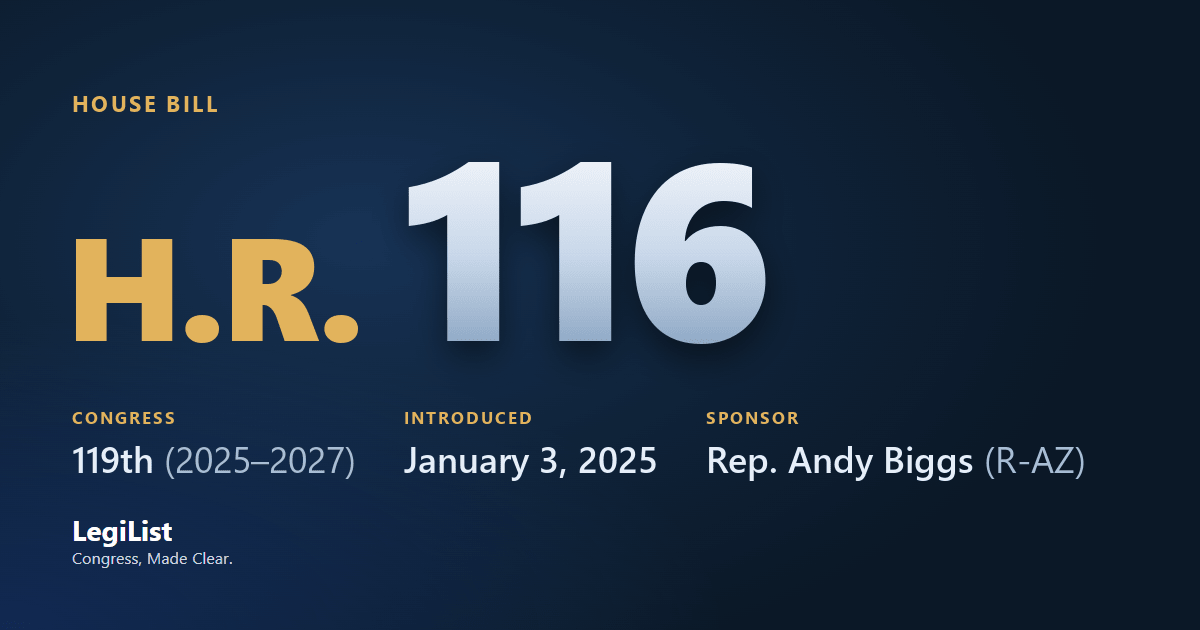
Stopping Border Surges Act
Latest action · Jan 3, 2025 Referred to the Committee on the Judiciary, and in addition to the Committee on Foreign Affairs, for a period to be subsequently determined by the Speaker, in each case for consideration of such provisions as fall within the jurisdiction of the committee concerned.
Progress
Where this bill reached, and when. A stage with no date was not reached; one that failed a vote and later carried shows the date it carried.
- IntroducedJan 3, 2025
- Passed HouseNot reached
- Passed SenateNot reached
- To the PresidentNot reached
- Became lawNot reached
Summary
Stopping Border Surges Act
This bill modifies immigration law provisions relating to unaccompanied alien minors and to asylum seekers.
The bill requires the Department of Homeland Security (DHS) to repatriate certain unaccompanied, inadmissible alien children, generally those not at risk of being trafficking victims nor having a fear of persecution. Currently, only inadmissible unaccompanied aliens from neighboring countries are subject to repatriation, and DHS has discretion whether to repatriate.
When the Department of Health and Human Services releases an unaccompanied child to an individual, it shall provide DHS with certain information about that individual, including Social Security number and immigration status.
The bill requires a stricter standard to find a credible fear of persecution and imposes additional rules on credible fear interviews.
If an alien is granted asylum because of fear of persecution in a country, the alien shall be deemed to have renounced asylum status by returning to that country, if there has been no change in the country's conditions.
The bill also (1) expands the definition of what constitutes a frivolous asylum application, (2) imposes additional limitations on eligibility for asylum, (3) shortens the deadline for applying for asylum, and (4) extends the time period an alien seeking asylum must wait before receiving employment authorization.
Any individual who knowingly and willfully makes materially false statements or uses fraudulent documents in asylum-related proceedings shall be fined or imprisoned up to 10 years, or both.
Cosponsors 41
Members who signed on, in the order they did. Signatures ran from Mar 11, 2025 to Oct 29, 2026.
| Seat | Cosponsor | Signed on | |
|---|---|---|---|
| R-TX | Brandon Gill | Mar 11, 2025 | |
| R-CO | Lauren Boebert | May 6, 2025 | |
| R-GA | Mike Collins | May 8, 2025 | |
| R-AZ | Paul A. Gosar | Jun 20, 2025 | |
| R-SC | Russell Fry | Aug 19, 2025 | |
| R-TX | Troy E. Nehls | Aug 19, 2025 | |
| R-TX | Chip Roy | Aug 22, 2025 | |
| R-OH | Warren Davidson | Sep 4, 2025 | |
| R-VA | Ben Cline | Sep 17, 2025 | |
| R-KY | Andy Barr | Oct 10, 2025 | |
| R-WI | Glenn Grothman | Oct 10, 2025 | |
| R-TX | Wesley Hunt | Oct 14, 2025 | |
| R-TX | Michael Cloud | Oct 17, 2025 | |
| R-SC | Sheri Biggs | Oct 21, 2025 | |
| R-FL | Byron Donalds | Oct 24, 2025 | |
| R-FL | Randy Fine | Oct 24, 2025 | |
| R-IL | Mary E. Miller | Dec 12, 2025 | |
| R-GA | Brian Jack | Dec 16, 2025 | |
| R-SC | Nancy Mace | Dec 17, 2025 | |
| R-FL | W. Gregory Steube | Jan 20, 2026 | |
| R-WV | Riley M. Moore | Jan 22, 2026 | |
| R-TX | August Pfluger | Feb 11, 2026 | |
| R-TX | Keith Self | Feb 11, 2026 | |
| R-TN | Andrew Ogles | Feb 20, 2026 | |
| R-CA | Tom McClintock | Mar 3, 2026 | |
| R-TX | Brian Babin | Mar 5, 2026 | |
| R-PA | Scott Perry | Mar 12, 2026 | |
| R-TN | Matt Van Epps | Mar 16, 2026 | |
| R-MO | Ann Wagner | Apr 13, 2026 | |
| R-AL | Barry Moore | Apr 27, 2026 | |
| R-SC | Ralph Norman | Apr 27, 2026 | |
| R-MT | Troy Downing | May 12, 2026 | |
| R-TN | Scott DesJarlais | Jun 2, 2026 | |
| R-TX | Beth Van Duyne | Jul 20, 2026 | |
| R-AL | Dale W. Strong | Aug 3, 2026 | |
| R-GA | Richard McCormick | Aug 3, 2026 | |
| R-NC | Addison P. McDowell | Sep 16, 2026 | |
| R-SC | Joe Wilson | Sep 16, 2026 | |
| R-TX | Randy K. Weber, Sr. | Sep 16, 2026 | |
| R-MO | Robert F. Onder, Jr. | Sep 28, 2026 | |
| R-OH | Michael A. Rulli | Oct 29, 2026 |
Committees 2
Where it was sent and what each committee and subcommittee did with it, in order.
| Chamber | Committee | What it did |
|---|---|---|
| House | Judiciary Committee | Referred Jan 3, 2025 |
| House | Foreign Affairs Committee | Referred Jan 3, 2025 |
Actions 2
Everything that happened, newest first.
- Jan 3, 2025Introduced in House
- Jan 3, 2025Referred to the Committee on the Judiciary, and in addition to the Committee on Foreign Affairs, for a period to be subsequently determined by the Speaker, in each case for consideration of such provisions as fall within the jurisdiction of the committee concerned.
Research
What has been written about this bill: committee reports, cost estimates, the sponsor’s authority statement, printed hearings and the Congressional Research Service’s work.
Constitutional authority
The sponsor’s statement, as printed in the Congressional Record, vol. 171, no. 1, January 3, 2025, page H39.
Related bills 1
Companion bills and other measures the record links to this one.
| Bill | Title | Relationship | Latest action |
|---|---|---|---|
| HR 61 | Ensuring United Families at the Border Act | Related bill | Jan 3, 2025 |
Titles 2
Every title it has carried, official and short, at each stage.
- Official Title as Introduced
- To close loopholes in the immigration laws that serve as incentives to aliens to attempt to enter the United States unlawfully, and for other purposes.
- Short Title(s) as Introduced
- Stopping Border Surges Act
Subjects
Assigned by the Library of Congress. Policy area: Immigration.
- Administrative remedies
- Border security and unlawful immigration
- Child safety and welfare
- Correctional facilities and imprisonment
- Department of Homeland Security
- Detention of persons
- Evidence and witnesses
- Family relationships
- Federal preemption
- Foreign labor
- Foreign language and bilingual programs
- Fraud offenses and financial crimes
- Government information and archives
- Government studies and investigations
- Human rights
- Human trafficking
- Immigrant health and welfare
- Immigration
- Immigration status and procedures
- International law and treaties
- Lawyers and legal services
- Licensing and registrations
- Refugees, asylum, displaced persons
- State and local government operations
Text 1
Each version as it was printed, newest first.
- Jan 3, 2025Introduced in House
Support LegiList
This page is free, carries no paywall, and is built and maintained by one person. If the record here is useful to you, a few dollars keeps it going.
Everything here is as published by Congress: the summary is the Congressional Research Service's, the action wording is the clerks', and the subjects are the Library of Congress's. How far it got is read from the actions themselves, taking the most recent one of each kind, so a bill that failed a vote and later passed is shown as having passed. Records come from this bill on Congress.gov and govinfo.gov; cost estimates are the Congressional Budget Office's, and the hearings are the printed hearings GovInfo publishes, which can appear months after the hearing.