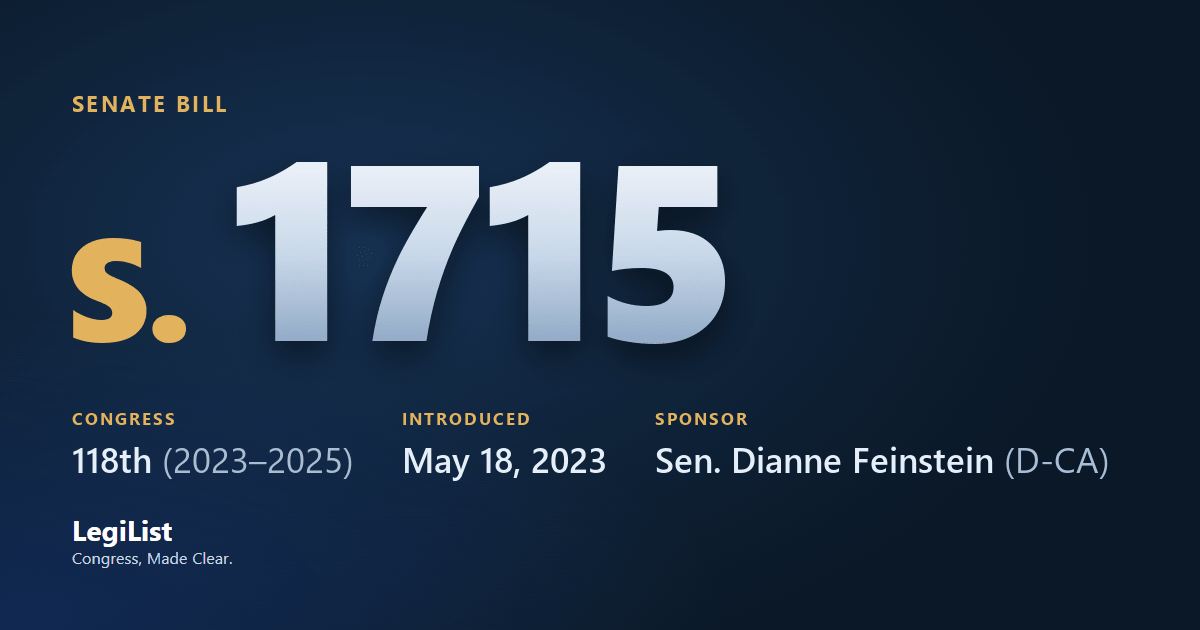
Wildfire Emergency Act of 2023
Latest action · May 18, 2023 Read twice and referred to the Committee on Agriculture, Nutrition, and Forestry.
Progress
Where this bill reached, and when. A stage with no date was not reached; one that failed a vote and later carried shows the date it carried.
- IntroducedMay 18, 2023
- Passed SenateNot reached
- Passed HouseNot reached
- To the PresidentNot reached
- Became lawNot reached
Summary
Wildfire Emergency Act of 2023
This bill provides for programs and activities in support of forest restoration, wildfire mitigation, and energy resilience.
The Department of Agriculture (USDA) shall establish a pilot program under which it may enter into conservation finance agreements with public or private persons to increase the pace and scale of forest restoration and land management projects across the National Forest System.
The bill provides for an increased federal cost share for conservation finance projects that would primarily benefit one or more low-income communities and for which the nonfederal entities involved cannot meet a specified cost share requirement.
The Department of Energy shall establish a program to support critical facilities (e.g., hospitals), including by improving the energy resilience and power needs of critical facilities through the development and use of microgrids, renewable energy, energy efficiency, reduced electricity demand, and on-site storage.
The bill expands the weatherization assistance program to support the use of fire-resistant materials.
The bill directs USDA and the Department of the Interior to take actions to improve the detection and monitoring of wildfires.
USDA and Interior shall establish one or more centers in western states to train individuals in methods relevant to the mitigation of wildfire risk.
USDA shall establish a competitive grant program to support workforce development in forestry and fire management.
USDA may issue grants to increase community capacity for land stewardship activities.
Cosponsors 4
Members who signed on, in the order they did. Signatures ran from May 18, 2023 to Jan 9, 2024; 3 are original cosponsors, there from the day it was introduced.
| Seat | Cosponsor | Signed on | |
|---|---|---|---|
| D-CA | Alex Padilla | Original | May 18, 2023 |
| D-OR | Ron Wyden | Original | May 18, 2023 |
| R-MT | Steve Daines | Original | May 18, 2023 |
| D-CA | Laphonza R. Butler | Jan 9, 2024 |
Committees 1
Where it was sent and what each committee and subcommittee did with it, in order.
| Chamber | Committee | What it did |
|---|---|---|
| Senate | Agriculture, Nutrition, and Forestry Committee | Referred May 18, 2023 |
Actions 2
Everything that happened, newest first.
- May 18, 2023Introduced in Senate
- May 18, 2023Read twice and referred to the Committee on Agriculture, Nutrition, and Forestry.
Related bills 3
Companion bills and other measures the record links to this one.
| Bill | Title | Relationship | Latest action |
|---|---|---|---|
| S 188 | Wildfire Emergency Act of 2023 | Identical bill | Jan 31, 2023 |
| HR 3439 | Emergency Wildfire Act of 2023 | Related bill | Jun 23, 2023 |
| HR 10917 | Wildfire Emergency Act of 2026 | Cross-Congress related bill | Oct 26, 2026 |
Titles 2
Every title it has carried, official and short, at each stage.
- Official Title as Introduced
- A bill to direct the Secretary of Agriculture to select and implement landscape-scale forest restoration projects, to assist communities in increasing their resilience to wildfire, and for other purposes.
- Short Title(s) as Introduced
- Wildfire Emergency Act of 2023
Subjects
Assigned by the Library of Congress. Policy area: Public Lands and Natural Resources.
- Advisory bodies
- Air quality
- Alternative and renewable resources
- Aquatic ecology
- Climate change and greenhouse gases
- Congressional oversight
- Correctional facilities and imprisonment
- Disaster relief and insurance
- Ecology
- Economic development
- Educational facilities and institutions
- Educational guidance
- Electric power generation and transmission
- Elementary and secondary education
- Employment and training programs
- Energy efficiency and conservation
- Energy storage, supplies, demand
- Environmental assessment, monitoring, research
- Environmental education
- Executive agency funding and structure
- Fires
- First responders and emergency personnel
- Forests, forestry, trees
- Government information and archives
- Health facilities and institutions
- Infrastructure development
- Land use and conservation
- Military facilities and property
- Poverty and welfare assistance
- Public contracts and procurement
- Public Lands and Natural Resources
- Public utilities and utility rates
- Public-private cooperation
- State and local government operations
- Technology transfer and commercialization
- Vocational and technical education
- Water use and supply
Text 1
Each version as it was printed, newest first.
- May 18, 2023Introduced in Senate
Everything here is as published by Congress: the summary is the Congressional Research Service's, the action wording is the clerks', and the subjects are the Library of Congress's. How far it got is read from the actions themselves, taking the most recent one of each kind, so a bill that failed a vote and later passed is shown as having passed. Records come from this bill on Congress.gov and govinfo.gov; cost estimates are the Congressional Budget Office's, and the hearings are the printed hearings GovInfo publishes, which can appear months after the hearing.