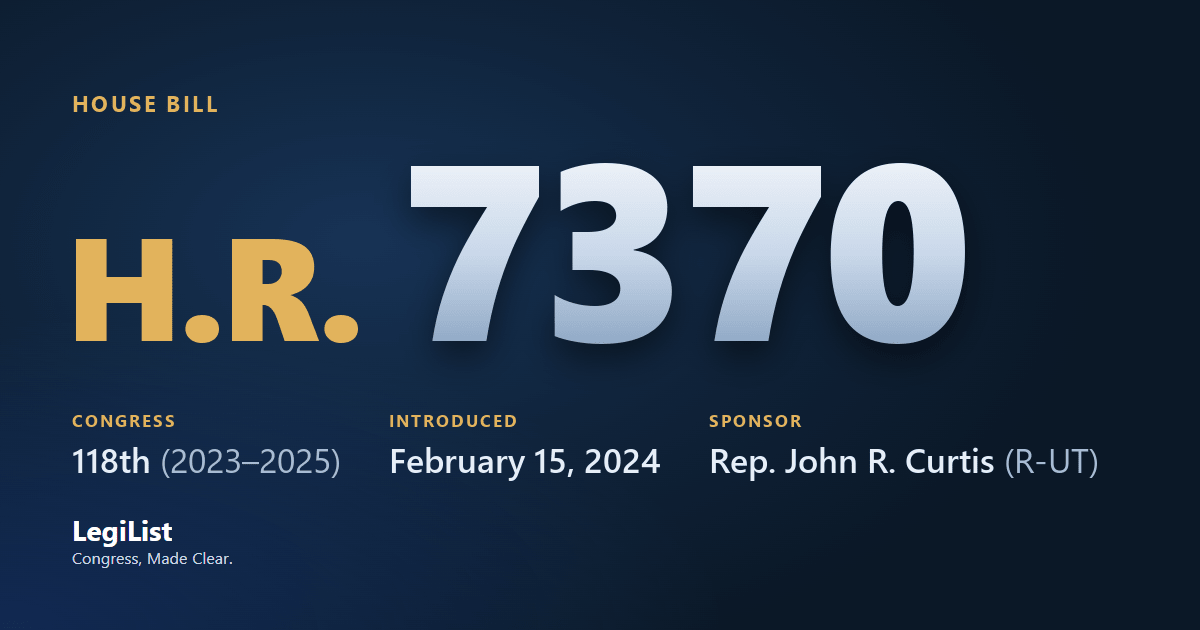
GEO Act
Latest action · Sep 25, 2024 Received in the Senate and Read twice and referred to the Committee on Energy and Natural Resources.
Progress
Where this bill reached, and when. A stage with no date was not reached; one that failed a vote and later carried shows the date it carried.
- IntroducedFeb 15, 2024
- Passed HouseSep 24, 2024
- Passed SenateNot reached
- To the PresidentNot reached
- Became lawNot reached
Summary
Geothermal Energy Opportunity Act or the GEO Act
This bill expands the Geothermal Steam Act of 1970 to establish a deadline for the Department of the Interior to process applications related to geothermal leases. Specifically, Interior must process each application for a geothermal drilling permit or other authorization under a valid existing geothermal lease within 60 days after completing all requirements under applicable federal laws and regulations (including the National Environmental Policy Act of 1969, the Endangered Species Act of 1973, and the National Historic Preservation Act) unless a U.S. federal court vacates or provides injunctive relief for the underlying lease.
Cosponsors
Members who signed on, in the order they did.
Committees 2
Where it was sent and what each committee and subcommittee did with it, in order.
| Chamber | Committee | What it did |
|---|---|---|
| House | Natural Resources Committee | Referred Feb 15, 2024Discharged Apr 16, 2024Markup Apr 16, 2024Reported Jun 27, 2024 |
| Energy and Mineral Resources Subcommittee | Referred Mar 4, 2024Hearings Mar 6, 2024 | |
| Senate | Energy and Natural Resources Committee | Referred Sep 25, 2024 |
Actions 15
Everything that happened, newest first.
- Sep 25, 2024Received in the Senate and Read twice and referred to the Committee on Energy and Natural Resources.
- Sep 24, 2024Mr. Westerman moved to suspend the rules and pass the bill, as amended.
- Sep 24, 2024Considered under suspension of the rules. (consideration: CR H5719-5720)
- Sep 24, 2024DEBATE - The House proceeded with forty minutes of debate on H.R. 7370.
- Sep 24, 2024Passed/agreed to in House: On motion to suspend the rules and pass the bill, as amended Agreed to by voice vote. (text: CR H5719)
In the Congressional Record 2
Days the Record’s own index lists this bill, newest first, with the pages and the members it names. Pages starting H are the House, S the Senate, E Extensions of Remarks.
| Where | In the Record | Members | Date |
|---|---|---|---|
| House | Debate and remarks H6090 | Melanie A. Stansbury D-NM | Nov 19, 2024 |
| House | Debate and remarks H5719, H5720Text printed H5719 | Alexandria Ocasio-Cortez D-NY, Bruce Westerman R-AR, John R. Curtis R-UT | Sep 24, 2024 |
Research
What has been written about this bill: committee reports, cost estimates, the sponsor’s authority statement, printed hearings and the Congressional Research Service’s work.
Committee report
Constitutional authority
The sponsor’s statement, as printed in the Congressional Record, vol. 170, no. 30, February 15, 2024, page H679.
Printed hearings 1
Hearings whose printed record names this bill, newest first: hearings on it, and wider hearings where it came up.
Titles 9
Every title it has carried, official and short, at each stage.
- Official Title as Introduced
- To amend the Geothermal Steam Act of 1970 to establish a deadline for processing applications related to geothermal leasing.
- Short Title(s) as Introduced
- Geothermal Energy Opportunity Act
- GEO Act
- Short Title(s) as Reported to House
- GEO Act
- Geothermal Energy Opportunity Act
- Short Title(s) as Passed House
- Geothermal Energy Opportunity Act
- GEO Act
- Short Titles from RFS (Referred to Senate) bill text
- Geothermal Energy Opportunity Act
- GEO Act
Subjects
Assigned by the Library of Congress. Policy area: Energy.
Text 4
Each version as it was printed, newest first.
- Sep 25, 2024Referred in Senate
- Sep 24, 2024Engrossed in House
- Jun 27, 2024Reported in House
- Feb 15, 2024Introduced in House
Support LegiList
This page is free, carries no paywall, and is built and maintained by one person. If the record here is useful to you, a few dollars keeps it going.
Everything here is as published by Congress: the summary is the Congressional Research Service's, the action wording is the clerks', and the subjects are the Library of Congress's. How far it got is read from the actions themselves, taking the most recent one of each kind, so a bill that failed a vote and later passed is shown as having passed. Records come from this bill on Congress.gov and govinfo.gov; cost estimates are the Congressional Budget Office's, and the hearings are the printed hearings GovInfo publishes, which can appear months after the hearing.