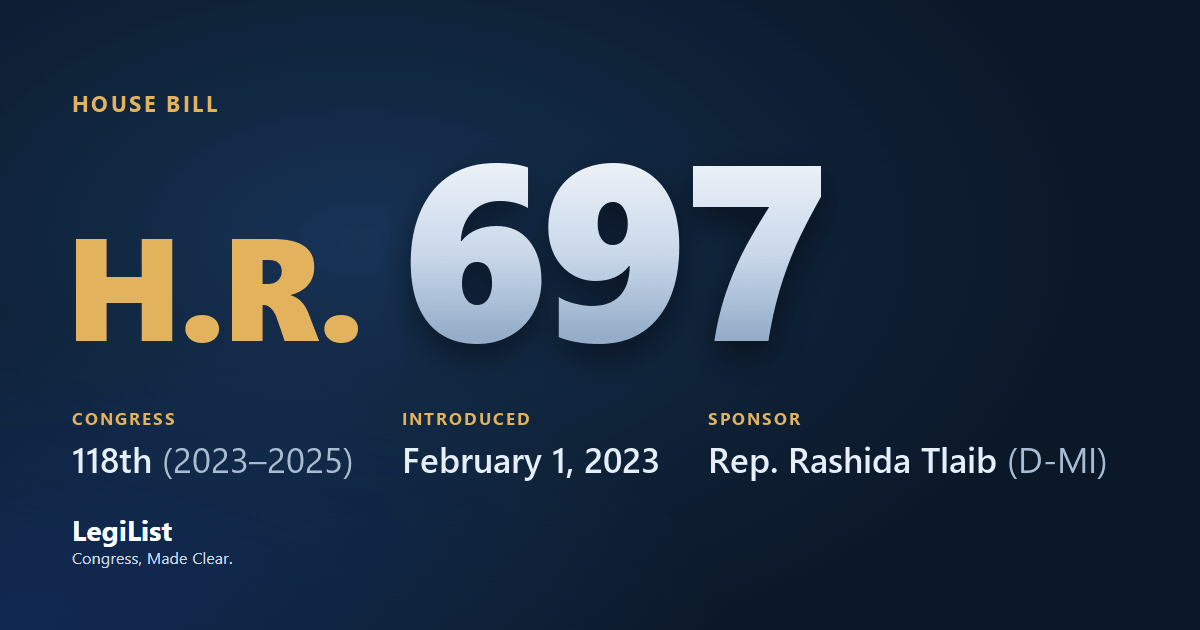
Justice for All Act of 2023
Latest action · Feb 1, 2023 Referred to the Committee on the Judiciary, and in addition to the Committee on Education and the Workforce, for a period to be subsequently determined by the Speaker, in each case for consideration of such provisions as fall within the jurisdiction of the committee concerned.
Progress
Where this bill reached, and when. A stage with no date was not reached; one that failed a vote and later carried shows the date it carried.
- IntroducedFeb 1, 2023
- Passed HouseNot reached
- Passed SenateNot reached
- To the PresidentNot reached
- Became lawNot reached
Summary
Justice for All Act of 2023
This bill prohibits discrimination based on sex, sexual orientation, gender identity, or race-related characteristics in schools, businesses, federally funded programs, and other settings. It also provides statutory authority for and expands the types of civil actions that may be brought for violations.
For example, the bill expands provisions under the Civil Rights Act of 1964 so as to (1) prohibit federally funded programs from discriminating based on sex or religion; and (2) prohibit public accommodations, including stores and transit services, from discriminating based on sex.
The bill defines sex to include sex stereotypes, pregnancy, childbirth, sexual orientation, gender identity, and sex characteristics. It also expands the definition of race to include traits that have been historically associated with race (e.g., natural hair textures). The expanded definitions apply to the Civil Rights Act of 1964, the Fair Housing Act (discrimination in public and private housing), and Title IX of the Education Amendments of 1972 (discrimination based on sex in federally funded educational programs).
Further, the bill provides statutory authority for disparate impact or intentional discrimination claims under the aforementioned acts, as well as the Age Discrimination Act of 1975 (discrimination based on age by federally funded programs) and the Rehabilitation Act of 1973 (discrimination based on disability by federally funded programs).
The bill also includes other provisions that address (1) profiling by law enforcement officers, (2) employer liability with respect to civil rights violations, (3) predispute arbitration agreements in civil rights cases, and (4) governmental immunity in suits involving constitutional violations.
Cosponsors 14
Members who signed on, in the order they did. Signatures ran from Feb 1, 2023 to Apr 25, 2023; 2 are original cosponsors, there from the day it was introduced.
| Seat | Cosponsor | Signed on | |
|---|---|---|---|
| D-MO | Cori Bush | Original | Feb 1, 2023 |
| D-PA | Summer L. Lee | Original | Feb 1, 2023 |
| D-TX | Al Green | Feb 7, 2023 | |
| D-NV | Steven Horsford | Feb 8, 2023 | |
| D-NC | Alma S. Adams | Feb 17, 2023 | |
| D-MS | Bennie G. Thompson | Feb 17, 2023 | |
| D-DC | Eleanor Holmes Norton | Feb 27, 2023 | |
| D-TX | Greg Casar | Feb 27, 2023 | |
| D-MA | Ayanna Pressley | Mar 9, 2023 | |
| D-IL | Jesús G. "Chuy" García | Mar 9, 2023 | |
| D-NC | Valerie P. Foushee | Mar 10, 2023 | |
| D-TX | Jasmine Crockett | Mar 23, 2023 | |
| D-IL | Danny K. Davis | Apr 3, 2023 | |
| D-FL | Maxwell Frost | Apr 25, 2023 |
Committees 2
Where it was sent and what each committee and subcommittee did with it, in order.
| Chamber | Committee | What it did |
|---|---|---|
| House | Judiciary Committee | Referred Feb 1, 2023 |
| House | Education and Workforce Committee | Referred Feb 1, 2023 |
Actions 2
Everything that happened, newest first.
- Feb 1, 2023Introduced in House
- Feb 1, 2023Referred to the Committee on the Judiciary, and in addition to the Committee on Education and the Workforce, for a period to be subsequently determined by the Speaker, in each case for consideration of such provisions as fall within the jurisdiction of the committee concerned.
Research
What has been written about this bill: committee reports, cost estimates, the sponsor’s authority statement, printed hearings and the Congressional Research Service’s work.
Constitutional authority
The sponsor’s statement, as printed in the Congressional Record, vol. 169, no. 21, February 1, 2023, page H629.
CRS reports 1
Congressional Research Service work that CRS links to this bill or the law it became, newest first.
Cite it 1
Products on other subjects that cite it, usually among other measures.
| Product | Title | Kind | Published |
|---|---|---|---|
| R48113 | The Fair Housing Act (FHA): A Legal Overview | Report | Jun 27, 2024 |
Related bills 2
Companion bills and other measures the record links to this one.
| Bill | Title | Relationship | Latest action |
|---|---|---|---|
| HR 4393 | Customer Non-Discrimination Act | Related bill | Jun 27, 2023 |
| HR 9219 | Justice for All Act of 2022 | Reintroduction of | Oct 21, 2022 |
Titles 2
Every title it has carried, official and short, at each stage.
- Official Title as Introduced
- To amend the Civil Rights Act of 1964 to clarify that disparate impacts on certain populations constitute a sufficient basis for rights of action under such Act, and for other purposes.
- Short Title(s) as Introduced
- Justice for All Act of 2023
Subjects
Assigned by the Library of Congress. Policy area: Civil Rights and Liberties, Minority Issues.
- Age discrimination
- Alternative dispute resolution, mediation, arbitration
- Aviation and airports
- Civil actions and liability
- Civil Rights and Liberties, Minority Issues
- Criminal investigation, prosecution, interrogation
- Due process and equal protection
- Employment discrimination and employee rights
- Government liability
- Judicial procedure and administration
- Law enforcement administration and funding
- Motor vehicles
- Public transit
- Racial and ethnic relations
- Railroads
- Retail and wholesale trades
- Service industries
- Sex, gender, sexual orientation discrimination
Text 1
Each version as it was printed, newest first.
- Feb 1, 2023Introduced in House
Support LegiList
This page is free, carries no paywall, and is built and maintained by one person. If the record here is useful to you, a few dollars keeps it going.
Everything here is as published by Congress: the summary is the Congressional Research Service's, the action wording is the clerks', and the subjects are the Library of Congress's. How far it got is read from the actions themselves, taking the most recent one of each kind, so a bill that failed a vote and later passed is shown as having passed. Records come from this bill on Congress.gov and govinfo.gov; cost estimates are the Congressional Budget Office's, and the hearings are the printed hearings GovInfo publishes, which can appear months after the hearing.