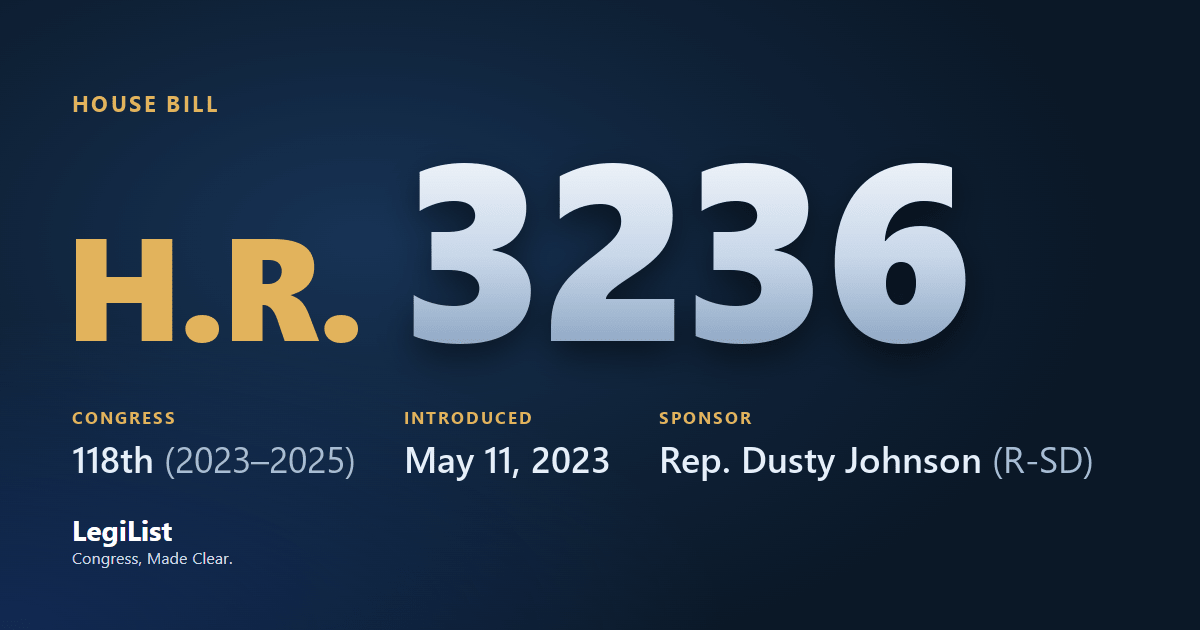
Tribal Police Department Parity Act
Latest action · May 11, 2023 Referred to the Committee on Ways and Means, and in addition to the Committee on the Judiciary, for a period to be subsequently determined by the Speaker, in each case for consideration of such provisions as fall within the jurisdiction of the committee concerned.
Progress
Where this bill reached, and when. A stage with no date was not reached; one that failed a vote and later carried shows the date it carried.
- IntroducedMay 11, 2023
- Passed HouseNot reached
- Passed SenateNot reached
- To the PresidentNot reached
- Became lawNot reached
Summary
Tribal Police Department Parity Act
This bill treats tribal law enforcement agencies in the same manner as federal, state, and local law enforcement agencies for purposes of accessing firearms.
The National Firearms Act (NFA) generally imposes a tax on the transfer of an NFA firearm; however, specified governmental entities (e.g., federal, state, and local law enforcement agencies) are exempt from this transfer tax. This bill extends this exemption to Indian tribes (and consequently, to tribal law enforcement agencies).
The Gun Control Act (GCA) generally prohibits the interstate shipment of firearms to unlicensed persons, but exempts specified governmental entities from this prohibition. This bill makes Indian tribes (and consequently, tribal law enforcement agencies) eligible to receive firearms interstate.
The GCA also prohibits the transfer or possession of machine guns manufactured after 1986, but exempts specified governmental entities from this prohibition. This bill makes Indian tribes (and consequently, tribal law enforcement agencies) eligible to transfer or possess these machine guns.
Cosponsors 5
Members who signed on, in the order they did. Signatures ran from May 11, 2023 to Jun 12, 2023; 3 are original cosponsors, there from the day it was introduced.
| Seat | Cosponsor | Signed on | |
|---|---|---|---|
| R-NE | Don Bacon | Original | May 11, 2023 |
| R-TX | Jake Ellzey | Original | May 11, 2023 |
| R-MT | Ryan K. Zinke | Original | May 11, 2023 |
| R-KS | Tracey Mann | May 15, 2023 | |
| D-AK | Mary Sattler Peltola | Jun 12, 2023 |
Committees 2
Where it was sent and what each committee and subcommittee did with it, in order.
| Chamber | Committee | What it did |
|---|---|---|
| House | Ways and Means Committee | Referred May 11, 2023 |
| House | Judiciary Committee | Referred May 11, 2023 |
Actions 2
Everything that happened, newest first.
- May 11, 2023Introduced in House
- May 11, 2023Referred to the Committee on Ways and Means, and in addition to the Committee on the Judiciary, for a period to be subsequently determined by the Speaker, in each case for consideration of such provisions as fall within the jurisdiction of the committee concerned.
Research
What has been written about this bill: committee reports, cost estimates, the sponsor’s authority statement, printed hearings and the Congressional Research Service’s work.
Constitutional authority
The sponsor’s statement, as printed in the Congressional Record, vol. 169, no. 80, May 11, 2023, page H2312.
Related bills 1
Companion bills and other measures the record links to this one.
| Bill | Title | Relationship | Latest action |
|---|---|---|---|
| S 1562 | Tribal Police Department Parity Act | Identical bill | May 11, 2023 |
Titles 2
Every title it has carried, official and short, at each stage.
- Official Title as Introduced
- To ensure that Federal laws that enable Federal, State, and local law enforcement agencies to access firearms apply equally to Tribal law enforcement agencies.
- Short Title(s) as Introduced
- Tribal Police Department Parity Act
Subjects
Assigned by the Library of Congress. Policy area: Native Americans.
Text 1
Each version as it was printed, newest first.
- May 11, 2023Introduced in House
Everything here is as published by Congress: the summary is the Congressional Research Service's, the action wording is the clerks', and the subjects are the Library of Congress's. How far it got is read from the actions themselves, taking the most recent one of each kind, so a bill that failed a vote and later passed is shown as having passed. Records come from this bill on Congress.gov and govinfo.gov; cost estimates are the Congressional Budget Office's, and the hearings are the printed hearings GovInfo publishes, which can appear months after the hearing.