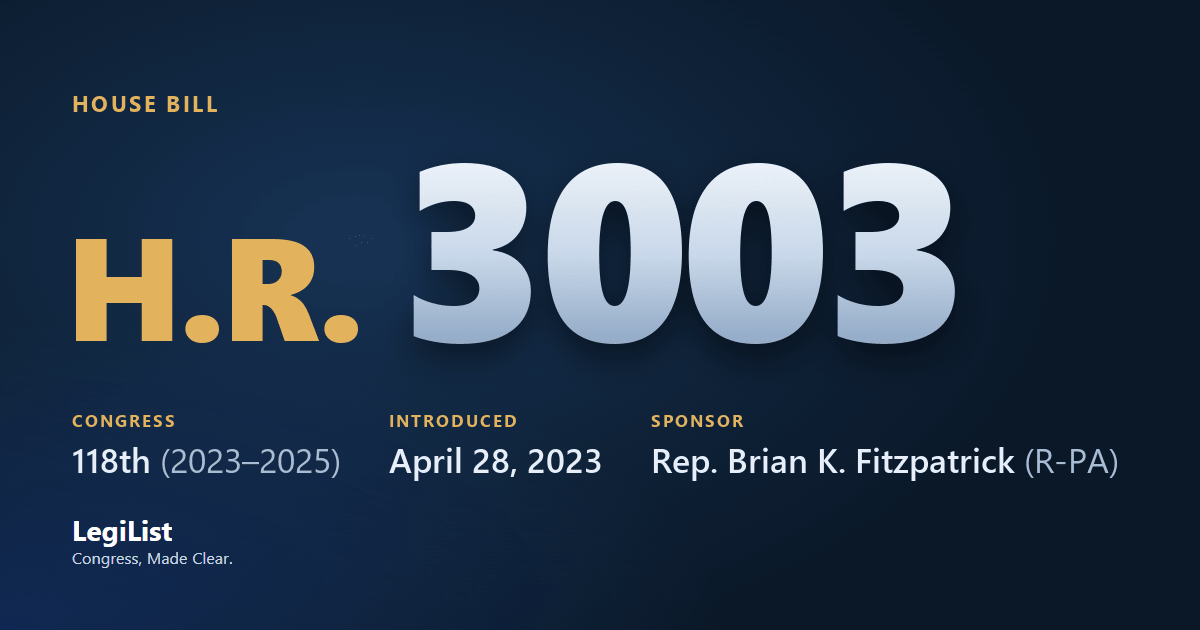
Bipartisan Restoring Faith in Government Act
Latest action · Apr 28, 2023 Referred to the Committee on House Administration, and in addition to the Committee on Ways and Means, for a period to be subsequently determined by the Speaker, in each case for consideration of such provisions as fall within the jurisdiction of the committee concerned.
Progress
Where this bill reached, and when. A stage with no date was not reached; one that failed a vote and later carried shows the date it carried.
- IntroducedApr 28, 2023
- Passed HouseNot reached
- Passed SenateNot reached
- To the PresidentNot reached
- Became lawNot reached
Summary
Bipartisan Restoring Faith in Government Act
This bill prohibits Members of Congress (and their spouses and dependents) from purchasing or selling certain investments, such as individual stocks and related financial instruments that are not diversified investment funds, U.S. Treasury securities, or other specified holdings.
Members must divest prohibited investments within 90 days by selling them or placing them in a qualified blind trust. The bill also restricts communications between trustees and beneficiaries related to investments held in qualified blind trusts.
Members must certify their compliance with the supervising ethics office, which must make the certificates publicly available online.
Violations are subject to specified civil penalties. Additionally, losses stemming from a transaction involving a prohibited investment that violates the provisions of the bill may not be deducted from income taxes.
Cosponsors 7
Members who signed on, in the order they did. Signatures ran from Apr 28, 2023 to Jun 27, 2024; 3 are original cosponsors, there from the day it was introduced.
| Seat | Cosponsor | Signed on | |
|---|---|---|---|
| D-NY | Alexandria Ocasio-Cortez | Original | Apr 28, 2023 |
| R-FL | Matt Gaetz | Original | Apr 28, 2023 |
| D-IL | Raja Krishnamoorthi | Original | Apr 28, 2023 |
| R-FL | Cory Mills | Jan 18, 2024 | |
| D-CO | Joe Neguse | Jan 18, 2024 | |
| R-NY | Michael Lawler | May 21, 2024 | |
| D-NY | Daniel S. Goldman | Jun 27, 2024 |
Committees 2
Where it was sent and what each committee and subcommittee did with it, in order.
| Chamber | Committee | What it did |
|---|---|---|
| House | Committee on House Administration | Referred Apr 28, 2023 |
| House | Ways and Means Committee | Referred Apr 28, 2023 |
Actions 2
Everything that happened, newest first.
- Apr 28, 2023Introduced in House
- Apr 28, 2023Referred to the Committee on House Administration, and in addition to the Committee on Ways and Means, for a period to be subsequently determined by the Speaker, in each case for consideration of such provisions as fall within the jurisdiction of the committee concerned.
Research
What has been written about this bill: committee reports, cost estimates, the sponsor’s authority statement, printed hearings and the Congressional Research Service’s work.
Constitutional authority
The sponsor’s statement, as printed in the Congressional Record, vol. 169, no. 72, April 28, 2023, page H2119.
CRS reports 3
Congressional Research Service work that CRS links to this bill or the law it became, newest first.
Cite it 3
Products on other subjects that cite it, usually among other measures.
| Product | Title | Kind | Published |
|---|---|---|---|
| R40962 | Members’ Representational Allowance: History and Usage | Report | Oct 13, 2026 |
| R44399 | Senators’ Official Personnel and Office Expense Account (SOPOEA): History and Usage | Report | Aug 4, 2026 |
| R47818 | Proposals to Limit Financial Activities of Members of Congress: Background and Analysis of Legislative Proposals | Report | Mar 19, 2025 |
Titles 2
Every title it has carried, official and short, at each stage.
- Official Title as Introduced
- To amend title 5, United States Code, to restrict trading and ownership of certain financial instruments by Members of Congress and their spouses and dependents, and for other purposes.
- Short Title(s) as Introduced
- Bipartisan Restoring Faith in Government Act
Subjects
Assigned by the Library of Congress. Policy area: Congress.
Text 1
Each version as it was printed, newest first.
- Apr 28, 2023Introduced in House
Support LegiList
This page is free, carries no paywall, and is built and maintained by one person. If the record here is useful to you, a few dollars keeps it going.
Everything here is as published by Congress: the summary is the Congressional Research Service's, the action wording is the clerks', and the subjects are the Library of Congress's. How far it got is read from the actions themselves, taking the most recent one of each kind, so a bill that failed a vote and later passed is shown as having passed. Records come from this bill on Congress.gov and govinfo.gov; cost estimates are the Congressional Budget Office's, and the hearings are the printed hearings GovInfo publishes, which can appear months after the hearing.