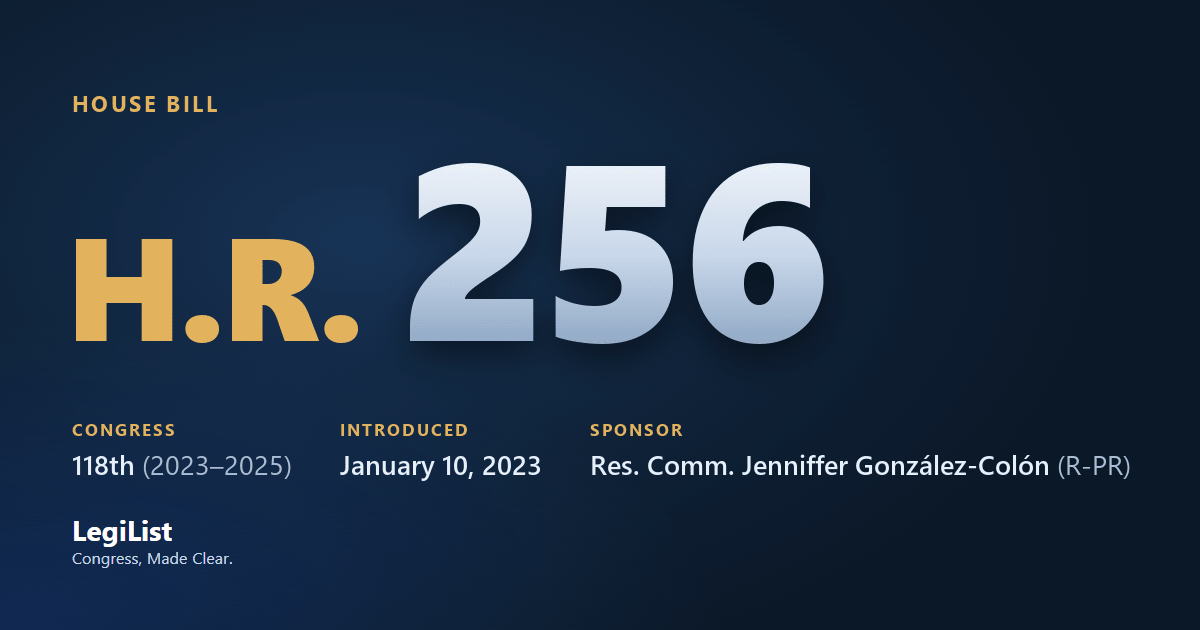
Supplemental Security Income Equality Act
Latest action · Dec 17, 2024 Referred to the Subcommittee on Work and Welfare.
Progress
Where this bill reached, and when. A stage with no date was not reached; one that failed a vote and later carried shows the date it carried.
- IntroducedJan 10, 2023
- Passed HouseNot reached
- Passed SenateNot reached
- To the PresidentNot reached
- Became lawNot reached
Summary
Supplemental Security Income Equality Act
This bill extends the Supplemental Security Income (SSI) program to Puerto Rico, the U.S. Virgin Islands, Guam, and American Samoa. This is a federal program designed to help aged, blind, and disabled individuals with limited income and resources meet basic needs. When Congress created the SSI program in 1972, it excluded these territories.
The Social Security Administration may waive or modify statutory requirements relating to the provision of benefits as necessary to adapt the SSI program to each territory.
This bill also eliminates a limit on payments from the Temporary Assistance for Needy Families (TANF) program and other Department of Health and Human Services programs to the territories.
Cosponsors 6
Members who signed on, in the order they did. Signatures ran from Jan 10, 2023 to Jan 24, 2023; 5 are original cosponsors, there from the day it was introduced.
| Seat | Cosponsor | Signed on | |
|---|---|---|---|
| D-FL | Darren Soto | Original | Jan 10, 2023 |
| D-MP | Gregorio Kilili Camacho Sablan | Original | Jan 10, 2023 |
| R-GU | James C. Moylan | Original | Jan 10, 2023 |
| D-NY | Ritchie Torres | Original | Jan 10, 2023 |
| D-VI | Stacey E. Plaskett | Original | Jan 10, 2023 |
| R-AS | Aumua Amata Coleman Radewagen | Jan 24, 2023 |
Committees 1
Where it was sent and what each committee and subcommittee did with it, in order.
| Chamber | Committee | What it did |
|---|---|---|
| House | Ways and Means Committee | Referred Jan 10, 2023 |
| Work and Welfare Subcommittee | Referred Dec 17, 2024 |
Actions 3
Everything that happened, newest first.
- Dec 17, 2024Referred to the Subcommittee on Work and Welfare.
- Jan 10, 2023Introduced in House
- Jan 10, 2023Referred to the House Committee on Ways and Means.
Research
What has been written about this bill: committee reports, cost estimates, the sponsor’s authority statement, printed hearings and the Congressional Research Service’s work.
Constitutional authority
The sponsor’s statement, as printed in the Congressional Record, vol. 169, no. 8, January 10, 2023, page H152.
Related bills 1
Companion bills and other measures the record links to this one.
| Bill | Title | Relationship | Latest action |
|---|---|---|---|
| HR 537 | Supplemental Security Income Equality Act | Reintroduction of | Jan 28, 2021 |
Titles 2
Every title it has carried, official and short, at each stage.
- Official Title as Introduced
- To extend the supplemental security income program to Puerto Rico, the United States Virgin Islands, Guam, and American Samoa, and for other purposes.
- Short Title(s) as Introduced
- Supplemental Security Income Equality Act
Subjects
Assigned by the Library of Congress. Policy area: Social Welfare.
Text 1
Each version as it was printed, newest first.
- Jan 10, 2023Introduced in House
Everything here is as published by Congress: the summary is the Congressional Research Service's, the action wording is the clerks', and the subjects are the Library of Congress's. How far it got is read from the actions themselves, taking the most recent one of each kind, so a bill that failed a vote and later passed is shown as having passed. Records come from this bill on Congress.gov and govinfo.gov; cost estimates are the Congressional Budget Office's, and the hearings are the printed hearings GovInfo publishes, which can appear months after the hearing.