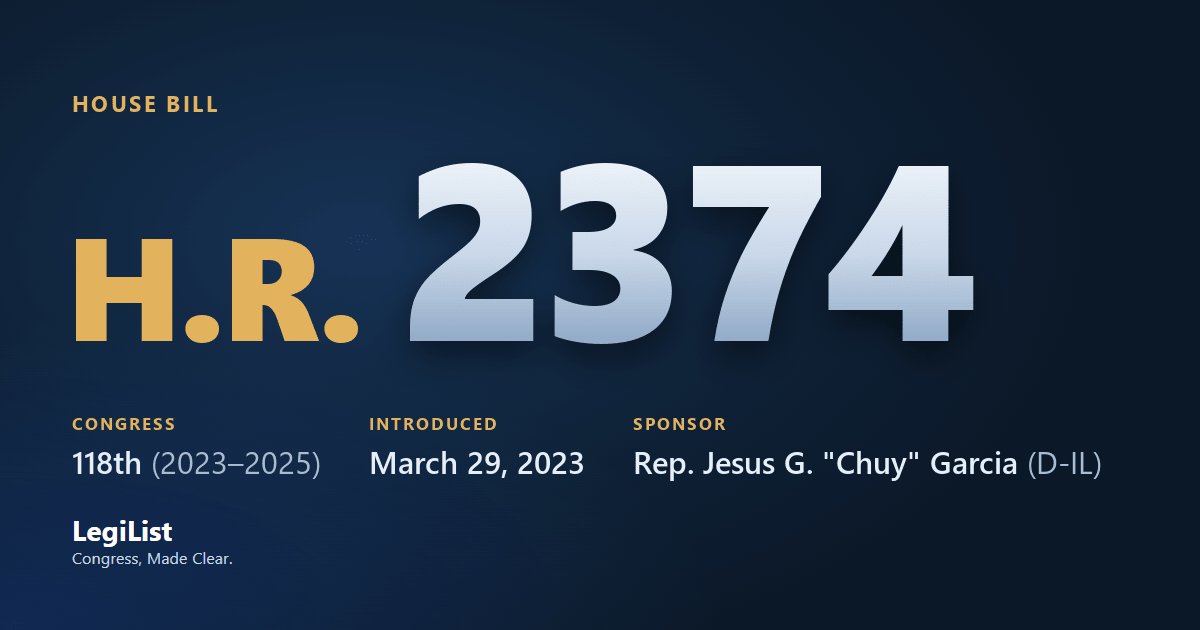
New Way Forward Act
Latest action · Mar 29, 2023 Referred to the House Committee on the Judiciary.
Progress
Where this bill reached, and when. A stage with no date was not reached; one that failed a vote and later carried shows the date it carried.
- IntroducedMar 29, 2023
- Passed HouseNot reached
- Passed SenateNot reached
- To the PresidentNot reached
- Became lawNot reached
Summary
New Way Forward Act
This bill makes changes to immigration enforcement, including ending mandatory detention in certain cases.
The Department of Homeland Security (DHS) may not enter into or extend any contract with any for-profit entity to own or operate a detention facility.
The bill provides for various protections related to detaining non-U.S. nationals (aliens under federal law), such as (1) requiring DHS to make an initial custody determination and establish probable cause within 48 hours of taking an individual into custody, (2) establishing in hearings related to such determinations a presumption that the individual be released, and (3) requiring immigration judges to impose the least restrictive detention conditions necessary.
A DHS officer may not interrogate an individual as to immigration status based on factors such as the individual's race, religion, or spoken language.
The bill removes mandatory detention requirements for certain individuals, such as asylum seekers with a credible fear of persecution.
Certain individuals who were previously admitted into the United States may be removed only if removal proceedings commenced within five years of the individual becoming deportable or inadmissible. The bill also removes certain crime-related grounds of inadmissibility and deportability.
The bill gives immigration judges discretion to provide relief from removal if the removal is not based on certain crime-related grounds.
State or local officers are prohibited from performing certain immigration enforcement functions. The National Crime Information Center database may not contain an individual's immigration information.
The bill repeals criminal penalties for improper entry or reentry into the United States.
Cosponsors 33
Members who signed on, in the order they did. Signatures ran from Mar 29, 2023 to Apr 9, 2024; 30 are original cosponsors, there from the day it was introduced.
| Seat | Cosponsor | Signed on | |
|---|---|---|---|
| D-NY | Adriano Espaillat | Original | Mar 29, 2023 |
| D-NY | Alexandria Ocasio-Cortez | Original | Mar 29, 2023 |
| D-MA | Ayanna Pressley | Original | Mar 29, 2023 |
| D-NJ | Bonnie Watson Coleman | Original | Mar 29, 2023 |
| D-MO | Cori Bush | Original | Mar 29, 2023 |
| D-IL | Delia C. Ramirez | Original | Mar 29, 2023 |
| D-OR | Earl Blumenauer | Original | Mar 29, 2023 |
| D-DC | Eleanor Holmes Norton | Original | Mar 29, 2023 |
| D-FL | Frederica S. Wilson | Original | Mar 29, 2023 |
| D-CA | Grace F. Napolitano | Original | Mar 29, 2023 |
| D-NY | Grace Meng | Original | Mar 29, 2023 |
| D-TX | Greg Casar | Original | Mar 29, 2023 |
| D-GA | Henry C. "Hank" Johnson, Jr. | Original | Mar 29, 2023 |
| D-MN | Ilhan Omar | Original | Mar 29, 2023 |
| D-NY | Jamaal Bowman | Original | Mar 29, 2023 |
| D-MA | James P. McGovern | Original | Mar 29, 2023 |
| D-IL | Janice D. Schakowsky | Original | Mar 29, 2023 |
| D-CA | Jimmy Gomez | Original | Mar 29, 2023 |
| D-CA | Juan Vargas | Original | Mar 29, 2023 |
| D-CA | Judy Chu | Original | Mar 29, 2023 |
| D-WI | Mark Pocan | Original | Mar 29, 2023 |
| D-FL | Maxwell Frost | Original | Mar 29, 2023 |
| D-CA | Nanette Diaz Barragán | Original | Mar 29, 2023 |
| D-GA | Nikema Williams | Original | Mar 29, 2023 |
| D-NY | Nydia M. Velázquez | Original | Mar 29, 2023 |
| D-MI | Rashida Tlaib | Original | Mar 29, 2023 |
| D-AZ | Raúl M. Grijalva | Original | Mar 29, 2023 |
| D-TX | Sylvia R. Garcia | Original | Mar 29, 2023 |
| D-CA | Tony Cárdenas | Original | Mar 29, 2023 |
| D-NY | Yvette D. Clarke | Original | Mar 29, 2023 |
| D-NY | Daniel S. Goldman | Sep 8, 2023 | |
| D-MN | Betty McCollum | Nov 7, 2023 | |
| D-IL | Mike Quigley | Apr 9, 2024 |
Committees 1
Where it was sent and what each committee and subcommittee did with it, in order.
| Chamber | Committee | What it did |
|---|---|---|
| House | Judiciary Committee | Referred Mar 29, 2023 |
Actions 2
Everything that happened, newest first.
- Mar 29, 2023Introduced in House
- Mar 29, 2023Referred to the House Committee on the Judiciary.
Research
What has been written about this bill: committee reports, cost estimates, the sponsor’s authority statement, printed hearings and the Congressional Research Service’s work.
Constitutional authority
The sponsor’s statement, as printed in the Congressional Record, vol. 169, no. 57, March 29, 2023, page H1659.
CRS reports 1
Congressional Research Service work that CRS links to this bill or the law it became, newest first.
Cite it 1
Products on other subjects that cite it, usually among other measures.
| Product | Title | Kind | Published |
|---|---|---|---|
| IF11438 | “Sanctuary” Jurisdictions: Policy Overview | Resource | Mar 4, 2025 |
Related bills 1
Companion bills and other measures the record links to this one.
| Bill | Title | Relationship | Latest action |
|---|---|---|---|
| HR 4727 | No Obamacare for Illegal Aliens Act of 2023 | Related bill | Dec 17, 2024 |
Titles 2
Every title it has carried, official and short, at each stage.
- Official Title as Introduced
- To reform the process for enforcing the immigration laws of the United States, and for other purposes.
- Short Title(s) as Introduced
- New Way Forward Act
Subjects
Assigned by the Library of Congress. Policy area: Immigration.
Text 1
Each version as it was printed, newest first.
- Mar 29, 2023Introduced in House
Everything here is as published by Congress: the summary is the Congressional Research Service's, the action wording is the clerks', and the subjects are the Library of Congress's. How far it got is read from the actions themselves, taking the most recent one of each kind, so a bill that failed a vote and later passed is shown as having passed. Records come from this bill on Congress.gov and govinfo.gov; cost estimates are the Congressional Budget Office's, and the hearings are the printed hearings GovInfo publishes, which can appear months after the hearing.