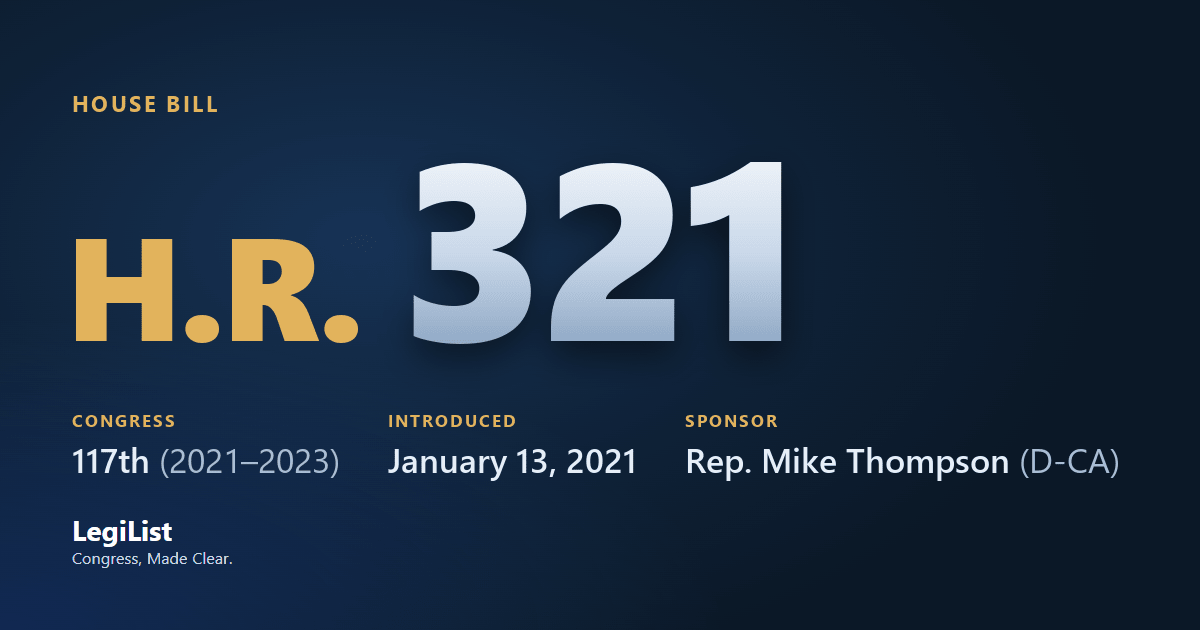
FEED Act
Latest action · Feb 4, 2021 Referred to the Subcommittee on Economic Development, Public Buildings, and Emergency Management.
Progress
Where this bill reached, and when. A stage with no date was not reached; one that failed a vote and later carried shows the date it carried.
- IntroducedJan 13, 2021
- Passed HouseNot reached
- Passed SenateNot reached
- To the PresidentNot reached
- Became lawNot reached
Summary
FEMA Empowering Essential Deliveries Act or the FEED Act
This bill authorizes the Federal Emergency Management Agency (FEMA) to approve state, local, and Indian tribal government plans to partner with small and mid-size restaurants and nonprofit organizations to provide nutritious meals to individuals in need.
Specifically, during the period following the President's emergency declaration of March 13, 2020, and under any subsequent major disaster declaration that supersedes it, FEMA may approve plans from state, local, and Indian tribal governments that (1) establish contracts with small and mid-sized restaurants and nonprofits, including faith-based organizations and soup kitchens, to prepare healthy meals for people in need; and (2) provide for partnerships with nonprofit organizations to purchase directly from food producers and farmers.
FEMA shall waive federal matching requirements under the Robert T. Stafford Disaster Relief and Emergency Assistance Act during such period.
Cosponsors 30
Members who signed on, in the order they did. All signed on Jan 13, 2021.
| Seat | Cosponsor | Signed on | |
|---|---|---|---|
| D-CA | Alan S. Lowenthal | Original | Jan 13, 2021 |
| D-CA | Ami Bera | Original | Jan 13, 2021 |
| D-NH | Ann M. Kuster | Original | Jan 13, 2021 |
| D-CA | Anna G. Eshoo | Original | Jan 13, 2021 |
| D-IL | Bill Foster | Original | Jan 13, 2021 |
| D-IL | Bobby L. Rush | Original | Jan 13, 2021 |
| D-ME | Chellie Pingree | Original | Jan 13, 2021 |
| D-PA | Conor Lamb | Original | Jan 13, 2021 |
| D-NV | Dina Titus | Original | Jan 13, 2021 |
| D-OR | Earl Blumenauer | Original | Jan 13, 2021 |
| D-VA | Elaine G. Luria | Original | Jan 13, 2021 |
| D-DC | Eleanor Holmes Norton | Original | Jan 13, 2021 |
| D-NY | Grace Meng | Original | Jan 13, 2021 |
| D-CT | Jahana Hayes | Original | Jan 13, 2021 |
| D-MA | James P. McGovern | Original | Jan 13, 2021 |
Committees 1
Where it was sent and what each committee and subcommittee did with it, in order.
| Chamber | Committee | What it did |
|---|---|---|
| House | Transportation and Infrastructure Committee | Referred Jan 13, 2021 |
| Economic Development, Public Buildings, and Emergency Management Subcommittee | Referred Feb 4, 2021 |
Actions 3
Everything that happened, newest first.
- Feb 4, 2021Referred to the Subcommittee on Economic Development, Public Buildings, and Emergency Management.
- Jan 13, 2021Introduced in House
- Jan 13, 2021Referred to the House Committee on Transportation and Infrastructure.
Research
What has been written about this bill: committee reports, cost estimates, the sponsor’s authority statement, printed hearings and the Congressional Research Service’s work.
Constitutional authority
The sponsor’s statement, as printed in the Congressional Record, vol. 167, no. 8, January 13, 2021, page H195.
Related bills 2
Companion bills and other measures the record links to this one.
Titles 3
Every title it has carried, official and short, at each stage.
- Official Title as Introduced
- To authorize the Administrator of the Federal Emergency Management Agency to approve State, local, and Indian tribal government plans to partner with small and mid-size restaurants and nonprofit organizations to provide nutritious meals to individuals in need, to waive certain matching fund requirements, and for other purposes.
- Short Title(s) as Introduced
- FEED Act
- FEMA Empowering Essential Deliveries Act
Subjects
Assigned by the Library of Congress. Policy area: Emergency Management.
- Administrative law and regulatory procedures
- Disaster relief and insurance
- Emergency Management
- Emergency planning and evacuation
- Federal Emergency Management Agency (FEMA)
- Food assistance and relief
- Food supply, safety, and labeling
- Public contracts and procurement
- Public-private cooperation
- State and local government operations
Text 1
Each version as it was printed, newest first.
- Jan 13, 2021Introduced in House
Support LegiList
This page is free, carries no paywall, and is built and maintained by one person. If the record here is useful to you, a few dollars keeps it going.
Everything here is as published by Congress: the summary is the Congressional Research Service's, the action wording is the clerks', and the subjects are the Library of Congress's. How far it got is read from the actions themselves, taking the most recent one of each kind, so a bill that failed a vote and later passed is shown as having passed. Records come from this bill on Congress.gov and govinfo.gov; cost estimates are the Congressional Budget Office's, and the hearings are the printed hearings GovInfo publishes, which can appear months after the hearing.