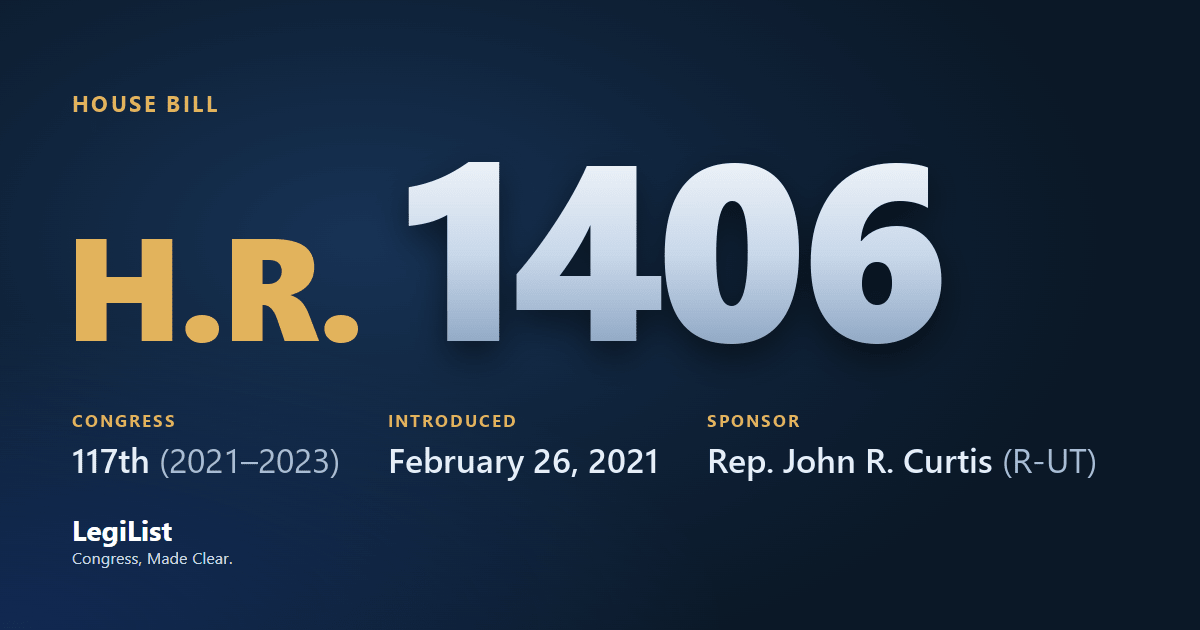
COVID–19 Emergency Telehealth Impact Reporting Act of 2021
Latest action · Feb 27, 2021 Referred to the Subcommittee on Health.
Progress
Where this bill reached, and when. A stage with no date was not reached; one that failed a vote and later carried shows the date it carried.
- IntroducedFeb 26, 2021
- Passed HouseNot reached
- Passed SenateNot reached
- To the PresidentNot reached
- Became lawNot reached
Summary
COVID-19 Emergency Telehealth Impact Reporting Act of 2021
This bill requires the Department of Health and Human Services (HHS) to analyze the impact of expanded Medicare telehealth services that were authorized through emergency waivers related to the COVID-19 (i.e., coronavirus disease 2019) pandemic.
In developing this analysis, HHS must seek input from the Medicare Payment Advisory Commission, the Medicaid and CHIP Payment and Access Commission, and other stakeholders.
Additionally, the final report of the analysis must include conclusions about the impact of telehealth on health care delivery and estimates for Medicare spending on telehealth during the COVID-19 emergency.
Cosponsors 5
Members who signed on, in the order they did. Signatures ran from Feb 26, 2021 to Apr 20, 2021; 2 are original cosponsors, there from the day it was introduced.
| Seat | Cosponsor | Signed on | |
|---|---|---|---|
| D-CA | Doris O. Matsui | Original | Feb 26, 2021 |
| D-VT | Peter Welch | Original | Feb 26, 2021 |
| R-TX | Michael C. Burgess | Mar 3, 2021 | |
| D-DE | Lisa Blunt Rochester | Apr 20, 2021 | |
| D-CA | Scott H. Peters | Apr 20, 2021 |
Committees 2
Where it was sent and what each committee and subcommittee did with it, in order.
| Chamber | Committee | What it did |
|---|---|---|
| House | Energy and Commerce Committee | Referred Feb 26, 2021 |
| Health Subcommittee | Referred Feb 27, 2021 | |
| House | Ways and Means Committee | Referred Feb 26, 2021 |
Actions 3
Everything that happened, newest first.
- Feb 27, 2021Referred to the Subcommittee on Health.
- Feb 26, 2021Introduced in House
- Feb 26, 2021Referred to the Committee on Energy and Commerce, and in addition to the Committee on Ways and Means, for a period to be subsequently determined by the Speaker, in each case for consideration of such provisions as fall within the jurisdiction of the committee concerned.
Research
What has been written about this bill: committee reports, cost estimates, the sponsor’s authority statement, printed hearings and the Congressional Research Service’s work.
Constitutional authority
The sponsor’s statement, as printed in the Congressional Record, vol. 167, no. 37, February 26, 2021, page H859.
Related bills 2
Companion bills and other measures the record links to this one.
| Bill | Title | Relationship | Latest action |
|---|---|---|---|
| HR 366 | Protecting Access to Post-COVID–19 Telehealth Act of 2021 | Related bill | Feb 2, 2021 |
| HR 7695 | COVID–19 Emergency Telehealth Impact Reporting Act of 2020 | Reintroduction of | Jul 21, 2020 |
Titles 2
Every title it has carried, official and short, at each stage.
- Official Title as Introduced
- To require the Secretary of Health and Human Services to collect, analyze, and report qualitative and quantitative data on the use of telehealth during the COVID-19 public health emergency.
- Short Title(s) as Introduced
- COVID–19 Emergency Telehealth Impact Reporting Act of 2021
Subjects
Assigned by the Library of Congress. Policy area: Health.
- Cardiovascular and respiratory health
- Computer security and identity theft
- Computers and information technology
- Congressional oversight
- Drug, alcohol, tobacco use
- Emergency medical services and trauma care
- Government information and archives
- Health
- Health care coverage and access
- Health care quality
- Health facilities and institutions
- Health information and medical records
- Health programs administration and funding
- Health promotion and preventive care
- Health technology, devices, supplies
- Hospital care
- Infectious and parasitic diseases
- Internet and video services
- Internet, web applications, social media
- Medicare
- Mental health
- Minority health
- Racial and ethnic relations
- Right of privacy
- Rural conditions and development
- Telephone and wireless communication
Text 1
Each version as it was printed, newest first.
- Feb 26, 2021Introduced in House
Support LegiList
This page is free, carries no paywall, and is built and maintained by one person. If the record here is useful to you, a few dollars keeps it going.
Everything here is as published by Congress: the summary is the Congressional Research Service's, the action wording is the clerks', and the subjects are the Library of Congress's. How far it got is read from the actions themselves, taking the most recent one of each kind, so a bill that failed a vote and later passed is shown as having passed. Records come from this bill on Congress.gov and govinfo.gov; cost estimates are the Congressional Budget Office's, and the hearings are the printed hearings GovInfo publishes, which can appear months after the hearing.