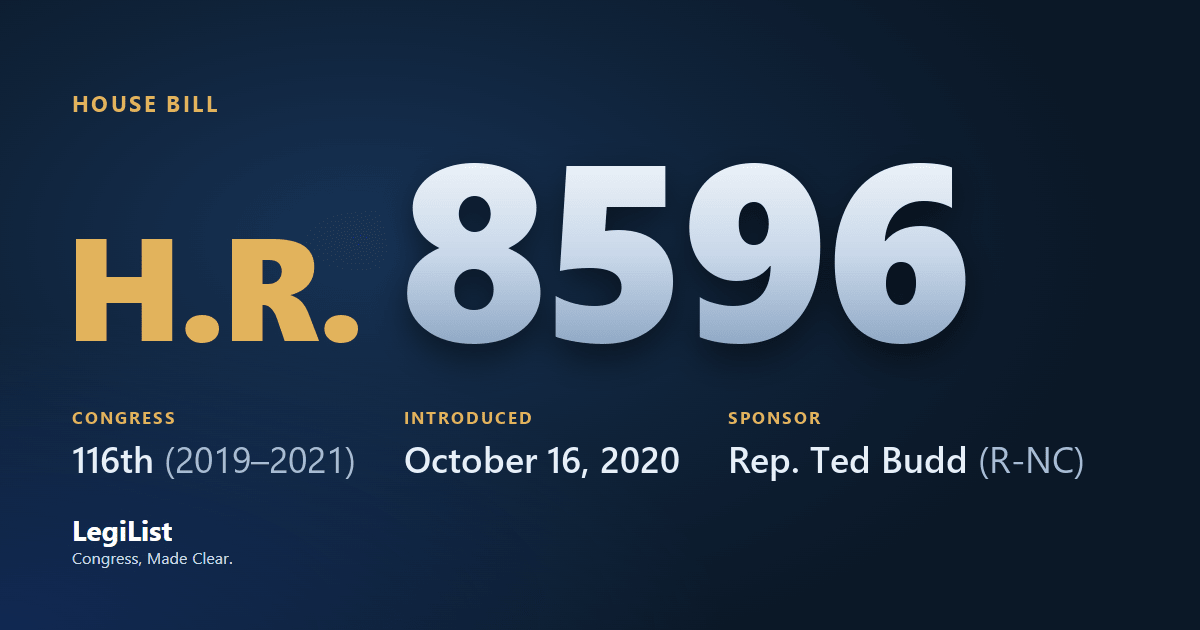
Limiting Section 230 Immunity to Good Samaritans Act
Latest action · Oct 16, 2020 Referred to the House Committee on Energy and Commerce.
Progress
Where this bill reached, and when. A stage with no date was not reached; one that failed a vote and later carried shows the date it carried.
- IntroducedOct 16, 2020
- Passed HouseNot reached
- Passed SenateNot reached
- To the PresidentNot reached
- Became lawNot reached
Summary
Limiting Section 230 Immunity to Good Samaritans Act
This bill requires an edge provider of an interactive computer service (e.g., social media website) to adopt and maintain written terms of service binding itself to a contractual duty of good faith in order to qualify for the statutory protection against being treated as the publisher of information distributed through the service by a third party.
An edge provider is a provider of an interactive computer service through which information published by other content providers is distributed and that has more than (1) $1.5 billion in annual global revenue, and (2) 30 million monthly users in the United States or 300 million monthly users worldwide.
Cosponsors 7
Members who signed on, in the order they did. Signatures ran from Oct 16, 2020 to Oct 23, 2020; 6 are original cosponsors, there from the day it was introduced.
| Seat | Cosponsor | Signed on | |
|---|---|---|---|
| R-AZ | Andy Biggs | Original | Oct 16, 2020 |
| R-TX | Bill Flores | Original | Oct 16, 2020 |
| R-NC | Dan Bishop | Original | Oct 16, 2020 |
| R-AR | Eric A. "Rick" Crawford | Original | Oct 16, 2020 |
| R-TX | Lance Gooden | Original | Oct 16, 2020 |
| R-FL | Michael Waltz | Original | Oct 16, 2020 |
| R-FL | Ted S. Yoho | Oct 23, 2020 |
Committees 1
Where it was sent and what each committee and subcommittee did with it, in order.
| Chamber | Committee | What it did |
|---|---|---|
| House | Energy and Commerce Committee | Referred Oct 16, 2020 |
Actions 2
Everything that happened, newest first.
- Oct 16, 2020Introduced in House
- Oct 16, 2020Referred to the House Committee on Energy and Commerce.
Research
What has been written about this bill: committee reports, cost estimates, the sponsor’s authority statement, printed hearings and the Congressional Research Service’s work.
Constitutional authority
The sponsor’s statement, as printed in the Congressional Record, vol. 166, no. 177, October 16, 2020, page H5694.
Related bills 2
Companion bills and other measures the record links to this one.
| Bill | Title | Relationship | Latest action |
|---|---|---|---|
| HR 277 | Limiting Section 230 Immunity to Good Samaritans Act | Reintroduced Bill | Feb 2, 2021 |
| S 3983 | Limiting Section 230 Immunity to Good Samaritans Act | Identical bill | Jun 17, 2020 |
Titles 2
Every title it has carried, official and short, at each stage.
- Official Title as Introduced
- To amend the Communications Act of 1934 to provide accountability for bad actors who abuse the Good Samaritan protections provided under that Act, and for other purposes.
- Short Title(s) as Introduced
- Limiting Section 230 Immunity to Good Samaritans Act
Subjects
Assigned by the Library of Congress. Policy area: Science, Technology, Communications.
Text 1
Each version as it was printed, newest first.
- Oct 16, 2020Introduced in House
Everything here is as published by Congress: the summary is the Congressional Research Service's, the action wording is the clerks', and the subjects are the Library of Congress's. How far it got is read from the actions themselves, taking the most recent one of each kind, so a bill that failed a vote and later passed is shown as having passed. Records come from this bill on Congress.gov and govinfo.gov; cost estimates are the Congressional Budget Office's, and the hearings are the printed hearings GovInfo publishes, which can appear months after the hearing.