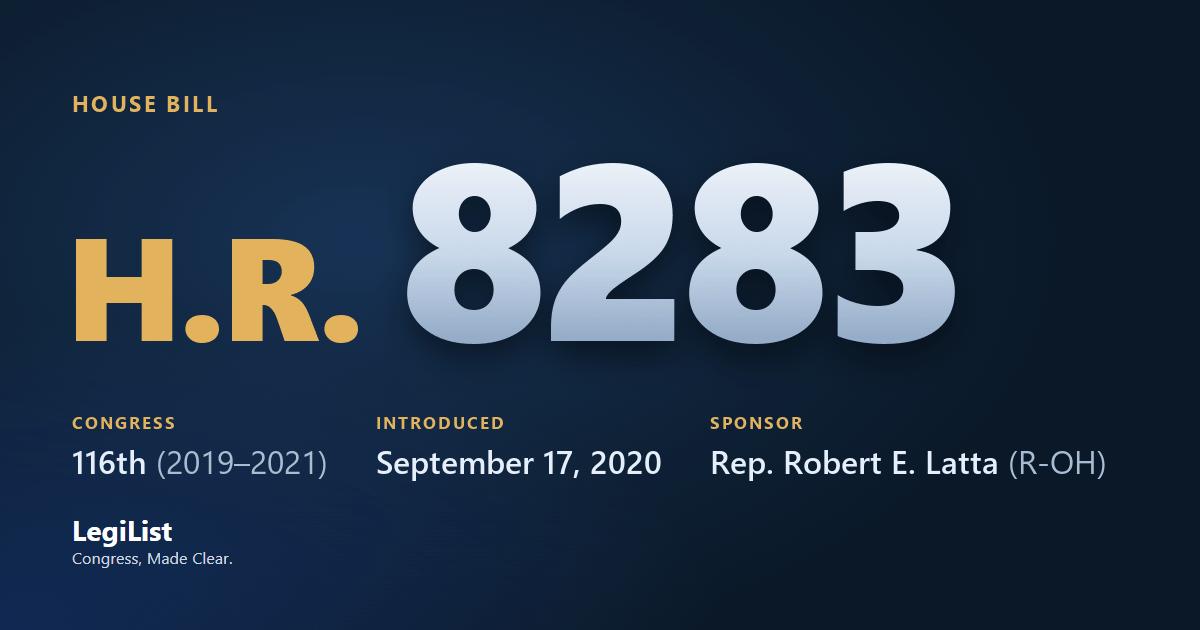
TREAT Act
Latest action · Sep 17, 2020 Referred to the House Committee on Energy and Commerce.
Progress
Where this bill reached, and when. A stage with no date was not reached; one that failed a vote and later carried shows the date it carried.
- IntroducedSep 17, 2020
- Passed HouseNot reached
- Passed SenateNot reached
- To the PresidentNot reached
- Became lawNot reached
Summary
Temporary Reciprocity to Ensure Access to Treatment Act or the TREAT Act
This bill temporarily allows, subject to scope of practice and other requirements, a health care professional to provide in-person and telehealth services in any U.S. jurisdiction based on that individual's authorization to practice in any one state or territory.
Specifically, health care professionals may provide these services in jurisdictions other than where they are licensed, certified, or authorized to practice for up to 180 days after the end of the COVID-19 (i.e., coronavirus disease 2019) emergency. In addition, the bill provides certain authorities to health care professional regulatory bodies, such as medical boards, to investigate and take disciplinary actions against a professional who provides telehealth services to a patient in that organization's jurisdiction pursuant to this bill.
The bill also permits the Department of Health and Human Services to similarly expand the authority of health care professionals to provide these services in the event of future major disasters or emergencies.
Cosponsors 8
Members who signed on, in the order they did. Signatures ran from Sep 17, 2020 to Nov 30, 2020; 1 is an original cosponsor, there from the day it was introduced.
| Seat | Cosponsor | Signed on | |
|---|---|---|---|
| D-MI | Debbie Dingell | Original | Sep 17, 2020 |
| D-MD | C. A. Dutch Ruppersberger | Sep 24, 2020 | |
| D-MD | Jamie Raskin | Sep 24, 2020 | |
| D-MD | Anthony G. Brown | Sep 29, 2020 | |
| D-MD | David J. Trone | Sep 30, 2020 | |
| D-PA | Dwight Evans | Oct 20, 2020 | |
| D-PA | Mary Gay Scanlon | Oct 23, 2020 | |
| R-AZ | Debbie Lesko | Nov 30, 2020 |
Committees 1
Where it was sent and what each committee and subcommittee did with it, in order.
| Chamber | Committee | What it did |
|---|---|---|
| House | Energy and Commerce Committee | Referred Sep 17, 2020 |
Actions 2
Everything that happened, newest first.
- Sep 17, 2020Introduced in House
- Sep 17, 2020Referred to the House Committee on Energy and Commerce.
Research
What has been written about this bill: committee reports, cost estimates, the sponsor’s authority statement, printed hearings and the Congressional Research Service’s work.
Constitutional authority
The sponsor’s statement, as printed in the Congressional Record, vol. 166, no. 161, September 17, 2020, page H4542.
Related bills 2
Companion bills and other measures the record links to this one.
Titles 3
Every title it has carried, official and short, at each stage.
- Official Title as Introduced
- To provide temporary licensing reciprocity for telehealth and interstate health care treatment.
- Short Title(s) as Introduced
- TREAT Act
- Temporary Reciprocity to Ensure Access to Treatment Act
Subjects
Assigned by the Library of Congress. Policy area: Health.
- Cardiovascular and respiratory health
- Disaster relief and insurance
- Emergency medical services and trauma care
- Health
- Health personnel
- Health technology, devices, supplies
- Infectious and parasitic diseases
- Intergovernmental relations
- Internet and video services
- Internet, web applications, social media
- Licensing and registrations
- State and local government operations
Text 1
Each version as it was printed, newest first.
- Sep 17, 2020Introduced in House
Everything here is as published by Congress: the summary is the Congressional Research Service's, the action wording is the clerks', and the subjects are the Library of Congress's. How far it got is read from the actions themselves, taking the most recent one of each kind, so a bill that failed a vote and later passed is shown as having passed. Records come from this bill on Congress.gov and govinfo.gov; cost estimates are the Congressional Budget Office's, and the hearings are the printed hearings GovInfo publishes, which can appear months after the hearing.