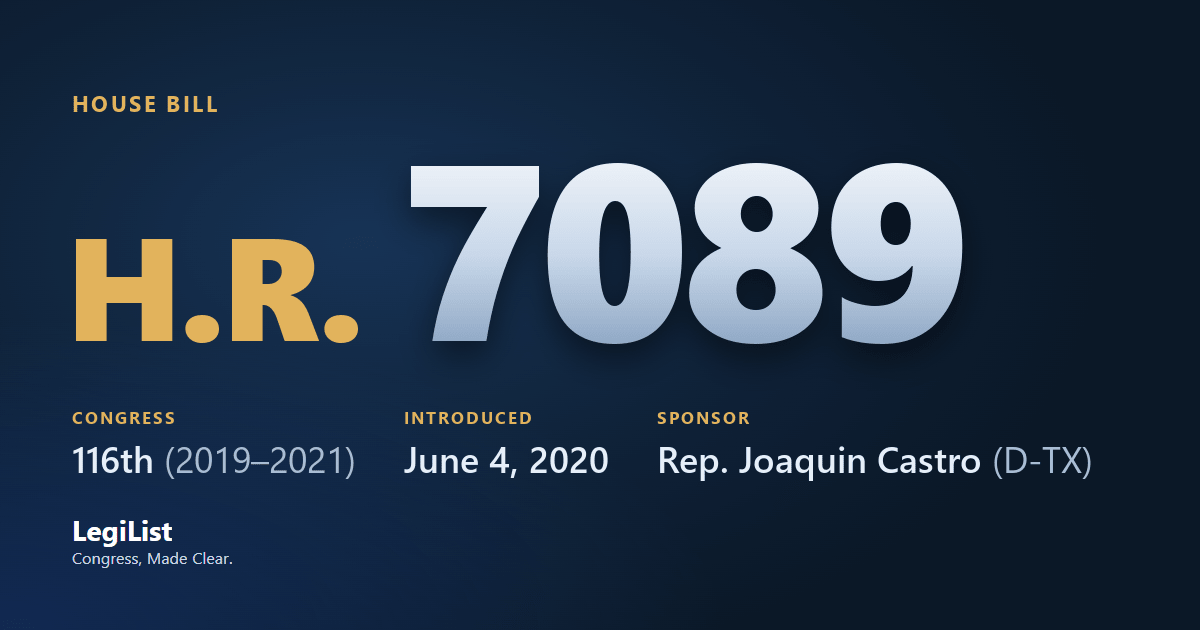
PRIDE Act
Latest action · Jun 4, 2020 Referred to the House Committee on the Judiciary.
Progress
Where this bill reached, and when. A stage with no date was not reached; one that failed a vote and later carried shows the date it carried.
- IntroducedJun 4, 2020
- Passed HouseNot reached
- Passed SenateNot reached
- To the PresidentNot reached
- Became lawNot reached
Summary
Police Reporting Information, Data, and Evidence Act of 2020 or the PRIDE Act
This bill establishes new reporting requirements related to use-of-force incidents involving a law enforcement officer and civilian.
Specifically, it requires a state or Indian tribe that receives funding under the Edward Byrne Memorial Justice Assistance Grant (JAG) program to report on use-of-force incidents involving a law enforcement officer and a civilian.
The Department of Justice (DOJ) may reduce by up to 10% the JAG allocation of a state or Indian tribe that fails to comply.
The bill also authorizes DOJ to make grants to law enforcement agencies to comply with the use-of-force reporting requirements, as well as to promote public awareness and train law enforcement personnel with respect to use-of-force incidents.
Cosponsors 17
Members who signed on, in the order they did. Signatures ran from Jun 8, 2020 to Jun 15, 2020.
| Seat | Cosponsor | Signed on | |
|---|---|---|---|
| D-FL | Alcee L. Hastings | Jun 8, 2020 | |
| D-IL | Bobby L. Rush | Jun 8, 2020 | |
| D-NJ | Bonnie Watson Coleman | Jun 8, 2020 | |
| D-DC | Eleanor Holmes Norton | Jun 8, 2020 | |
| D-CT | Jahana Hayes | Jun 8, 2020 | |
| D-MA | James P. McGovern | Jun 8, 2020 | |
| D-CA | Jerry McNerney | Jun 8, 2020 | |
| D-IL | Jesús G. "Chuy" García | Jun 8, 2020 | |
| D-MA | Joseph P. Kennedy III | Jun 8, 2020 | |
| D-OH | Joyce Beatty | Jun 8, 2020 | |
| D-CA | Nanette Diaz Barragán | Jun 8, 2020 | |
| D-AZ | Ruben Gallego | Jun 8, 2020 | |
| D-MA | Stephen F. Lynch | Jun 8, 2020 | |
| D-WA | Suzan K. DelBene | Jun 8, 2020 | |
| D-IL | Janice D. Schakowsky | Jun 15, 2020 | |
| D-CA | Jared Huffman | Jun 15, 2020 | |
| D-GU | Michael F. Q. San Nicolas | Jun 15, 2020 |
Committees 1
Where it was sent and what each committee and subcommittee did with it, in order.
| Chamber | Committee | What it did |
|---|---|---|
| House | Judiciary Committee | Referred Jun 4, 2020 |
Actions 2
Everything that happened, newest first.
- Jun 4, 2020Introduced in House
- Jun 4, 2020Referred to the House Committee on the Judiciary.
Research
What has been written about this bill: committee reports, cost estimates, the sponsor’s authority statement, printed hearings and the Congressional Research Service’s work.
Constitutional authority
The sponsor’s statement, as printed in the Congressional Record, vol. 166, no. 104, June 4, 2020, page H2368.
Related bills 4
Companion bills and other measures the record links to this one.
| Bill | Title | Relationship | Latest action |
|---|---|---|---|
| S 697 | Next Step Act of 2019 | Related bill | Mar 7, 2019 |
| HR 1893 | Next Step Act of 2019 | Related bill | Apr 8, 2019 |
| S 3912 | Justice in Policing Act of 2020 | Related bill | Jun 8, 2020 |
| HR 7120 | George Floyd Justice in Policing Act of 2020 | Related bill | Jul 20, 2020 |
Titles 3
Every title it has carried, official and short, at each stage.
- Official Title as Introduced
- To reform law enforcement practices, and for other purposes.
- Short Title(s) as Introduced
- PRIDE Act
- Police Reporting Information, Data, and Evidence Act of 2020
Subjects
Assigned by the Library of Congress. Policy area: Crime and Law Enforcement.
- Crime and Law Enforcement
- Criminal investigation, prosecution, interrogation
- Criminal justice information and records
- Firearms and explosives
- Government information and archives
- Government studies and investigations
- Intergovernmental relations
- Law enforcement administration and funding
- Law enforcement officers
- State and local government operations
Text 1
Each version as it was printed, newest first.
- Jun 4, 2020Introduced in House
Everything here is as published by Congress: the summary is the Congressional Research Service's, the action wording is the clerks', and the subjects are the Library of Congress's. How far it got is read from the actions themselves, taking the most recent one of each kind, so a bill that failed a vote and later passed is shown as having passed. Records come from this bill on Congress.gov and govinfo.gov; cost estimates are the Congressional Budget Office's, and the hearings are the printed hearings GovInfo publishes, which can appear months after the hearing.