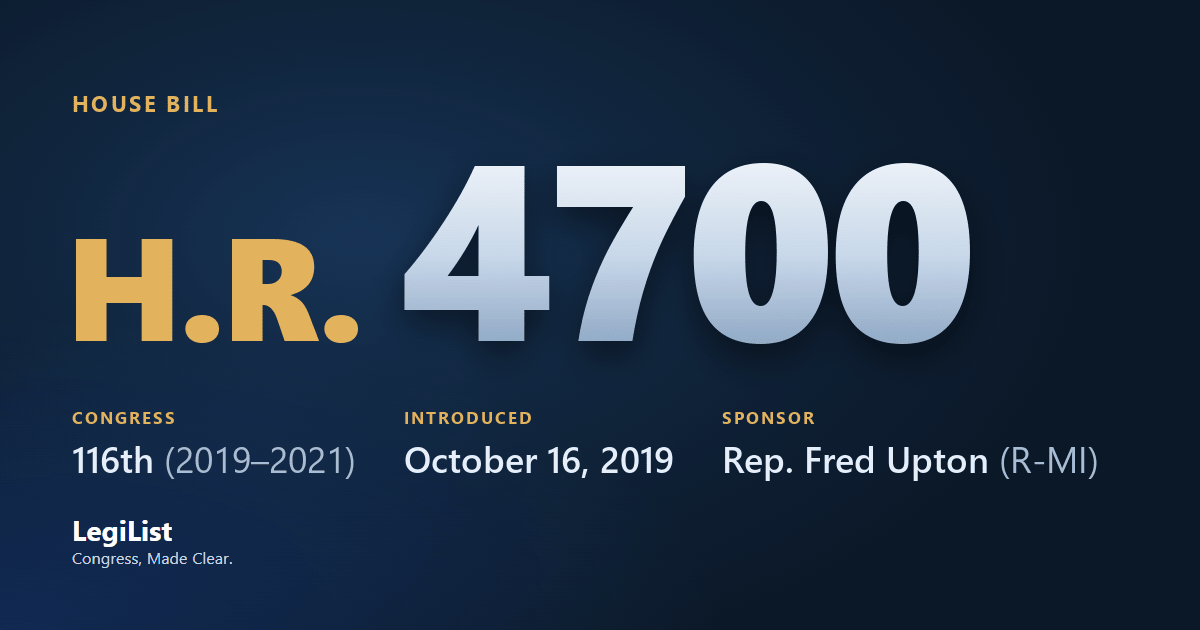
Pipeline Safety Act of 2019
Latest action · Oct 17, 2019 Referred to the Subcommittee on Energy.
Progress
Where this bill reached, and when. A stage with no date was not reached; one that failed a vote and later carried shows the date it carried.
- IntroducedOct 16, 2019
- Passed HouseNot reached
- Passed SenateNot reached
- To the PresidentNot reached
- Became lawNot reached
Summary
Pipeline Safety Act of 2019
This bill reauthorizes appropriations through FY2021 and provides direct hire authority for pipeline safety activities.
Cosponsors 24
Members who signed on, in the order they did. Signatures ran from Oct 16, 2019 to Dec 18, 2019; 15 are original cosponsors, there from the day it was introduced.
| Seat | Cosponsor | Signed on | |
|---|---|---|---|
| R-IL | Adam Kinzinger | Original | Oct 16, 2019 |
| R-TX | Bill Flores | Original | Oct 16, 2019 |
| R-OH | Bill Johnson | Original | Oct 16, 2019 |
| R-WA | Cathy McMorris Rodgers | Original | Oct 16, 2019 |
| R-WV | David B. McKinley | Original | Oct 16, 2019 |
| R-OR | Greg Walden | Original | Oct 16, 2019 |
| R-VA | H. Morgan Griffith | Original | Oct 16, 2019 |
| R-SC | Jeff Duncan | Original | Oct 16, 2019 |
| R-IL | John Shimkus | Original | Oct 16, 2019 |
| R-IN | Larry Bucshon | Original | Oct 16, 2019 |
| R-OK | Markwayne Mullin | Original | Oct 16, 2019 |
| R-TX | Pete Olson | Original | Oct 16, 2019 |
| R-NC | Richard Hudson | Original | Oct 16, 2019 |
| R-OH | Robert E. Latta | Original | Oct 16, 2019 |
| R-MI | Tim Walberg | Original | Oct 16, 2019 |
| R-MO | Billy Long | Oct 23, 2019 | |
| R-KY | Brett Guthrie | Oct 23, 2019 | |
| R-GA | Earl L. "Buddy" Carter | Oct 23, 2019 | |
| R-MT | Greg Gianforte | Oct 23, 2019 | |
| R-FL | Gus M. Bilirakis | Oct 23, 2019 | |
| R-TX | Michael C. Burgess | Oct 23, 2019 | |
| R-LA | Steve Scalise | Oct 23, 2019 | |
| R-IN | Susan W. Brooks | Oct 23, 2019 | |
| R-TX | Dan Crenshaw | Dec 18, 2019 |
Committees 2
Where it was sent and what each committee and subcommittee did with it, in order.
| Chamber | Committee | What it did |
|---|---|---|
| House | Transportation and Infrastructure Committee | Referred Oct 16, 2019 |
| Railroads, Pipelines, and Hazardous Materials Subcommittee | Referred Oct 17, 2019 | |
| House | Energy and Commerce Committee | Referred Oct 16, 2019 |
| Energy Subcommittee | Referred Oct 17, 2019 |
Actions 4
Everything that happened, newest first.
- Oct 17, 2019Referred to the Subcommittee on Railroads, Pipelines, and Hazardous Materials.
- Oct 17, 2019Referred to the Subcommittee on Energy.
- Oct 16, 2019Introduced in House
- Oct 16, 2019Referred to the Committee on Transportation and Infrastructure, and in addition to the Committee on Energy and Commerce, for a period to be subsequently determined by the Speaker, in each case for consideration of such provisions as fall within the jurisdiction of the committee concerned.
Research
What has been written about this bill: committee reports, cost estimates, the sponsor’s authority statement, printed hearings and the Congressional Research Service’s work.
Constitutional authority
The sponsor’s statement, as printed in the Congressional Record, vol. 165, no. 163, October 16, 2019, page H8199.
Related bills 2
Companion bills and other measures the record links to this one.
| Bill | Title | Relationship | Latest action |
|---|---|---|---|
| HR 3432 | Safer Pipelines Act of 2019 | Related bill | Nov 20, 2019 |
| HR 5120 | SAFER Pipelines Act of 2019 | Related bill | Dec 17, 2020 |
Titles 2
Every title it has carried, official and short, at each stage.
- Official Title as Introduced
- To amend title 49, United States Code, to reauthorize pipeline safety programs, and for other purposes.
- Short Title(s) as Introduced
- Pipeline Safety Act of 2019
Subjects
Assigned by the Library of Congress. Policy area: Transportation and Public Works.
- Accidents
- Emergency communications systems
- Emergency planning and evacuation
- Employee hiring
- First responders and emergency personnel
- Hazardous wastes and toxic substances
- Minority employment
- Oil and gas
- Pipelines
- Transportation and Public Works
- Transportation programs funding
- Transportation safety and security
- Veterans' education, employment, rehabilitation
- Women's employment
Text 1
Each version as it was printed, newest first.
- Oct 16, 2019Introduced in House
Everything here is as published by Congress: the summary is the Congressional Research Service's, the action wording is the clerks', and the subjects are the Library of Congress's. How far it got is read from the actions themselves, taking the most recent one of each kind, so a bill that failed a vote and later passed is shown as having passed. Records come from this bill on Congress.gov and govinfo.gov; cost estimates are the Congressional Budget Office's, and the hearings are the printed hearings GovInfo publishes, which can appear months after the hearing.