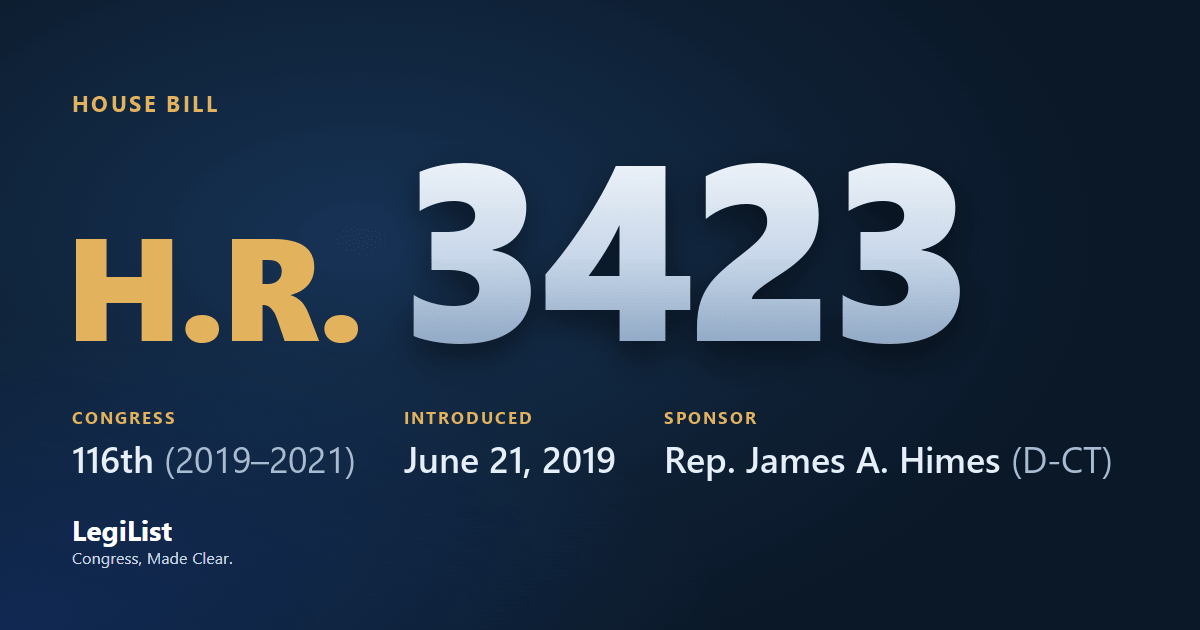
National Green Bank Act of 2019
Latest action · Jun 24, 2019 Referred to the Subcommittee on Energy.
Progress
Where this bill reached, and when. A stage with no date was not reached; one that failed a vote and later carried shows the date it carried.
- IntroducedJun 21, 2019
- Passed HouseNot reached
- Passed SenateNot reached
- To the PresidentNot reached
- Became lawNot reached
Summary
National Green Bank Act of 2019
This bill establishes a U.S. Green Bank to finance climate change mitigation and adaptation projects at the state and local level by capitalizing regional, state, and municipal green banks.
The Department of the Treasury must issue green bonds to provide the bank with (1) an initial capitalization of $10 billion; and (2) additional capitalization, upon the bank's request, of no more than $50 billion in aggregate at any one time.
The bill also establishes in the Treasury a revolving Green Bank Establishment Fund.
Cosponsors 17
Members who signed on, in the order they did. Signatures ran from Jun 21, 2019 to Oct 4, 2019; 13 are original cosponsors, there from the day it was introduced.
| Seat | Cosponsor | Signed on | |
|---|---|---|---|
| D-CA | Anna G. Eshoo | Original | Jun 21, 2019 |
| D-CA | Doris O. Matsui | Original | Jun 21, 2019 |
| D-OR | Earl Blumenauer | Original | Jun 21, 2019 |
| D-VA | Gerald E. Connolly | Original | Jun 21, 2019 |
| D-NY | Gregory W. Meeks | Original | Jun 21, 2019 |
| D-MA | James P. McGovern | Original | Jun 21, 2019 |
| D-CT | Joe Courtney | Original | Jun 21, 2019 |
| D-KY | John A. Yarmuth | Original | Jun 21, 2019 |
| D-CA | Katie Hill | Original | Jun 21, 2019 |
| D-PA | Matt Cartwright | Original | Jun 21, 2019 |
| D-PA | Michael F. Doyle | Original | Jun 21, 2019 |
| D-NY | Paul Tonko | Original | Jun 21, 2019 |
| D-CA | Scott H. Peters | Original | Jun 21, 2019 |
| D-CA | Julia Brownley | Jun 27, 2019 | |
| D-MI | Elissa Slotkin | Sep 13, 2019 |
Committees 2
Where it was sent and what each committee and subcommittee did with it, in order.
| Chamber | Committee | What it did |
|---|---|---|
| House | Ways and Means Committee | Referred Jun 21, 2019 |
| House | Energy and Commerce Committee | Referred Jun 21, 2019 |
| Energy Subcommittee | Referred Jun 24, 2019 |
Actions 3
Everything that happened, newest first.
- Jun 24, 2019Referred to the Subcommittee on Energy.
- Jun 21, 2019Introduced in House
- Jun 21, 2019Referred to the Committee on Ways and Means, and in addition to the Committee on Energy and Commerce, for a period to be subsequently determined by the Speaker, in each case for consideration of such provisions as fall within the jurisdiction of the committee concerned.
Research
What has been written about this bill: committee reports, cost estimates, the sponsor’s authority statement, printed hearings and the Congressional Research Service’s work.
Constitutional authority
The sponsor’s statement, as printed in the Congressional Record, vol. 165, no. 105, June 21, 2019, page H5038.
Related bills 2
Companion bills and other measures the record links to this one.
| Bill | Title | Relationship | Latest action |
|---|---|---|---|
| S 1528 | A bill to amend title 31, United States Code, to provide for the issuance of Green Bonds and to establish the United States Green Bank, and for other purposes. | Related bill | May 16, 2019 |
| HR 2656 | To amend title 31, United States Code, to provide for the issuance of Green Bonds and to establish the United States Green Bank, and for other purposes. | Reintroduced Bill | Apr 20, 2021 |
Titles 3
Every title it has carried, official and short, at each stage.
- Official Title as Introduced
- To amend title 31, United States Code, to provide for the issuance of Green Bonds and to establish the United States Green Bank, and for other purposes.
- Short Title(s) as Introduced
- National Green Bank Act of 2019
- Short Title(s) as Introduced for portions of this bill
- United States Green Bank Act of 2019
Subjects
Assigned by the Library of Congress. Policy area: Energy.
- Agricultural conservation and pollution
- Agricultural practices and innovations
- Air quality
- Alternative and renewable resources
- Climate change and greenhouse gases
- Corporate finance and management
- Credit and credit markets
- Electric power generation and transmission
- Energy
- Energy efficiency and conservation
- Energy storage, supplies, demand
- Executive agency funding and structure
- Forests, forestry, trees
- Government corporations and government-sponsored enterprises
- Government lending and loan guarantees
- Hybrid, electric, and advanced technology vehicles
- Land use and conservation
- Motor fuels
- Public transit
- Regional and metropolitan planning
- Securities
- Solid waste and recycling
- State and local finance
- Water use and supply
- Wetlands
Text 1
Each version as it was printed, newest first.
- Jun 21, 2019Introduced in House
Support LegiList
This page is free, carries no paywall, and is built and maintained by one person. If the record here is useful to you, a few dollars keeps it going.
Everything here is as published by Congress: the summary is the Congressional Research Service's, the action wording is the clerks', and the subjects are the Library of Congress's. How far it got is read from the actions themselves, taking the most recent one of each kind, so a bill that failed a vote and later passed is shown as having passed. Records come from this bill on Congress.gov and govinfo.gov; cost estimates are the Congressional Budget Office's, and the hearings are the printed hearings GovInfo publishes, which can appear months after the hearing.