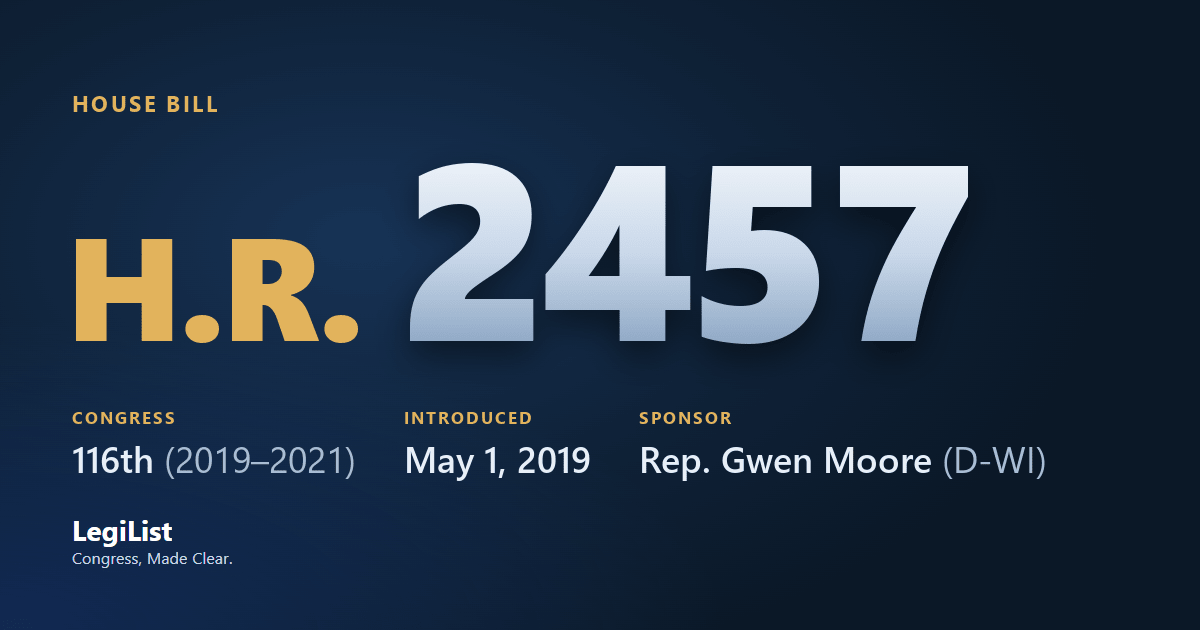
National De-Escalation of Violence and Community Safety Training Act of 2019
Latest action · May 2, 2019 Referred to the Subcommittee on Health.
Progress
Where this bill reached, and when. A stage with no date was not reached; one that failed a vote and later carried shows the date it carried.
- IntroducedMay 1, 2019
- Passed HouseNot reached
- Passed SenateNot reached
- To the PresidentNot reached
- Became lawNot reached
Summary
National De-Escalation of Violence and Community Safety Training Act of 2019
This bill requires the Substance Abuse and Mental Health Services Administration (SAMHSA) of the Department of Health and Human Services to establish a grant program for de-escalation of violence training in communities. Among other requirements, such training must include (1) techniques to de-escalate situations to avoid violence, (2) education about implicit bias, (3) communication and negotiation skills, and (4) scenario-based application of such de-escalation tactics. SAMHSA must establish the De-Escalation Advisory Board to advise and assist SAMHSA's development and implementation of the grant program.
Additionally, the bill expands and extends through FY2025 mental health awareness training grants.
Cosponsors 40
Members who signed on, in the order they did. Signatures ran from May 3, 2019 to Sep 29, 2020.
Committees 2
Where it was sent and what each committee and subcommittee did with it, in order.
| Chamber | Committee | What it did |
|---|---|---|
| House | Education and Workforce Committee | Referred May 1, 2019 |
| House | Energy and Commerce Committee | Referred May 1, 2019 |
| Health Subcommittee | Referred May 2, 2019 |
Actions 3
Everything that happened, newest first.
- May 2, 2019Referred to the Subcommittee on Health.
- May 1, 2019Introduced in House
- May 1, 2019Referred to the Committee on Education and Labor, and in addition to the Committee on Energy and Commerce, for a period to be subsequently determined by the Speaker, in each case for consideration of such provisions as fall within the jurisdiction of the committee concerned.
Research
What has been written about this bill: committee reports, cost estimates, the sponsor’s authority statement, printed hearings and the Congressional Research Service’s work.
Constitutional authority
The sponsor’s statement, as printed in the Congressional Record, vol. 165, no. 71, May 1, 2019, page H3406.
Printed hearings 1
Hearings whose printed record names this bill, newest first: hearings on it, and wider hearings where it came up.
| Number | Hearing | Committee | Held |
|---|---|---|---|
| Serial No. 116-38 | ENGAGING THE COMMUNITY: PERSPECTIVES ON SCHOOL SECURITY90 pages | Homeland Security Committee | Sep 26, 2019 |
Related bills 2
Companion bills and other measures the record links to this one.
| Bill | Title | Relationship | Latest action |
|---|---|---|---|
| HR 4324 | National Community Violence De-Escalation Training Act of 2021 | Reintroduced Bill | Jul 2, 2021 |
| HR 7142 | National De-Escalation of Violence and Community Safety Training Act of 2018 | Reintroduction of | Nov 16, 2018 |
Titles 2
Every title it has carried, official and short, at each stage.
- Official Title as Introduced
- To help train individuals in effective and evidence-based de-escalation techniques to ensure that individuals at diverse levels of society have and retain greater skills to resolve conflicts, manage anger, and control implicit bias without the use of physical or other force, and for other purposes.
- Short Title(s) as Introduced
- National De-Escalation of Violence and Community Safety Training Act of 2019
Subjects
Assigned by the Library of Congress. Policy area: Health.
Text 1
Each version as it was printed, newest first.
- May 1, 2019Introduced in House
Everything here is as published by Congress: the summary is the Congressional Research Service's, the action wording is the clerks', and the subjects are the Library of Congress's. How far it got is read from the actions themselves, taking the most recent one of each kind, so a bill that failed a vote and later passed is shown as having passed. Records come from this bill on Congress.gov and govinfo.gov; cost estimates are the Congressional Budget Office's, and the hearings are the printed hearings GovInfo publishes, which can appear months after the hearing.