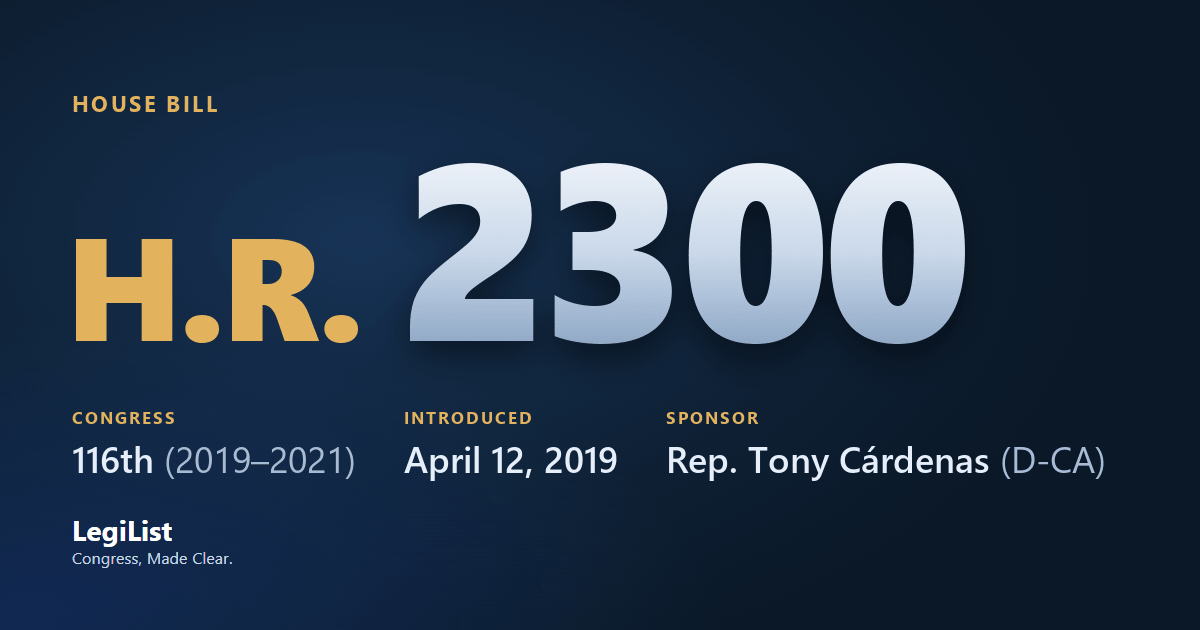
Eliminating Debtor’s Prison for Kids Act of 2019
Latest action · May 20, 2019 Referred to the Subcommittee on Crime, Terrorism, and Homeland Security.
Progress
Where this bill reached, and when. A stage with no date was not reached; one that failed a vote and later carried shows the date it carried.
- IntroducedApr 12, 2019
- Passed HouseNot reached
- Passed SenateNot reached
- To the PresidentNot reached
- Became lawNot reached
Summary
Eliminating Debtor's Prison for Kids Act of 2019
This bill directs the Department of Justice to make grants for states to provide mental and behavioral health services to at-risk youth in any school, secure detention facility, or secure correctional facility in the state.
A state that receives a grant must report, for inclusion in a national report, certain information about fines and fees imposed on adults and juveniles in the criminal justice system.
Cosponsors 30
Members who signed on, in the order they did. Signatures ran from Apr 12, 2019 to Dec 9, 2019; 14 are original cosponsors, there from the day it was introduced.
| Seat | Cosponsor | Signed on | |
|---|---|---|---|
| D-NY | Adriano Espaillat | Original | Apr 12, 2019 |
| D-NY | Alexandria Ocasio-Cortez | Original | Apr 12, 2019 |
| D-NC | Alma S. Adams | Original | Apr 12, 2019 |
| D-CA | Barbara Lee | Original | Apr 12, 2019 |
| D-IL | Danny K. Davis | Original | Apr 12, 2019 |
| D-MD | David J. Trone | Original | Apr 12, 2019 |
| D-NJ | Donald M. Payne, Jr. | Original | Apr 12, 2019 |
| D-DC | Eleanor Holmes Norton | Original | Apr 12, 2019 |
| D-CA | Grace F. Napolitano | Original | Apr 12, 2019 |
| D-NY | Grace Meng | Original | Apr 12, 2019 |
| D-IL | Janice D. Schakowsky | Original | Apr 12, 2019 |
| D-CA | Karen Bass | Original | Apr 12, 2019 |
| D-MI | Rashida Tlaib | Original | Apr 12, 2019 |
| D-AL | Terri A. Sewell | Original | Apr 12, 2019 |
| D-LA | Cedric L. Richmond | Apr 15, 2019 |
Committees 2
Where it was sent and what each committee and subcommittee did with it, in order.
| Chamber | Committee | What it did |
|---|---|---|
| House | Judiciary Committee | Referred Apr 12, 2019 |
| Crime and Federal Government Surveillance Subcommittee | Referred May 20, 2019 | |
| House | Education and Workforce Committee | Referred Apr 12, 2019 |
Actions 3
Everything that happened, newest first.
- May 20, 2019Referred to the Subcommittee on Crime, Terrorism, and Homeland Security.
- Apr 12, 2019Introduced in House
- Apr 12, 2019Referred to the Committee on the Judiciary, and in addition to the Committee on Education and Labor, for a period to be subsequently determined by the Speaker, in each case for consideration of such provisions as fall within the jurisdiction of the committee concerned.
Research
What has been written about this bill: committee reports, cost estimates, the sponsor’s authority statement, printed hearings and the Congressional Research Service’s work.
Constitutional authority
The sponsor’s statement, as printed in the Congressional Record, vol. 165, no. 64, April 12, 2019, page H3265.
Titles 2
Every title it has carried, official and short, at each stage.
- Official Title as Introduced
- To establish a grant to provide mental health services and behavioral health services to at-risk youth, and for other purposes.
- Short Title(s) as Introduced
- Eliminating Debtor’s Prison for Kids Act of 2019
Subjects
Assigned by the Library of Congress. Policy area: Crime and Law Enforcement.
- Adoption and foster care
- Child health
- Congressional oversight
- Correctional facilities and imprisonment
- Crime and Law Enforcement
- Criminal justice information and records
- Criminal procedure and sentencing
- Detention of persons
- Drug, alcohol, tobacco use
- Elementary and secondary education
- Homelessness and emergency shelter
- Judicial procedure and administration
- Juvenile crime and gang violence
- Law enforcement administration and funding
- Legal fees and court costs
- Mental health
- State and local finance
- State and local government operations
Text 1
Each version as it was printed, newest first.
- Apr 12, 2019Introduced in House
Support LegiList
This page is free, carries no paywall, and is built and maintained by one person. If the record here is useful to you, a few dollars keeps it going.
Everything here is as published by Congress: the summary is the Congressional Research Service's, the action wording is the clerks', and the subjects are the Library of Congress's. How far it got is read from the actions themselves, taking the most recent one of each kind, so a bill that failed a vote and later passed is shown as having passed. Records come from this bill on Congress.gov and govinfo.gov; cost estimates are the Congressional Budget Office's, and the hearings are the printed hearings GovInfo publishes, which can appear months after the hearing.