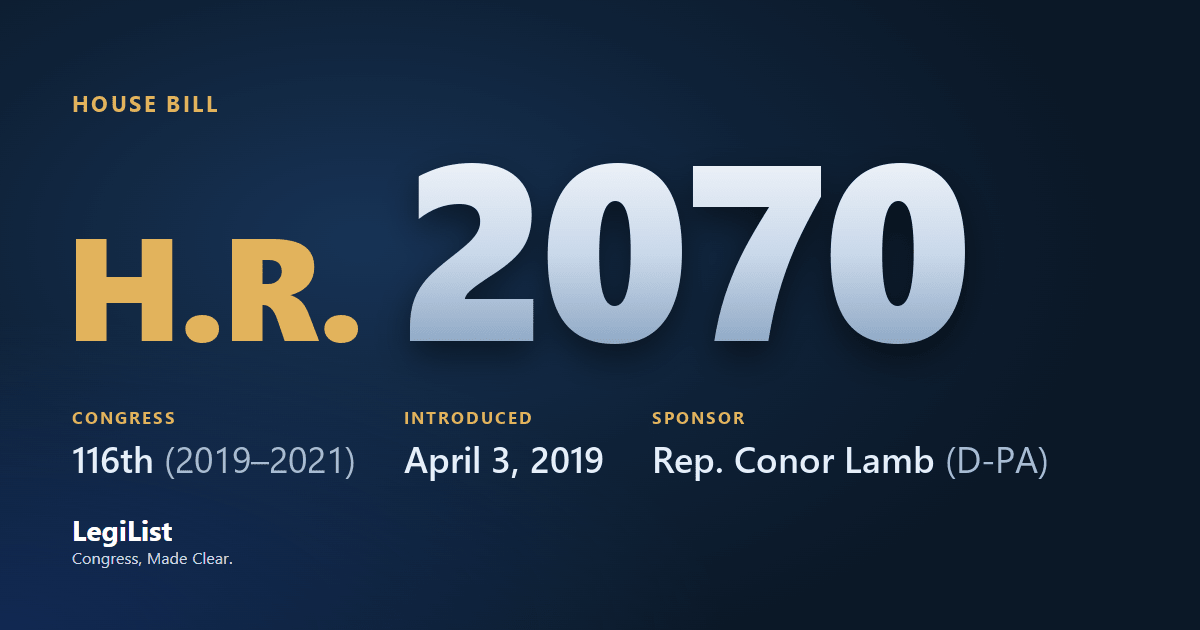
POWER Act
Latest action · May 15, 2019 Referred to the Subcommittee on Crime, Terrorism, and Homeland Security.
Progress
Where this bill reached, and when. A stage with no date was not reached; one that failed a vote and later carried shows the date it carried.
- IntroducedApr 3, 2019
- Passed HouseNot reached
- Passed SenateNot reached
- To the PresidentNot reached
- Became lawNot reached
Summary
Providing Officers With Electronic Resources Act or the POWER Act
This bill authorizes the Office of Community Oriented Policing Services within the Department of Justice to make grants to law enforcement agencies to purchase a chemical screening device and to train personnel to use, and interpret data collected by, such device.
Cosponsors 22
Members who signed on, in the order they did. Signatures ran from Apr 3, 2019 to Sep 11, 2020; 2 are original cosponsors, there from the day it was introduced.
| Seat | Cosponsor | Signed on | |
|---|---|---|---|
| D-MD | David J. Trone | Original | Apr 3, 2019 |
| R-OH | David P. Joyce | Original | Apr 3, 2019 |
| R-CO | Scott R. Tipton | Apr 8, 2019 | |
| D-OH | Tim Ryan | Apr 10, 2019 | |
| D-MA | Stephen F. Lynch | Apr 15, 2019 | |
| R-WV | Alexander X. Mooney | Apr 22, 2019 | |
| R-WV | David B. McKinley | Apr 25, 2019 | |
| D-CA | Eric Swalwell | Apr 29, 2019 | |
| R-PA | Brian K. Fitzpatrick | May 1, 2019 | |
| D-MO | Wm. Lacy Clay | May 1, 2019 | |
| D-MD | C. A. Dutch Ruppersberger | May 2, 2019 | |
| D-TN | Jim Cooper | May 17, 2019 | |
| D-PA | Madeleine Dean | Jun 3, 2019 | |
| D-CA | Ro Khanna | Jun 10, 2019 | |
| R-PA | Guy Reschenthaler | Sep 20, 2019 | |
| D-CA | J. Luis Correa | Oct 1, 2019 | |
| R-OH | Steve Chabot | Oct 4, 2019 | |
| R-WI | Bryan Steil | Jan 8, 2020 | |
| D-IA | Cynthia Axne | Jan 13, 2020 | |
| D-NJ | Josh Gottheimer | Feb 5, 2020 | |
| D-NH | Ann M. Kuster | May 5, 2020 | |
| D-TX | Lizzie Fletcher | Sep 11, 2020 |
Committees 1
Where it was sent and what each committee and subcommittee did with it, in order.
| Chamber | Committee | What it did |
|---|---|---|
| House | Judiciary Committee | Referred Apr 3, 2019 |
| Crime and Federal Government Surveillance Subcommittee | Referred May 15, 2019 |
Actions 3
Everything that happened, newest first.
- May 15, 2019Referred to the Subcommittee on Crime, Terrorism, and Homeland Security.
- Apr 3, 2019Introduced in House
- Apr 3, 2019Referred to the House Committee on the Judiciary.
In the Congressional Record 1
Days the Record’s own index lists this bill, newest first, with the pages and the members it names. Pages starting H are the House, S the Senate, E Extensions of Remarks.
| Where | In the Record | Members | Date |
|---|---|---|---|
| House | Debate and remarks H3914 | Katie Hill D-CA | May 16, 2019 |
Research
What has been written about this bill: committee reports, cost estimates, the sponsor’s authority statement, printed hearings and the Congressional Research Service’s work.
Constitutional authority
The sponsor’s statement, as printed in the Congressional Record, vol. 165, no. 58, April 3, 2019, page H3069.
Related bills 3
Companion bills and other measures the record links to this one.
Titles 3
Every title it has carried, official and short, at each stage.
- Official Title as Introduced
- To provide grants to State, local, territorial, and tribal law enforcement agencies to purchase chemical screening devices and train personnel to use chemical screening devices in order to enhance law enforcement efficiency and protect law enforcement officers.
- Short Title(s) as Introduced
- POWER Act
- Providing Officers With Electronic Resources Act
Subjects
Assigned by the Library of Congress. Policy area: Crime and Law Enforcement.
Text 1
Each version as it was printed, newest first.
- Apr 3, 2019Introduced in House
Everything here is as published by Congress: the summary is the Congressional Research Service's, the action wording is the clerks', and the subjects are the Library of Congress's. How far it got is read from the actions themselves, taking the most recent one of each kind, so a bill that failed a vote and later passed is shown as having passed. Records come from this bill on Congress.gov and govinfo.gov; cost estimates are the Congressional Budget Office's, and the hearings are the printed hearings GovInfo publishes, which can appear months after the hearing.