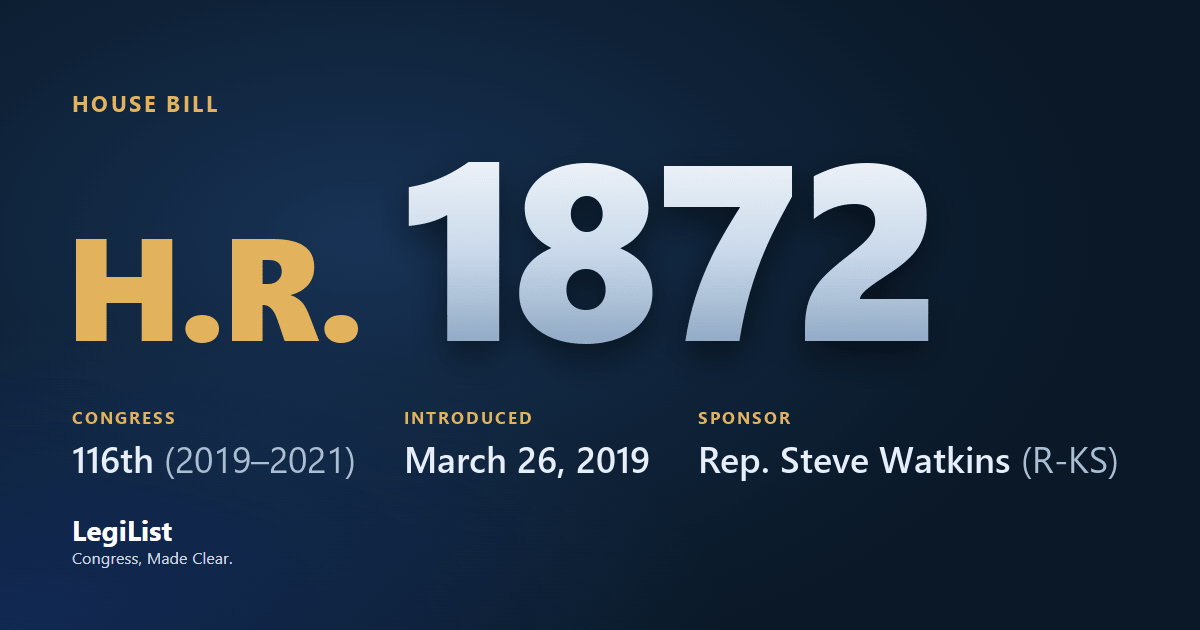
Enhancing Credit Opportunities in Rural America Act of 2019
Latest action · Mar 26, 2019 Referred to the House Committee on Ways and Means.
Progress
Where this bill reached, and when. A stage with no date was not reached; one that failed a vote and later carried shows the date it carried.
- IntroducedMar 26, 2019
- Passed HouseNot reached
- Passed SenateNot reached
- To the PresidentNot reached
- Became lawNot reached
Summary
Enhancing Credit Opportunities in Rural America Act of 2019 or the ECORA Act of 2019
This bill modifies the requirements for calculating taxable income to exclude from gross income interest received by a lender from real estate loans secured by agricultural real estate or by a leasehold mortgage (with a status as a lien) on agricultural real estate.
Agricultural real estate includes real property that is substantially used for the production of one or more agricultural products. It also includes any single family residence that is (1) the principal residence of its occupant, (2) located in a rural area which is not within a Metropolitan Statistical Area and has a population of 2,500 or less; and (3) is purchased or improved with the proceeds of a loan secured by property used for the production of one or more agricultural products.
Cosponsors 18
Members who signed on, in the order they did. Signatures ran from Mar 26, 2019 to Oct 16, 2020; 1 is an original cosponsor, there from the day it was introduced.
| Seat | Cosponsor | Signed on | |
|---|---|---|---|
| R-KS | Roger Marshall | Original | Mar 26, 2019 |
| R-WV | Carol D. Miller | Apr 8, 2019 | |
| R-IN | Jim Banks | Apr 12, 2019 | |
| R-VA | Denver Riggleman | Apr 30, 2019 | |
| R-PA | Guy Reschenthaler | May 1, 2019 | |
| R-KY | James Comer | May 22, 2019 | |
| R-IA | Steve King | May 23, 2019 | |
| R-MI | John R. Moolenaar | Jun 3, 2019 | |
| R-KS | Ron Estes | Jun 5, 2019 | |
| R-MS | Steven M. Palazzo | Jun 25, 2019 | |
| D-NJ | Jefferson Van Drew | Jul 9, 2019 | |
| R-LA | Ralph Lee Abraham | Jul 9, 2019 | |
| R-AL | Mo Brooks | Nov 18, 2019 | |
| R-MO | Jason Smith | Dec 4, 2019 | |
| R-NE | Don Bacon | Jan 15, 2020 |
Committees 1
Where it was sent and what each committee and subcommittee did with it, in order.
| Chamber | Committee | What it did |
|---|---|---|
| House | Ways and Means Committee | Referred Mar 26, 2019 |
Actions 2
Everything that happened, newest first.
- Mar 26, 2019Introduced in House
- Mar 26, 2019Referred to the House Committee on Ways and Means.
Research
What has been written about this bill: committee reports, cost estimates, the sponsor’s authority statement, printed hearings and the Congressional Research Service’s work.
Constitutional authority
The sponsor’s statement, as printed in the Congressional Record, vol. 165, no. 52, March 26, 2019, page H2827.
Printed hearings 1
Hearings whose printed record names this bill, newest first: hearings on it, and wider hearings where it came up.
| Number | Hearing | Committee | Held |
|---|---|---|---|
| Serial No. 116-24 | REVIEW OF CREDIT CONDITIONS93 pages | Agriculture Committee | Nov 19, 2019–Dec 11, 2019 |
Related bills 1
Companion bills and other measures the record links to this one.
| Bill | Title | Relationship | Latest action |
|---|---|---|---|
| S 1641 | ECORA Act of 2019 | Identical bill | May 23, 2019 |
Titles 2
Every title it has carried, official and short, at each stage.
- Official Title as Introduced
- To amend the Internal Revenue Code of 1986 to exclude from gross income interest received on certain loans secured by agricultural real property.
- Short Title(s) as Introduced
- Enhancing Credit Opportunities in Rural America Act of 2019
Subjects
Assigned by the Library of Congress. Policy area: Taxation.
Text 1
Each version as it was printed, newest first.
- Mar 26, 2019Introduced in House
Everything here is as published by Congress: the summary is the Congressional Research Service's, the action wording is the clerks', and the subjects are the Library of Congress's. How far it got is read from the actions themselves, taking the most recent one of each kind, so a bill that failed a vote and later passed is shown as having passed. Records come from this bill on Congress.gov and govinfo.gov; cost estimates are the Congressional Budget Office's, and the hearings are the printed hearings GovInfo publishes, which can appear months after the hearing.