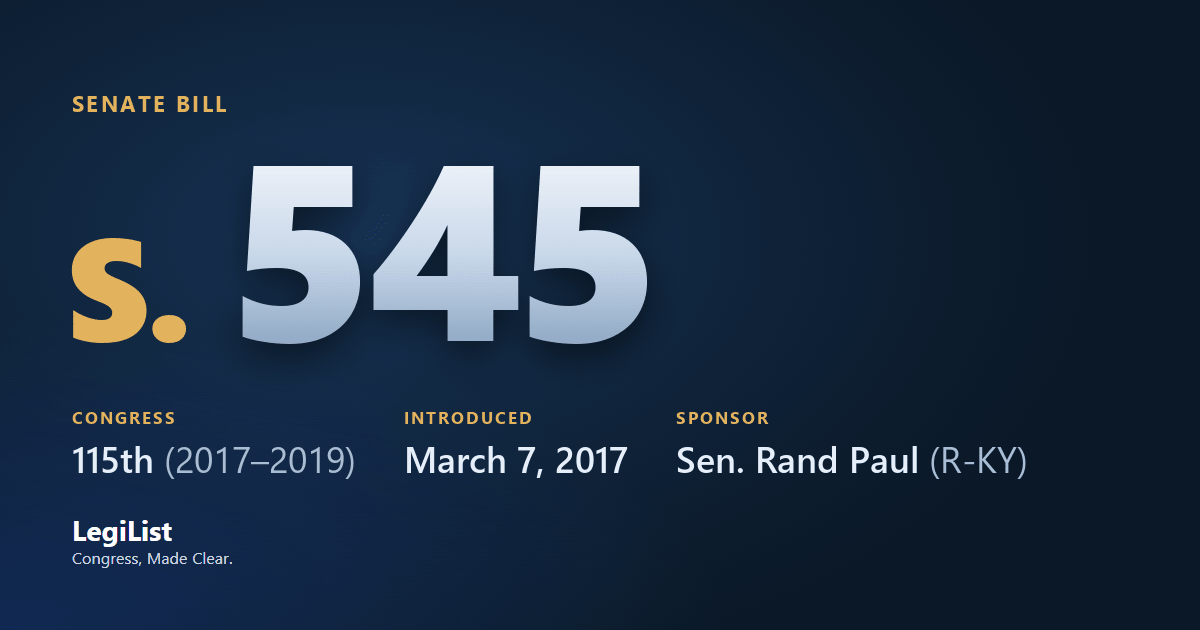
National Right-to-Work Act
Latest action · Mar 7, 2017 Read twice and referred to the Committee on Health, Education, Labor, and Pensions.
Progress
Where this bill reached, and when. A stage with no date was not reached; one that failed a vote and later carried shows the date it carried.
- IntroducedMar 7, 2017
- Passed SenateNot reached
- Passed HouseNot reached
- To the PresidentNot reached
- Became lawNot reached
Summary
National Right-to-Work Act
This bill amends the National Labor Relations Act and the Railway Labor Act to repeal those provisions that permit employers, pursuant to a collective bargaining agreement that is a union security agreement, to require employees to join a union as a condition of employment (including provisions permitting railroad carriers to require, pursuant to such an agreement, payroll deduction of union dues or fees as a condition of employment).
Cosponsors 30
Members who signed on, in the order they did. Signatures ran from Mar 7, 2017 to Oct 11, 2018; 21 are original cosponsors, there from the day it was introduced.
| Seat | Cosponsor | Signed on | |
|---|---|---|---|
| R-GA | David Perdue | Original | Mar 7, 2017 |
| R-NV | Dean Heller | Original | Mar 7, 2017 |
| R-OK | James Lankford | Original | Mar 7, 2017 |
| R-OK | James M. Inhofe | Original | Mar 7, 2017 |
| R-KS | Jerry Moran | Original | Mar 7, 2017 |
| R-WY | John Barrasso | Original | Mar 7, 2017 |
| R-TX | John Cornyn | Original | Mar 7, 2017 |
| R-IA | Joni Ernst | Original | Mar 7, 2017 |
| R-SC | Lindsey Graham | Original | Mar 7, 2017 |
| R-FL | Marco Rubio | Original | Mar 7, 2017 |
| R-WY | Michael B. Enzi | Original | Mar 7, 2017 |
| R-UT | Mike Lee | Original | Mar 7, 2017 |
| R-SD | Mike Rounds | Original | Mar 7, 2017 |
| R-UT | Orrin G. Hatch | Original | Mar 7, 2017 |
| R-KS | Pat Roberts | Original | Mar 7, 2017 |
| R-MS | Roger F. Wicker | Original | Mar 7, 2017 |
| R-TX | Ted Cruz | Original | Mar 7, 2017 |
| R-MS | Thad Cochran | Original | Mar 7, 2017 |
| R-NC | Thom Tillis | Original | Mar 7, 2017 |
| R-SC | Tim Scott | Original | Mar 7, 2017 |
| R-AR | Tom Cotton | Original | Mar 7, 2017 |
| R-AR | John Boozman | Apr 6, 2017 | |
| R-AL | Luther Strange | Jul 10, 2017 | |
| R-WI | Ron Johnson | Jan 25, 2018 | |
| R-ID | James E. Risch | Feb 6, 2018 | |
| R-NC | Richard Burr | Feb 6, 2018 | |
| R-IA | Chuck Grassley | Mar 8, 2018 | |
| R-AZ | John McCain | Mar 8, 2018 | |
| R-CO | Cory Gardner | Jul 24, 2018 | |
| R-MS | Cindy Hyde-Smith | Oct 11, 2018 |
Committees 1
Where it was sent and what each committee and subcommittee did with it, in order.
| Chamber | Committee | What it did |
|---|---|---|
| Senate | Health, Education, Labor, and Pensions Committee | Referred Mar 7, 2017 |
Actions 2
Everything that happened, newest first.
- Mar 7, 2017Introduced in Senate
- Mar 7, 2017Read twice and referred to the Committee on Health, Education, Labor, and Pensions.
Research
What has been written about this bill: committee reports, cost estimates, the sponsor’s authority statement, printed hearings and the Congressional Research Service’s work.
Printed hearings 1
Hearings whose printed record names this bill, newest first: hearings on it, and wider hearings where it came up.
| Number | Hearing | Committee | Held |
|---|---|---|---|
| S. Hrg. 115-838 | IMPACT OF TARIFFS ON THE U.S. AUTOMOTIVE INDUSTRY178 pages | Finance Committee | Sep 26, 2018 |
Related bills 1
Companion bills and other measures the record links to this one.
| Bill | Title | Relationship | Latest action |
|---|---|---|---|
| HR 785 | National Right-to-Work Act | Related bill | Feb 1, 2017 |
Titles 2
Every title it has carried, official and short, at each stage.
- Official Title as Introduced
- A bill to preserve and protect the free choice of individual employees to form, join, or assist labor organizations, or to refrain from such activities.
- Short Titles as Introduced
- National Right-to-Work Act
Subjects
Assigned by the Library of Congress. Policy area: Labor and Employment.
Text 1
Each version as it was printed, newest first.
- Mar 7, 2017Introduced in Senate
Everything here is as published by Congress: the summary is the Congressional Research Service's, the action wording is the clerks', and the subjects are the Library of Congress's. How far it got is read from the actions themselves, taking the most recent one of each kind, so a bill that failed a vote and later passed is shown as having passed. Records come from this bill on Congress.gov and govinfo.gov; cost estimates are the Congressional Budget Office's, and the hearings are the printed hearings GovInfo publishes, which can appear months after the hearing.